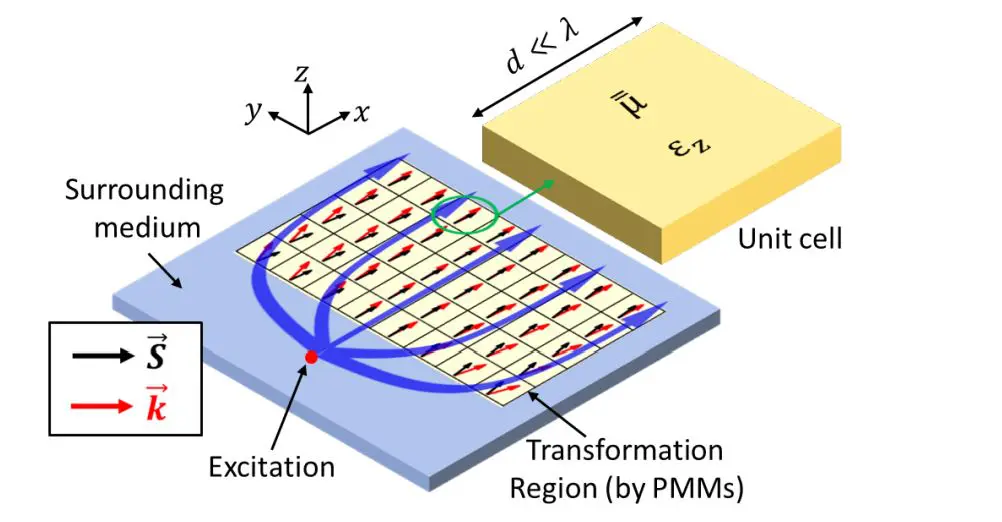
Controlling electromagnetic fields remains a significant challenge in modern physics, yet metamaterials offer a promising pathway to achieving this goal. Jorge Ruiz-Garcia from Institut d’Electronique et des Technologies du numérique, and Anthony Grbic from The University of Michigan, now introduce a new concept called Perfectly Matched Metamaterials, or PMMs, which represent a fundamental advance in the field. These passive materials uniquely manipulate fields without reflection, offering both simplicity and broad applicability to design processes, unlike previous approaches reliant on complex coordinate transformations. The research demonstrates that PMMs achieve true time delay in controlling electromagnetic waves, paving the way for innovative devices capable of wideband beamforming, spatial filtering and advanced signal pre-processing.
All-Metal Metamaterials for Broadband Wave Control
This research introduces a new approach to manipulating electromagnetic fields using Perfectly Matched Metamaterials (PMMs). These materials offer a way to precisely control how electromagnetic waves propagate, offering advantages over existing techniques. Key to this achievement is the all-metal construction, simplifying fabrication compared to designs incorporating dielectric materials. The team demonstrates that PMMs enable the creation of devices like beam collimators and lenses with improved performance and bandwidth, employing an efficient inverse design methodology utilizing circuit-based surrogate models and the adjoint method to optimize performance for specific applications. PMMs offer a simpler and potentially broader bandwidth solution compared to complex transformation optics designs, actively controlling wave propagation and shaping the electromagnetic field rather than simply preventing reflections.
Broadband Field Control with Metamaterials
Researchers introduced Perfectly Matched Metamaterials (PMMs) to overcome limitations in controlling electromagnetic fields, particularly the narrow bandwidth often associated with advanced designs. This work pioneers a new approach to field manipulation, creating passive, inhomogeneous media that perform purely refractive field transformations without reflections, offering both analytical and numerical design flexibility. The team engineered anisotropic unit cells configured to control electromagnetic fields through true-time delay, enabling broadband performance unattainable with many existing methods. Unlike Transformation Optics, which relies on complex coordinate transformations, PMM designs avoid these manipulations, simplifying fabrication and broadening operational frequencies. Scientists developed simple analytical designs to demonstrate the broadband capability of PMM devices, showcasing their potential in wideband beamforming and analog computing applications.
Reflectionless Metamaterials Enable Wave Control
Scientists have introduced a new class of materials, termed Perfectly Matched Metamaterials (PMMs), which achieve reflectionless field transformations with unprecedented control over electromagnetic waves. This work demonstrates a design approach that overcomes limitations found in traditional Transformation Optics techniques, delivering purely refractive wave propagation and independent control of both power and phase. The core achievement lies in engineering anisotropic unit cells with precisely calculated material parameters to ensure impedance matching throughout the metamaterial and at its boundaries. Experiments reveal that PMMs can perform arbitrary field transformations, relying on refractive wave propagation, much like true-time delay structures.
Researchers successfully designed and tested a beam-collimator operating across a bandwidth from 5 to 30GHz, achieving approximately 140% fractional bandwidth. Importantly, these materials remain impedance-matched for any excitation, demonstrating a robust and versatile functionality. Scientists have demonstrated that PMMs, composed of carefully designed, subwavelength unit cells, can perform reflectionless field transformations, meaning they guide electromagnetic waves without losing energy to reflections. Unlike traditional methods relying on complex coordinate transformations, PMMs achieve control through purely refractive effects, offering a simpler and more direct pathway to manipulate wave behavior. The team derived closed-form expressions for the material parameters needed to construct PMMs, enabling the analytical design of devices operating across a broad frequency range, demonstrated from 5 to 30GHz. This capability circumvents limitations inherent in Transformation Optics and opens possibilities for inverse design routines, where desired functionality dictates the material properties. Researchers also highlighted the distinction between PMMs and Perfectly Matched Layers, noting that while the latter absorb waves, PMMs control them without loss.