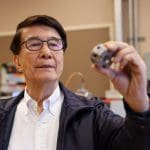
In a new collaboration, Meta’s Fundamental AI Research team, Dutch nanotechnology engineering company VSParticle, and the University of Toronto have developed a revolutionary approach to accelerate the discovery of new materials critical to achieving net-zero emissions.
By combining cutting-edge nanoparticle technology with advanced AI models, the partnership has successfully synthesized 525 unique materials in just a few months, creating its largest open-source experimental catalyst database. This breakthrough has significant implications for clean energy solutions, including carbon dioxide reduction reactions, hydrogen production, and next-generation batteries.
Key individuals involved in this research include Aaike van Vugt, co-founder and CEO of VSParticle, and Larry Zitnick, Research Director at Meta AI. The collaboration marks a major milestone in bridging the gap between computational models and experimental studies, bringing us closer to viable clean energy solutions at scale.
Accelerating Clean Energy Transition with AI and Nanoparticle Technology
The quest for clean energy solutions has taken a significant leap forward with the collaboration between Meta’s Fundamental AI Research (FAIR) team, VSParticle, and the University of Toronto. This groundbreaking research demonstrates how Large Language Models (LLMs) and nanoparticle technology can be used to discover and produce new materials critical to the transition to net zero.
Bridging the Gap between Computational Models and Experimental Studies
Electrocatalysts are crucial in clean energy processes like carbon dioxide reduction reactions (CO2RR), hydrogen production, and next-generation batteries. However, translating AI-driven predictions into scalable applications remains a complex challenge, typically taking up to 15 years. To accelerate the discovery of these catalysts, Meta’s FAIR team has been developing AI models to identify candidates for energy conversion processes in a matter of hours. However, training AI models requires large and diverse experimental datasets, which do not exist today.
To bridge this gap, VSP, Meta, and UoT came together to test datasets of hundreds of unique and diverse materials in the lab, creating an open-source database. Using a process called spark ablation, the VSP-P1 nanoprinter synthesized 525 materials that AI had predicted as the best candidates for CO2 Reduction Reactions (CO2RR) by vaporizing each one into nanoparticles.
The Power of Nanoparticle Technology
VSP’s unique nanoparticle approach gave researchers greater control over particle size and composition, with high levels of automation and speed needed to create nanoporous materials at scale. Other technologies would need decades to synthesize such a high number of new nanoporous materials, making the project impossible.
The findings were fed into an experimental database, from which researchers validated AI predictions against real-world results, identified hundreds of potential low-cost catalysts for key reactions, and can now be used to train and further refine AI and ML predictions. Next to building the largest experimental dataset, the project ran a record 20 million computer simulations – the largest computation of its kind to date – which can now be used to build even larger databases for scaling up processes.
The Future of Material Discovery
To crack the code for material discovery, AI models need to be trained on a much larger experimental dataset of between 10,000 to 100,000 unique tested materials. VSP’s technology is the only one capable of synthesizing such a large number of thin-film nanoporous with high electrocatalytic performance.
The company is working with many more organizations to scale up its technology and support green hydrogen production through printing the necessary components for the porous transport electrode. This would enable it to reduce current production costs by 85%, making it the most cost-competitive production technology for this critical aspect of green hydrogen production.
In conclusion, the collaboration between Meta’s FAIR team, VSParticle, and the University of Toronto has demonstrated the potential of AI and nanoparticle technology in accelerating the discovery of new materials critical to the transition to net zero. As researchers continue to push the boundaries of what is possible, we can expect significant breakthroughs in the quest for clean energy solutions.
External Link: Click Here For More