Researchers have made significant progress in text-to-3D generation, a technology that allows users to create 3D objects and scenes using only textual descriptions. The team, led by experts in quantum physics and business, has developed a system called 3DGen that can generate high-quality 3D models from text prompts with impressive accuracy and diversity.
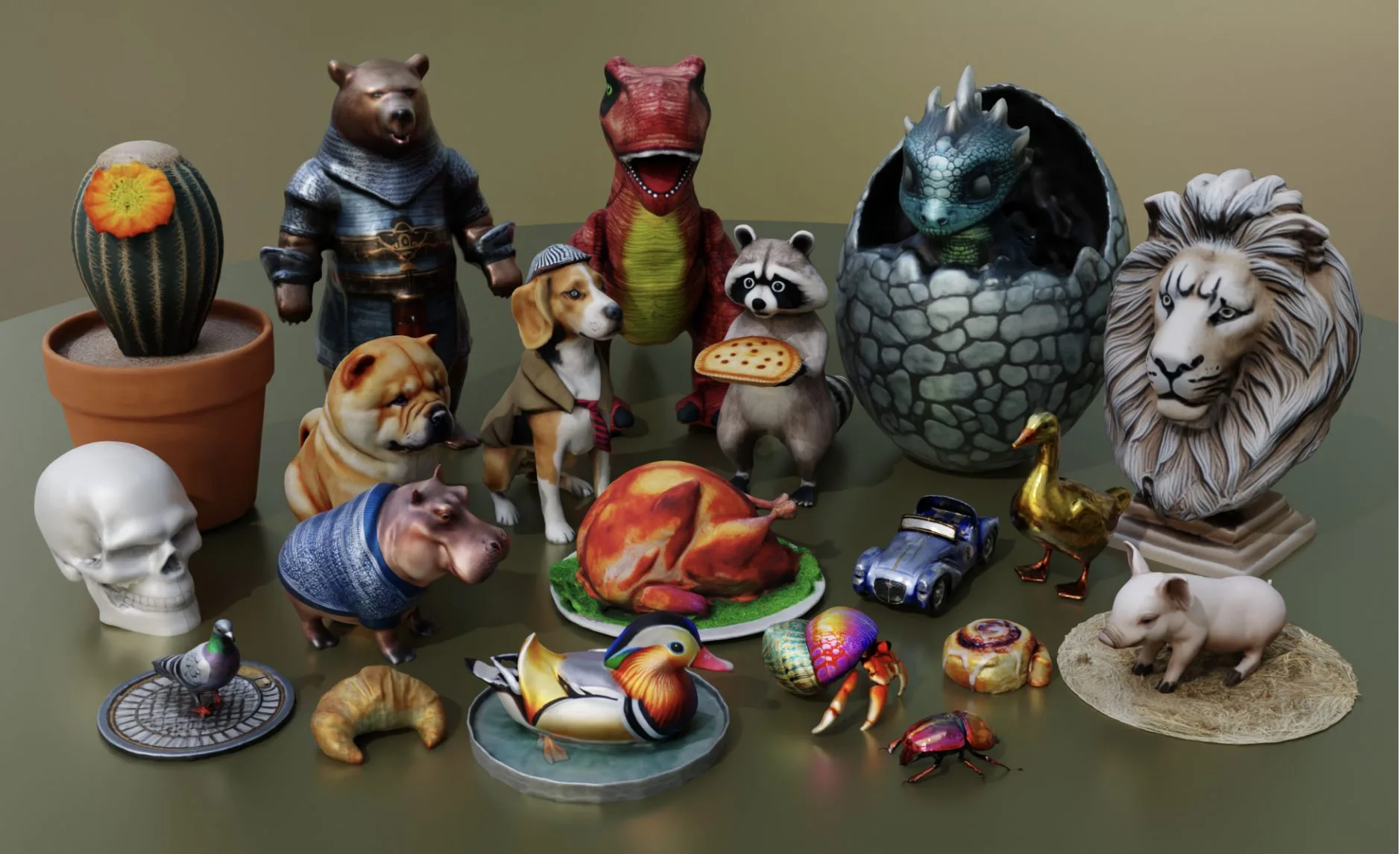
In user studies, the Stage II generations of 3DGen achieved a win rate of 68% in texture quality over the first-stage generations. The system is capable of generating a wide range of objects and scenes, from animals and food to vehicles and fantasy creatures.
The technology has many potential applications, including e-commerce, gaming, and architecture. Companies like Meta are already working on similar technologies, and experts like Bensadoun et al. have made significant contributions to the field.
With 3DGen, users can create new assets with the same base shapes but different appearances, and even retexture whole scenes in a coherent manner. The system is a major breakthrough in text-to-3D generation and has the potential to revolutionize many industries.
The authors are showcasing their Meta 3D Gen model, which can generate 3D objects and scenes from textual descriptions. They’re comparing the performance of their model with industry baselines, highlighting its strengths and weaknesses.
Here are some key takeaways:
- Visual Aesthetics: The authors’ Stage II generations tend to have higher visual aesthetics, appear more realistic, and have higher-frequency details compared to Stage I. In fact, human annotators prefer the Stage II generations in 68% of cases.
- Qualitative Examples: The paper presents numerous examples of generated 3D objects and scenes, demonstrating the model’s capabilities in creating diverse assets, from a plush T-Rex dinosaur toy to an orc forging a hammer on an anvil.
- Failure Modes: The authors also showcase typical failure modes of different methods, including their own. This transparency is essential for understanding these models’ limitations and identifying improvement areas.
-
(Re)texturing Results: The paper highlights the model’s ability to retexture generated shapes with new textual prompts, creating new assets with the same base shapes but different appearances. This feature can be applied to both generated and artist-created 3D assets.
-
Themed Scenes: By augmenting object-level prompts with style information, the model can create coherent themed scenes, such as an amigurumi-themed scene or a horror movie-themed scene.
In summary, this paper demonstrates the capabilities of Meta 3D Gen in generating high-quality 3D objects and scenes from textual descriptions. While there are still limitations to be addressed, the results show promise for applications in computer graphics, game development, and beyond.
External Link: Click Here For More