

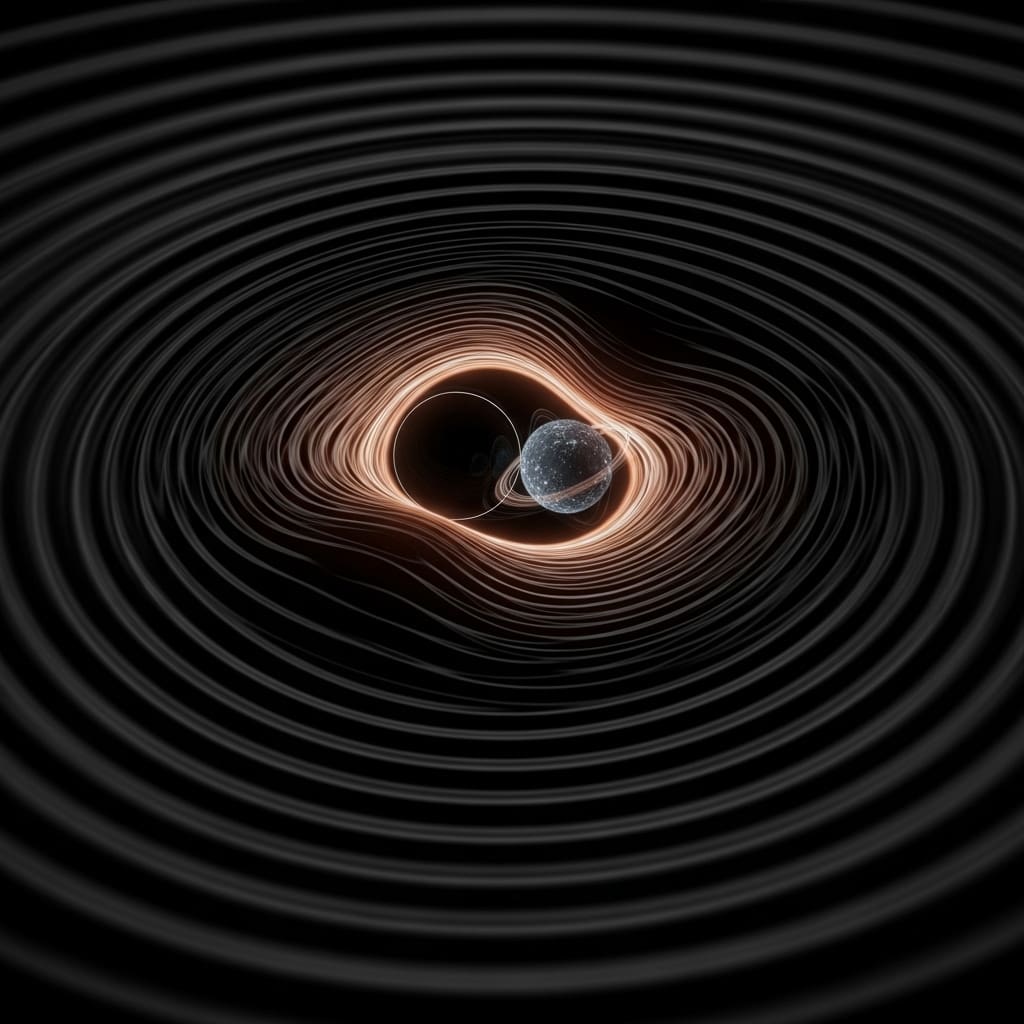
The dynamics of merging celestial bodies represent a fundamental problem in astrophysics, and new research sheds light on this process using a novel model system. Qi Su, alongside Baicheng Zhang and Ding-Fang Zeng from Beijing University of Technology, and their colleagues, have simulated the inspiral and merger of two co-planar rings under Newtonian gravity with corrections inspired by general relativity. Their work reveals striking similarities between these ring mergers and the behaviour of binary black hole systems, notably a distinctive “banana” deformation of the merging objects and a spiralling, typhoon-like structure in the resulting merged body. By computing the full gravitational waveform using an eXact One-Body approach, the researchers demonstrate qualitative agreement with results from complex numerical relativity simulations, offering a clearer, more transparent connection between waveform features and the internal structure of black holes.
Researchers have pioneered an approach to modelling black hole binary mergers by replacing black holes with co-planar rings within a Newtonian framework, augmented with corrections motivated by general relativity. This technique allows for a transparent link between the internal deformation of the simulated rings and the complex geometry observed in numerical relativity simulations of black hole mergers. Simulations employed a quadrupole radiation formula to account for energy loss through gravitational waves, focusing on the variation of the mass quadrupole moment on the orbital plane as the dominant factor.
Scientists developed a time-dilation correction to the Newtonian dynamics, addressing the challenges of accurately representing the extreme gravitational effects experienced by objects nearing merger. The resulting merger product displays a typhoon-like spiral structure, mirroring patterns seen in the aftermath of black hole collisions. To compute the full gravitational waveform of this process, the team harnessed an eXact One-Body approach, a method previously used to approximate quasi-normal mode behaviour. This analytical technique qualitatively reproduces results consistent with those obtained through computationally intensive numerical relativity, offering a complementary interpretation of the underlying physics.
The system delivers a computationally tractable framework for exploring gravitational wave signals, enabling detailed analysis of the late-time ringdown phase and its associated damping features. This work departs from traditional numerical relativity by focusing on the lasting mass distribution and deformation of the collapsing objects, rather than the singularities and horizons typically modelled. By modelling black holes as collapsars with an approximately r mass profile, the research circumvents the technical difficulties of defining isolated horizons in extreme time dilation scenarios. The study’s innovative methodology provides a simplified, phenomenological model capable of capturing the qualitative features of black hole mergers in a more accessible and visually intuitive manner.
Rings Model Black Hole Inspirals and Mergers
Scientists have successfully modeled the inspiral and merger of two co-planar rings, incorporating Newtonian mechanics with corrections motivated by general relativity, to simulate the dynamics of binary black hole systems. Simulations revealed a distinctive banana-shape deformation of the rings and the formation of a typhoon-like spiral structure in the resulting merger product. This work establishes a clear connection between the features observed in gravitational waveforms and the internal structure of the simulated black holes, offering a complementary perspective to numerical relativity studies. The team computed the full gravitational waveform of this process using an eXact One-Body approach, achieving results that qualitatively reproduce those obtained through complex numerical relativity simulations.
Experiments demonstrated that the model accurately captures the dynamics of the merging rings, showing how internal gravitation causes asymmetric deformation during the inspiral phase. Measurements confirm that the rings exhibit a significant time dilation effect, emulating the gravitational time dilation experienced near black hole event horizons, which is crucial for accurately modelling the merger process. Further analysis revealed that the framework accurately predicts the late-time quasi-normal mode oscillations detected in gravitational wave observations. The research employed a Newtonian framework coupled with a quadrupole radiation formula to model the merger dynamics, and incorporated internal gravitation among particles within each ring to induce realistic deformation.
By adopting units where the gravitational constant G and the speed of light c are both equal to 1, the scientists were able to streamline calculations and focus on the core physics of the merger. This breakthrough delivers a transparent and computationally tractable model for understanding black hole mergers, allowing for detailed investigation of the relationship between the geometry of merging objects and the characteristics of emitted gravitational waves. The study’s results provide a valuable tool for interpreting complex numerical relativity simulations and offer new insights into the physical processes governing the final stages of black hole coalescence. The team’s work opens avenues for exploring the internal structure of black holes and refining our understanding of the gravitational waves they produce.
Rings Mimic Black Hole Merger Waveforms
This research presents a novel approach to modelling the dynamics of merging black hole systems, utilising co-planar rings as a simplified analogue. Simulations demonstrate that these rings undergo a distinctive deformation during inspiral and merger, exhibiting a ‘banana-shape’ and generating a spiral structure in the resulting combined object. Crucially, the team successfully computed the gravitational waveform produced by this process using an eXact One-Body approach, achieving qualitative agreement with results obtained from full numerical relativity calculations. The study establishes a clear connection between the features observed in gravitational waveforms and the internal dynamics of the simulated ‘black holes’, offering an alternative perspective to complement existing numerical relativity interpretations.
The authors acknowledge the model’s limitations, specifically noting that the ring representation is a heuristic tool intended to illustrate deformation dynamics rather than a precise depiction of black hole event horizons. Furthermore, the initial simulations neglected internal gravitational forces within the rings and focused on systems with equal mass, simplifying the calculations and allowing for initial verification of the observed deformation. Future work could extend this model to incorporate these neglected factors, particularly exploring the complexities introduced by unequal-mass binaries and internal ring interactions. The authors also suggest that varying the dimensionless parameter ‘K’, which controls the strength of radiation back-reaction, allows for investigation of different deformation rates and morphological evolutions. This research provides a valuable, transparent framework for understanding the complex processes occurring during black hole mergers and offers a pathway for further investigation into the relationship between waveform characteristics and internal structure.
👉 More information
🗞 Merger Dynamics of N+N Co-planar Particles in Newton Gravitation
🧠 ArXiv: https://arxiv.org/abs/2601.07500


