
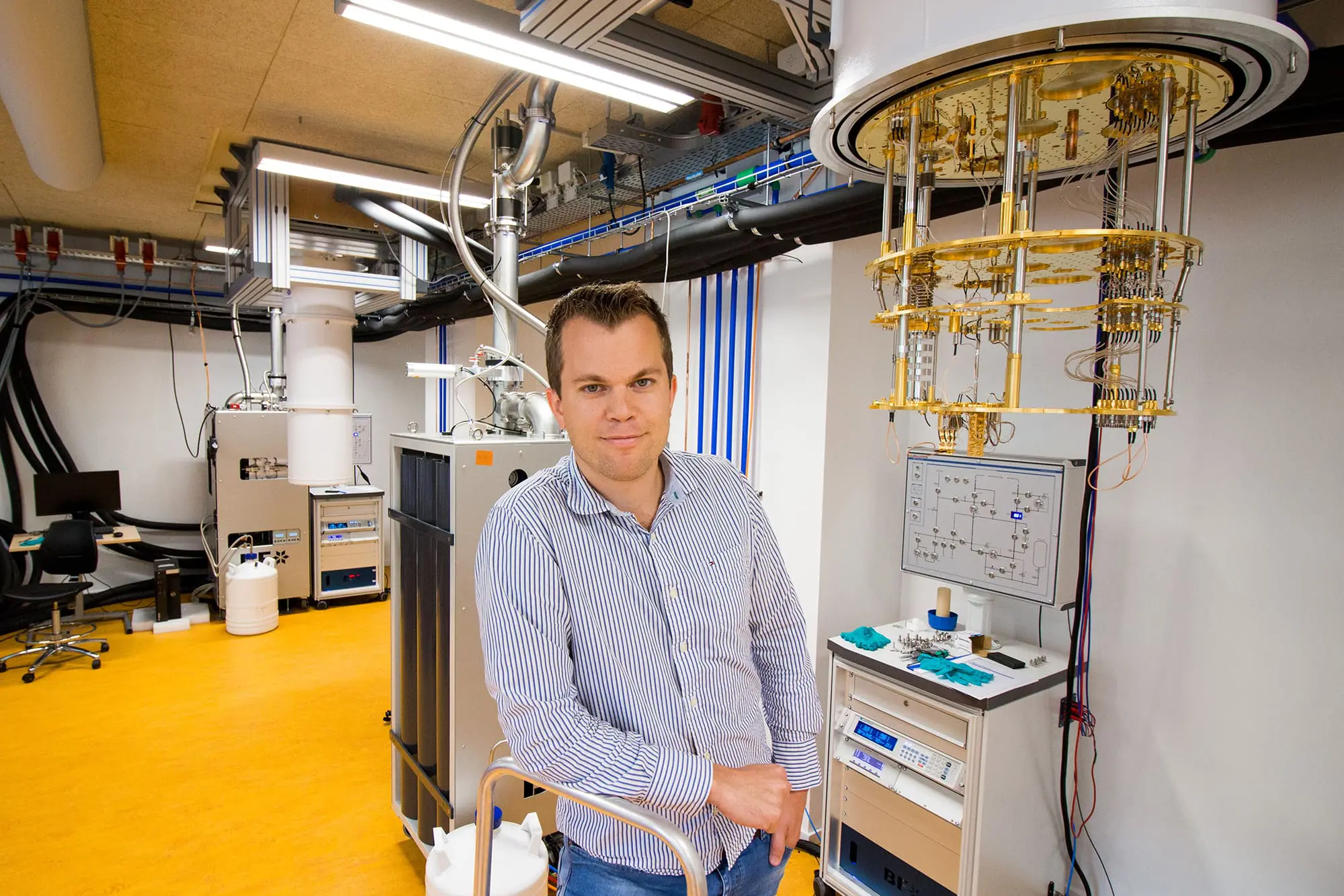
Menno Veldhorst, group leader of the Veldhorst Lab and Research Lead at QuTech’s Quantum Computing Division, has received an NWO Vici grant from the Dutch Research Council to explore connecting quantum dots in three dimensions. The research aims to build upon his team’s previous achievement of creating a two-dimensional qubit array by stacking quantum dots in multilayer structures, potentially enabling novel qubits with high connectivity and advancing quantum computation and simulation.
Menno Veldhorst Receives NWO Vici Grant for Quantum Dot Research
Menno Veldhorst has been awarded an NWO Vici grant to explore a novel approach to quantum computing by connecting quantum dots in three dimensions. The grant recognizes Veldhorst’s leadership and pioneering research in the field of quantum information science. His work focuses on controlling single electron spins in semiconductor quantum dots, which are promising for both quantum computation and simulation.
Veldhorst is particularly interested in expanding beyond two-dimensional qubit arrays to create three-dimensional structures. By stacking quantum dots in multilayer systems, he aims to develop high-connectivity qubits that could revolutionize quantum simulations. This approach mirrors the natural world, where phenomena often occur in three dimensions, potentially offering new insights into complex quantum systems.
The research builds on Veldhorst’s previous achievement of creating the first two-dimensional qubit array. Expanding into three dimensions represents a significant technical challenge but holds the promise of advancing quantum technologies. The grant will enable his team to investigate whether these stacked quantum dots can be independently controlled, paving the way for more sophisticated quantum computations and simulations.
Veldhorst’s work as group leader at QuTech‘s Quantum Computing Division underscores his role in pushing the boundaries of quantum research. His exploration of three-dimensional quantum dots could provide a foundation for future advancements in quantum information science, with implications for both theoretical understanding and practical applications.
Controlling Spins in Three Dimensions
Menno Veldhorst’s research aims to advance quantum computing by exploring three-dimensional quantum dot arrays. His work focuses on controlling single electron spins in semiconductor quantum dots, which are promising for both quantum computation and simulation. By expanding beyond two dimensions, Veldhorst seeks to create stacked quantum dot structures that could enhance connectivity and enable more sophisticated quantum simulations.
The proposed approach involves stacking quantum dots in multilayer systems, allowing independent control of each layer. This innovation could lead to the development of high-connectivity qubits, potentially revolutionizing quantum computing. The research builds on Veldhorst’s previous achievement of creating the first two-dimensional qubit array and aims to explore how three-dimensional structures might better emulate natural phenomena.
Veldhorst’s team will investigate whether stacked quantum dots can be independently controlled, a critical step toward realizing more complex quantum computations. This work could provide new insights into quantum systems and pave the way for practical applications in fields such as materials science and theoretical physics. The project represents an early-stage effort with significant potential to advance both fundamental understanding and technological capabilities in quantum computing.
Building Three-Dimensional Quantum Dot Arrays
The proposed approach involves stacking quantum dots in multilayer systems, allowing independent control of each layer. This innovation could lead to the development of high-connectivity qubits, potentially revolutionizing quantum computing. The research builds on Veldhorst’s previous achievement of creating the first two-dimensional qubit array and aims to explore how three-dimensional structures might better emulate natural phenomena.
Veldhorst’s team will investigate whether stacked quantum dots can be independently controlled, a critical step toward realizing more complex quantum computations. This work could provide new insights into quantum systems and pave the way for practical applications in fields such as materials science and theoretical physics. The project represents an early-stage effort with significant potential to advance both fundamental understanding and technological capabilities in quantum computing.
More information
External Link: Click Here For More