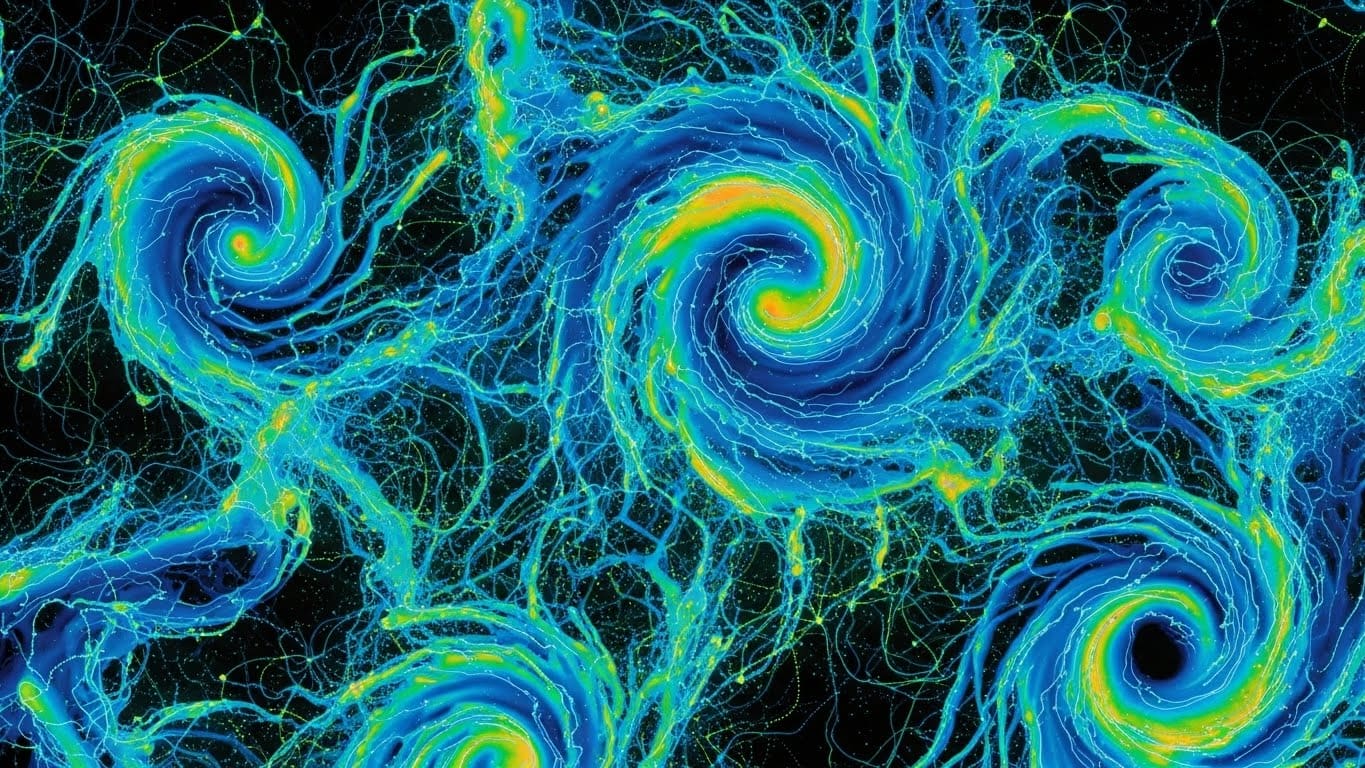
University of Pittsburgh’s Juan Jose Mendoza Arenas and Pennsylvania State University’s Xiang Yang are collaborating to model turbulence using quantum computing, an effort supported by a New Initiative Grant from the Charles E. Kaufman Foundation. Their two-year project, “Small-Scale Turbulence as a Quantum System,” will design algorithms and utilize quantum bits, or qubits, to represent the random nature of turbulent flows—a challenge that could require millions of years for a classical computer to simulate air flow around an airplane wing. This approach seeks to advance understanding of turbulence by leveraging the ability of quantum computers to represent multiple possibilities simultaneously.
Modeling Turbulence: The Challenges
Modeling turbulence presents a significant challenge due to its complexity across multiple length scales. Even seemingly simple flows, like smoke from a candle, break down into interacting eddies that dissipate at various sizes. Fully accounting for these scales is computationally intensive; simulating turbulent airflow around an airplane wing, for example, could take a classical computer millions of years to complete. Current traditional models often approximate smaller motions to save processing power, sacrificing a complete understanding of the flow.
Researchers are now exploring quantum computing as a potential solution to overcome these limitations. Unlike classical computers using binary code, quantum systems utilize qubits which can represent multiple possibilities simultaneously. This capability allows quantum computers to model complex systems like turbulence “more naturally” by representing its inherent randomness. The Pitt and Penn State team aims to design new algorithms for quantum computers to accurately represent turbulent flows.
This project received a Charles E. Kaufman Foundation grant due to its “high-risk, high-reward” potential. Success could lead to more accurate and efficient models, improving designs in fields like engineering, environmental prediction, and even understanding the human body. The team will first test algorithms on a quantum simulator before implementing them on actual quantum computers, hoping to advance understanding of multiscale systems where small-scale behavior significantly impacts overall dynamics.
Quantum Computing as a Solution
Researchers at the University of Pittsburgh and Pennsylvania State University are exploring quantum computing as a potential solution to model small-scale turbulence, a long-standing unsolved problem in classical physics. A two-year project, funded by a Charles E. Kaufman Foundation grant, aims to design algorithms utilizing quantum computers to better understand and model this complex phenomenon. Current classical computer simulations of turbulent flow, such as around an airplane wing, can take “millions of years” to complete, highlighting the need for new approaches.
Quantum computers offer a fundamentally different approach through the use of qubits, which can represent multiple possibilities simultaneously—a “superposition” of one and zero. Unlike classical systems limited to binary logic, quantum computers function under the laws of quantum mechanics, allowing for a more natural representation of the randomness inherent in turbulence. The team will first test these new algorithms on a quantum simulator before implementation on an actual quantum computer, a sensitive and expensive technology.
This research is considered “high-risk, high-reward” due to its potential to create scalable, physically grounded models for multiscale systems. Successful development of these models could profoundly impact several fields, including engineering design of vehicles, accurate prediction of environmental flows, and improved understanding of human body dynamics—addressing limitations found in traditional models which approximate smaller motions to save computational power.
Turbulence is the most important unsolved problem of classical physics.
Richard Feynman
The Research Project and Potential Impact
The University of Pittsburgh and Penn State are collaborating on a two-year research project, funded by a Charles E. Kaufman Foundation grant, to explore how quantum computers can model small-scale turbulence. This project, titled “Small-Scale Turbulence as a Quantum System,” aims to move beyond traditional turbulence modeling which often approximates smaller motions to save computational power. The researchers hope to create more accurate models, recognizing that behavior at small scales significantly impacts larger systems.
Turbulence presents a substantial computational challenge; simulating air flow around an airplane wing under standard conditions could take a classical computer millions of years. The team will design new algorithms specifically for quantum computers, leveraging qubits – which can represent multiple possibilities simultaneously – to more naturally model the random nature of turbulence. These algorithms will first be tested on a quantum simulator before being deployed on an actual quantum computer.
This “high-risk, high-reward” research could profoundly improve multiple fields. More accurate turbulence models have the potential to revolutionize engineering design, environmental flow prediction, and understanding of human body dynamics. By combining expertise in fluid dynamics and quantum computing, the researchers hope to develop scalable, physically grounded models for complex multiscale systems, where small-scale behavior has significant consequences.