

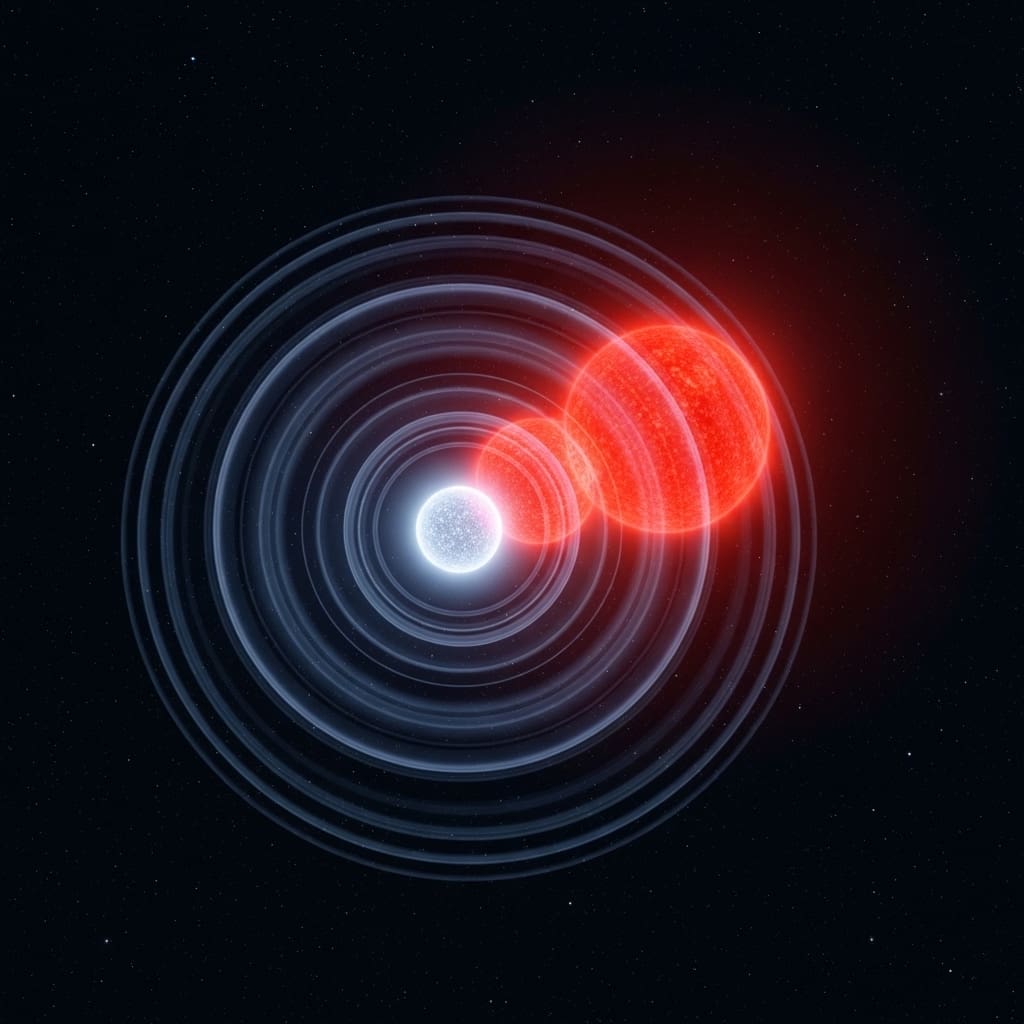
Researchers have detected unexpectedly bright radio signals emanating from the Be/X-ray binary system A0538-66, a peculiar source within the Large Magellanic Cloud. Led by Justine Crook-Mansour, Rob Fender, and Alex Andersson of the University of Oxford’s Astrophysics department, alongside Hao Qiu from the SKA Observatory and a further team of international collaborators, this discovery challenges existing understanding of radio emission from neutron star X-ray binaries. The team’s observations, utilising the Australian Square Kilometre Array Pathfinder and the MeerKAT telescope, reveal A0538-66 to be amongst the most radio-luminous such systems known, exhibiting modulated emission reaching mJy. This finding is significant because it offers a new avenue for investigating the physics of accretion and jet formation in these extreme environments, potentially unlocking clues about the behaviour of matter under intense gravitational forces.
Radio Luminosity and Orbital Dependence in the Be/X-ray Binary A0538-66 reveal a complex relationship
Scientists have discovered radio emission from the Be/X-ray binary A0538-66, a system located in the Large Magellanic Cloud, and subsequently conducted a weekly monitoring campaign using the MeerKAT radio telescope. A0538-66 hosts a neutron star with a remarkably short spin period of approximately 69 milliseconds within a highly eccentric 16.6-day orbit.
This binary system is particularly interesting due to its infrequent episodes of super-Eddington accretion, rapid optical and X-ray flares, and other unusual characteristics among high-mass X-ray binaries. The team’s MeerKAT data reveal that A0538-66 is one of the most radio-luminous neutron star X-ray binaries observed to date, reaching an intensity of approximately 3 × 10²² erg s−1Hz−1.
Experiments show that the radio emission from A0538-66 exhibits orbital modulation, suggesting a connection to the binary’s orbital parameters. Researchers investigated several potential mechanisms responsible for this radio emission, carefully considering the unique properties of the system. The study establishes A0538-66 as a key example for comparison with other similar systems, allowing for a broader understanding of radio emission processes in neutron star X-ray binaries.
This discovery builds on previous observations of the source, which revealed X-ray outbursts exceeding the isotropic Eddington limit for a neutron star, approximately 1038 erg s−1. The research demonstrates that A0538-66 undergoes X-ray outbursts with luminosities spanning five orders of magnitude, highlighting its dynamic nature.
Observations in 2018 and 2025 revealed super-Eddington luminosities, peaking at approximately 4 × 1038 erg s−1 and 1.5 × 1039 erg s−1 respectively, accompanied by rapid X-ray flares. The detection of X-ray pulsations at 69 milliseconds, though sporadic, further distinguishes A0538-66 as the fastest spinning accretion-powered neutron star in a high-mass X-ray binary. Data from MeerKAT revealed A0538-66 to be one of the most radio-luminous neutron star X-ray binaries observed, reaching a peak flux density of 1.28GHz.
Researchers extracted Stokes V and linear polarisation flux densities, utilising beam-shaped forced aperture photometry fixed at the Stokes I position to quantify the radio signal. To determine circular polarisation, the team derived a 3σ confidence interval of −0.5% Addressing potential bandwidth depolarisation, the study re-imaged the data with 1024 frequency channels and performed rotation measure (RM) synthesis using RM-tools (Brentjens & de Bruyn 2005; Purcell et al 2020), ensuring accuracy for |RM| ≲104 rad m−2.
The resulting Faraday dispersion function showed a marginal peak at RM ≈1600 rad m−2 with a significance of 2.3σ, though this was considered likely spurious. An ∼8.5-hour deep image was produced with a root-mean-square noise of σrms∼10 μJy beam−1, but failed to detect a natal supernova remnant, consistent with the source’s association with the LMC open cluster NGC 2034 and an estimated age ≳106 years.
Quasi-simultaneous 0.2, 10 keV observations were obtained with the Neil Gehrels Swift Observatory X-ray Telescope, utilising SWIFTTOOLS to extract spectra and XSPEC (Arnaud 1996) for spectral fitting with Cash statistics. Unabsorbed 1, 10 keV fluxes were calculated adopting tbabs(pegpwrlw) for low-count spectra and tbabs(pegpwrlw+pegpwrlw) for higher-count spectra, fixing the line-of-sight column density NH at 8 × 1020cm−2. Located in the Large Magellanic Cloud, A0538-66 hosts a neutron star spinning with a period of approximately 69 milliseconds in a highly eccentric 16.6-day orbit.
The research team measured a radio luminosity reaching approximately 3 × 10²² erg s−1Hz−1, establishing it as one of the most radio-luminous neutron star X-ray binaries observed to date. Experiments revealed that the radio emission from A0538-66 exhibits orbital modulation, suggesting a connection between the radio signal and the binary system’s orbital parameters.
The team recorded data indicating that the source underwent X-ray outbursts with luminosities spanning five orders of magnitude, and occasionally exceeding the isotropic Eddington limit for a neutron star, which is around 1038 erg s−1. Observations during a 2018 outburst showed a peak 0.2, 10 keV luminosity of approximately 4 × 1038 erg s−1, while a 2025 outburst reached approximately 1.5 × 1039 erg s−1 in 0.2, 12 keV luminosity.
Results demonstrate that A0538-66 displays X-ray pulsations at approximately 69 milliseconds, a characteristic observed sporadically during super-Eddington outbursts and at lower luminosities of around 8 × 1036 erg s−1. Tests prove that the optical emission from the system is also orbitally modulated, with double-peaked profiles near periastron supporting a misalignment between the disc plane and the observer’s line of sight. This neutron star system, characterised by a short spin period and highly eccentric orbit, is known for its unusual accretion episodes and rapid flares.
The MeerKAT data revealed A0538-66 to be one of the most radio-luminous neutron star X-ray binaries observed, reaching a peak flux density of approximately 9 mJy. Researchers also found tentative evidence suggesting the radio emission may be modulated by the system’s orbit. This discovery expands understanding of high-mass X-ray binaries and their radio emission mechanisms.
A0538-66 occupies a unique position in the luminosity ratio between radio and X-ray emission, falling between known gamma-ray binaries and other unusual neutron star systems. The authors acknowledge limitations in the current data, specifically the need for higher cadence multi-wavelength observations to fully understand the origin of the radio emission. Future research will focus on these observations, aiming to unravel the processes driving the observed radio signals and further characterise this peculiar system.
👉 More information
🗞 Detection of an Extremely Luminous Radio Counterpart to the Be/X-ray Binary A0538-66
🧠 ArXiv: https://arxiv.org/abs/2601.22741

