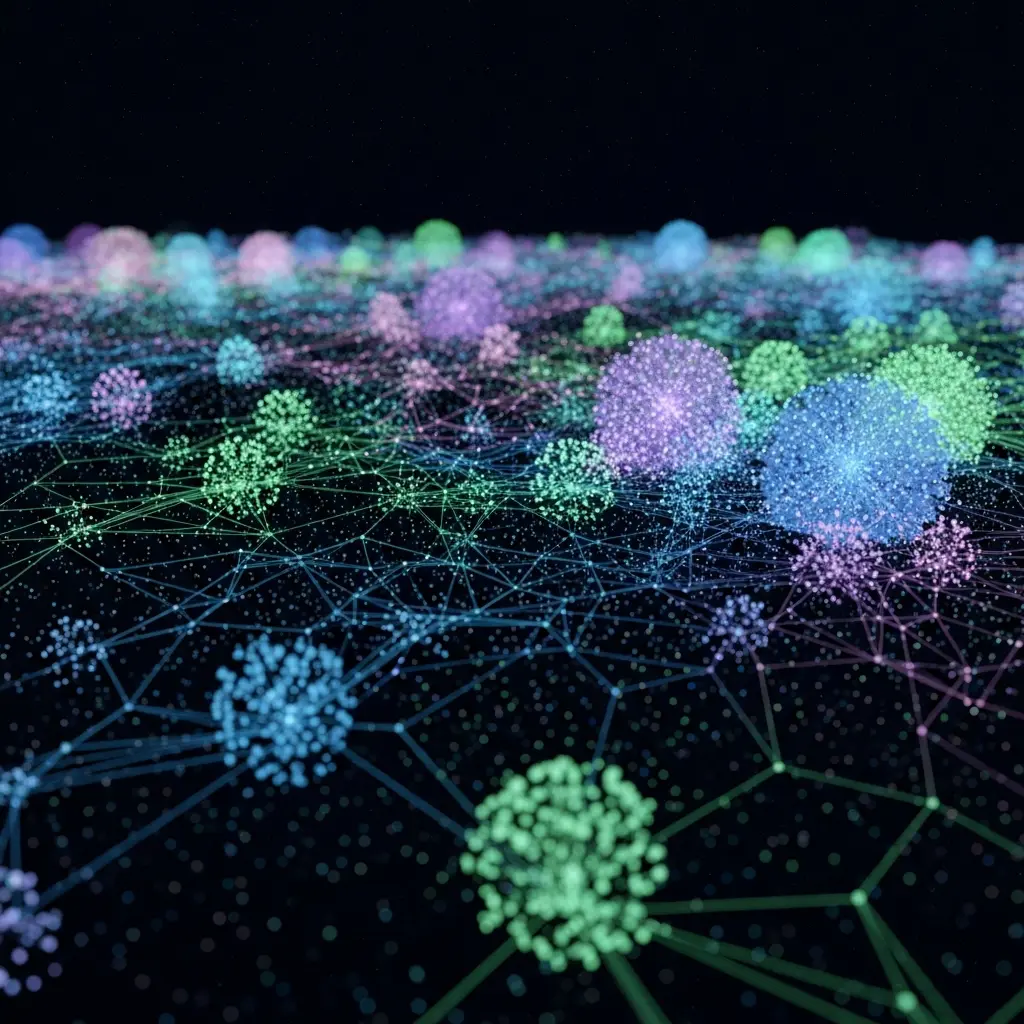
Scientists are tackling the overwhelming challenge of navigating the ever-expanding landscape of biomedical literature. Huan He, Xueqing Peng, and Yutong Xie, from the University of Michigan, alongside Qijia Liu, Chia-Hsuan Chang, and Lingfei Qian et al, present MedViz , a novel visual analytics system designed to transform how researchers explore complex scientific data. Unlike conventional search engines that deliver simple ranked lists, MedViz integrates intelligent agents with interactive visualisation, enabling users to query, summarise and generate hypotheses from a semantic map of millions of articles. This innovative approach bridges a critical gap between large language models and literature search workflows, promising to accelerate knowledge discovery by turning static searches into a dynamic and exploratory process.
MedViz agent system for literature exploration streamlines research
Implementing the Visually-Guided Research Assistant
Scientists introduce MedViz, an agent-based, visually-guided research assistant designed for navigating the increasingly complex landscape of Biomedical literature. To generate human-readable topic labels, the team leverages term-frequency, inverse document frequency (TF-IDF) based representations, employing a class-based TF-IDF (c-TF-IDF) approach for high-level clusters. This method aggregates terms within defined classes and contrasts them against the entire corpus, effectively identifying dominant themes and providing a broad overview of research areas. However, recognising that traditional c-TF-IDF often struggles with discerning closely related sub-clusters, researchers propose a tree-based TF-IDF strategy, computing inverse document frequency locally among sibling clusters sharing a parent node. This localized comparison enhances sensitivity to subtle topical differences, yielding more specific labels for fine-grained subtopics and significantly improving the interpretability of the resulting semantic map, allowing researchers to pinpoint nuanced areas of investigation. Experiments employ a WebGL-based GPU rendering approach, implemented through the Points system in Three. js, to overcome performance limitations inherent in CPU-bound rendering pipelines. Traditional rendering methods often become bottlenecks when visualising large datasets, as each graphical element requires individual processing by the central processing unit. Rather than individually drawing thousands of elements, the system transmits all publication points to the GPU in a single batch operation, enabling parallel processing of millions of points and minimising communication overhead between the CPU and GPU. Visual attributes, such as colour and size, are encoded in GPU-resident textures, facilitating dynamic updates without necessitating a complete re-rendering of the entire scene, and dramatically improving interactivity for the user. The study further innovates by integrating a kernel density estimation (KDE), based edge-bundling algorithm, termed Hammer Bundle, to visualise citation and co-citation relationships, revealing the interconnectedness of research publications.
Advanced Optimization for Large-Scale Visualization
This technique aggregates geometrically similar edges into smooth curves, preserving global structural cues while reducing the number of rendered primitives by more than an order of magnitude. Rendering a large number of individual lines representing citations quickly becomes computationally expensive; edge-bundling offers a solution by simplifying the visual representation without sacrificing essential information. Bundles are rendered as curved splines using GPU-accelerated line materials, allowing smooth transitions in opacity and thickness, and enabling interactive visualisation of complex literature networks. Real-time point hover functionality, crucial for exploratory data analysis, is achieved by building a 2D quadtree over projected point coordinates, enabling O(log n) time complexity for insertion and facilitating responsive interaction with million-scale datasets, ensuring a fluid user experience even with extensive information loads. A quadtree is a tree data structure in which each internal node has exactly four children, used here to efficiently locate points within a defined area.
🗞 MedViz: An Agent-based, Visual-guided Research Assistant for Navigating Biomedical Literature
🧠 ArXiv: https://arxiv.org/abs/2601.20709