Deep research using artificial intelligence promises to revolutionise how we access and understand complex information, but current systems struggle with the specific demands of the medical field. Ailing and colleagues at [Institution name(s), not provided in source] address this challenge with MedResearcher-R1, a new deep research agent designed for medical inquiries. The team’s innovation lies in combining a detailed medical knowledge base with a specialised retrieval engine, allowing the system to synthesise information and answer complex questions with greater accuracy than existing tools. This approach generates extensive research pathways, averaging over four interactions with various information sources, and establishes a new benchmark for performance, demonstrating that strategically designed, smaller open-source systems can outperform much larger proprietary models in specialised domains like medicine.
AI Agents Autonomously Conduct Medical Research
This collection of research papers explores the rapidly developing field of deep research agents, AI systems designed to autonomously conduct complex research tasks, particularly within the medical domain. The core idea is to move beyond simple question answering to AI agents that can actively research a topic, formulate hypotheses, gather evidence, analyze data, and synthesize findings, mirroring the process of a human researcher. Several systems, including xBench, Skywork, Gaia, and OpenHands, are highlighted, all designed to push the boundaries of agentic capabilities. Researchers are increasingly focusing on evaluating these agents on realistic tasks and datasets, with MedBrowseComp specifically designed for complex medical deep research.
A crucial component of these agents is the ability to interact with the web, searching, browsing, extracting information, and utilizing online tools, as demonstrated by the WebArena environment. Many papers concentrate on applying these agentic systems to medical research, diagnosis, and treatment, tackling challenges like rare disease diagnosis, medical literature review, and clinical decision support. Key technical advancements driving this progress include Retrieval-Augmented Generation, which enhances language models by retrieving relevant information, and Chain-of-Thought Reasoning, which encourages models to articulate their reasoning steps for greater transparency. Utilizing Knowledge Graphs, structured knowledge representations, further improves reasoning and information retrieval, while sophisticated agent architectures combine planning, acting, and observation capabilities.
However, developing these agents presents significant challenges. Training requires large amounts of high-quality data, which can be difficult to obtain, especially in specialized fields like medicine. Ensuring agents provide accurate and reliable information, avoiding “hallucinations,” is a major concern. Understanding why an agent made a particular decision is crucial for building trust and ensuring accountability, and developing agents that can generalize to new tasks and domains remains a significant hurdle. Despite these challenges, this collection of papers paints a picture of a rapidly evolving field with the potential to revolutionize how we conduct research, solve complex problems, and improve healthcare.
Medical Inquiry Agent with Dynamic Tool Switching
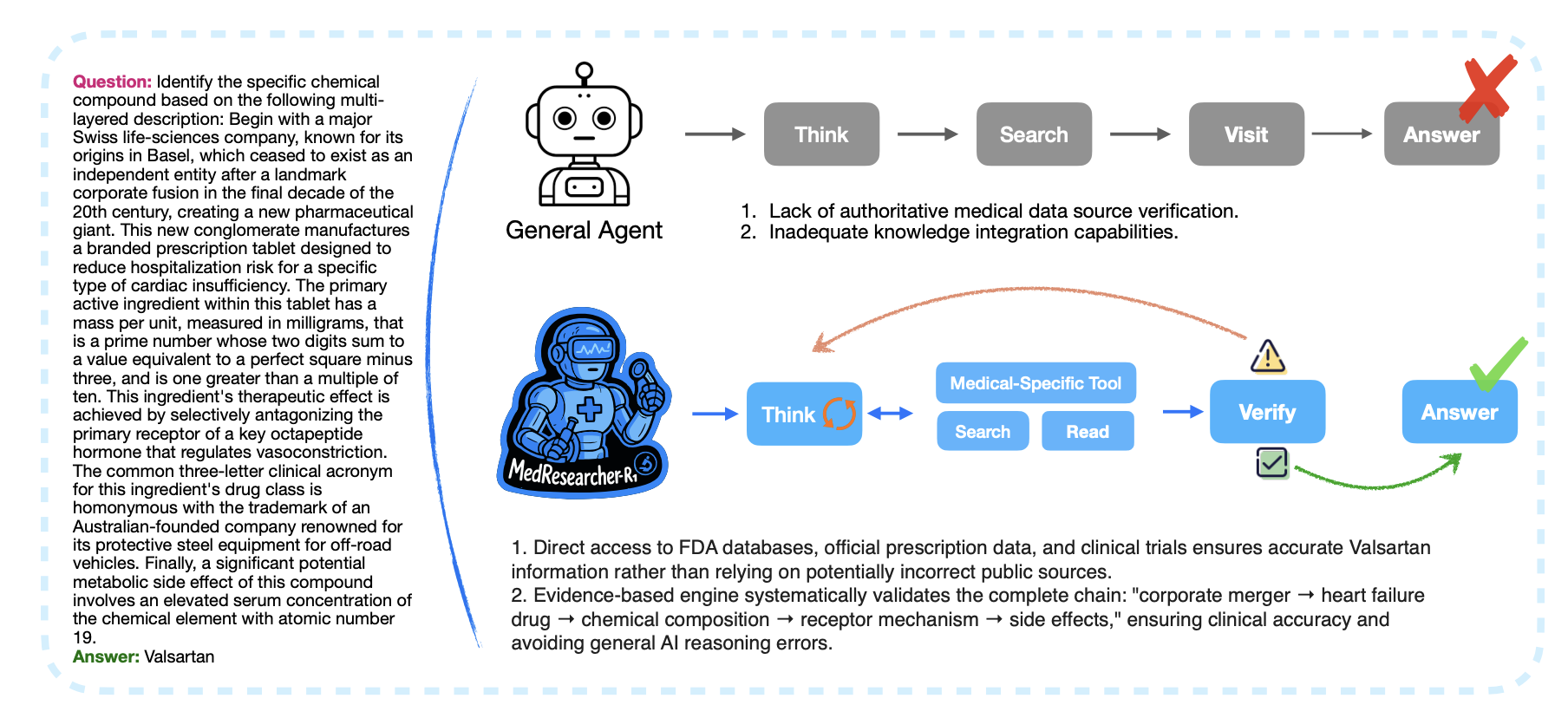
The research team developed a novel deep research agent, MedReseacher-R1, specifically designed to excel in complex medical inquiries, addressing limitations found in general-purpose systems. Recognizing that existing agents struggle with the density of specialized medical knowledge and lack tailored retrieval tools, the team focused on building a system capable of navigating intricate medical databases and synthesizing information accurately. The methodology centers around a reasoning-acting paradigm, inspired by the REACT framework, but significantly enhanced with medical-specific adaptations to facilitate exploratory research. A key innovation lies in the agent’s ability to dynamically switch between general and specialized tools, guided by a learned policy that prioritizes authoritative medical sources over broad web content.
This process involves iterative cycles of reasoning, action, and observation, where the agent formulates hypotheses, identifies information gaps, and selects the most appropriate tool for extraction. The system maintains a detailed state representation, tracking dialogue context, accumulated medical knowledge structured as a knowledge graph, and a history of reasoning paths, enabling it to connect rare medical entities through complex relationships. To overcome the challenges of training an agent for such a nuanced domain, the researchers employed a two-stage learning approach called knowledge-anchored learning. This begins with supervised fine-tuning on high-quality medical trajectories, effectively teaching the agent how to use tools and navigate medical information. This is then followed by reinforcement learning, guided by a technique called Masked Trajectory Guidance, which provides structural scaffolding to prevent memorization and encourage genuine medical reasoning. By combining these approaches, the team successfully developed an agent that not only achieves state-of-the-art performance on medical benchmarks but also maintains competitive capabilities on general research tasks, demonstrating that specialized training can enhance overall agent versatility.
Medical Reasoning Enhanced by Knowledge Synthesis
Recent advances in artificial intelligence have produced agents capable of complex reasoning and information synthesis, but these systems struggle with the specialized demands of the medical field. Current deep research agents, even leading proprietary systems, demonstrate limited accuracy when tackling complex medical queries, revealing a critical gap in their capabilities. Researchers have identified that this stems from a lack of dense, specialized medical knowledge and reliance on general-purpose retrieval tools that fail to capture the nuanced relationships within medical information. To address this, a new medical deep research agent has been developed, employing a novel approach to both data synthesis and information retrieval.
The system generates exceptionally complex training examples by focusing on rare medical entities, those occurring less than once in a million medical documents, and constructing reasoning chains around them. This process creates training scenarios that mirror the challenges of real medical research, demanding systematic exploration and synthesis rather than simple information lookup. The agent integrates a custom-built medical retrieval engine alongside standard tools, allowing for more accurate information gathering. This system achieves state-of-the-art results on the MedBrowseComp benchmark, reaching 27.
5% accuracy, surpassing previous leading systems like OpenAI’s o3-deepresearch (25. 5%) and significantly outperforming search-only approaches. Importantly, this improved performance in the medical domain does not come at the expense of general research capabilities; the agent achieves competitive results on broader deep research tasks, matching the performance of other advanced systems on benchmarks like GAIA and xBench. This research demonstrates that strategically focused innovations in architecture, tool design, and training data can enable smaller, open-source models to outperform much larger proprietary systems in specialized fields, opening new avenues for accessible and effective medical AI. The team plans to release the code and datasets used in this work to further accelerate research in this critical area.
MedResearcher-R1 Advances Medical Question Answering Performance
The study highlights the potential of strategically incorporating domain-specific innovations, in architecture, tool design, and training data, to enable smaller, open-source agents to outperform larger proprietary systems in specialized fields. While acknowledging current limitations in areas such as handling dynamic clinical environments and the need for robust safety mechanisms, the authors outline several avenues for future research. These include integrating multi-modal medical tools, incorporating human expert feedback, developing advanced medical reasoning benchmarks, and systematically studying model safety and reliability for real-world deployment. The team has released their codebase, datasets, and trained models to encourage further research in this area.
🗞 MedReseacher-R1: Expert-Level Medical Deep Researcher via A Knowledge-Informed Trajectory Synthesis Framework
🧠 ArXiv: https://arxiv.org/abs/2508.14880