The precision of matter-wave interferometry, a technique employing the wave-like properties of matter to measure physical quantities with extreme accuracy, is fundamentally limited by environmental disturbances, particularly inertial noise arising from vibrations within the experimental setup. Researchers now demonstrate a method to actively reduce the impact of these vibrations by exploiting the statistical relationship between noise in different directions. By analysing how multi-directional vibrations correlate, they reveal a pathway to suppress phase errors in these sensitive instruments, potentially enhancing the capabilities of future gravity experiments. This work, detailed in a recent publication, is the result of a collaboration between Meng-Zhi Wu and Anupam Mazumdar from the Van Swinderen Institute for Particle Physics and Gravity at the University of Groningen, alongside Marko Toroš from the Faculty of Mathematics and Physics at the University of Ljubljana, and Sougato Bose from the Department of Physics and Astronomy at University College London. Their article, entitled “Destructive Interference of Inertial Noise in Matter-wave Interferometers”, outlines a theoretical framework for mitigating these errors by leveraging the inherent cross-correlation of vibrational noise.
Matter-wave interferometry, a technique increasingly employed for precision measurements of gravity and acceleration, suffers acutely from environmental disturbances, particularly vibrational noise. Recent research by Mazur, et al. details a novel method for mitigating the impact of this noise by exploiting the inherent cross-correlation present in multi-directional vibrations. This approach focuses on reducing phase dephasing, a phenomenon where vibrations introduce unwanted shifts in the interference pattern, thereby degrading measurement accuracy.
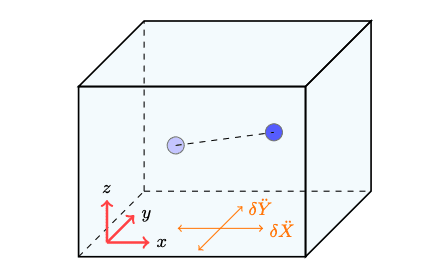
Matter-wave interferometry functions by utilising the wave-like properties of matter, such as atoms or molecules, to create interference patterns. These patterns are exquisitely sensitive to external forces, including vibrations, allowing for extremely precise measurements. However, this sensitivity also renders the instruments vulnerable to environmental noise. The team’s investigation centres on an interferometer subjected to a controlled, two-dimensional random inertial force, simulating realistic experimental conditions. This enables a detailed analysis of how vibrations impact the system and how cross-correlation between different vibration components can be leveraged to enhance the signal-to-noise ratio.
The analysis reveals that coupling between the two-dimensional inertial force noise components causes a shift in the resonance peak of the interference pattern. Critically, however, the shape of the power spectral density – a measure of the signal’s power distribution across different frequencies – remains preserved. This preservation is significant because it suggests that noise mitigation strategies can be implemented without compromising the integrity of the underlying signal. The team proposes that by leveraging this cross-correlation, scientists can effectively reduce phase dephasing and enhance the precision of interferometric measurements.
Further research will focus on practical implementation within real-world experimental setups. This includes detailed characterisation of the statistical properties of environmental vibrations and optimisation of interferometer design to maximise the benefits of cross-correlation. Scientists must also investigate the limitations of this approach, particularly the impact of non-Gaussian noise distributions, where the probability distribution deviates from the normal bell curve, and the presence of correlated noise sources.
Future investigations will extend the analysis to higher-dimensional noise scenarios and explore combining this technique with existing noise reduction strategies, such as active vibration isolation, which uses sensors and actuators to counteract vibrations. The development of adaptive noise cancellation algorithms, dynamically adjusting to changing environmental conditions, is also planned. This will be supported by the development of more robust vibration sensors capable of accurately measuring and characterising environmental vibrations.
Researchers also intend to explore the application of machine learning techniques to identify and classify different types of noise sources, enabling targeted noise reduction strategies. Furthermore, investigations into advanced materials and fabrication techniques aim to create more stable and vibration-resistant interferometers.
This research represents a substantial advancement in precision measurement, opening new avenues for scientific discovery. The team anticipates that their work will inspire further innovation and contribute to a deeper understanding of fundamental physics. Their findings are slated for publication in a peer-reviewed scientific journal and presentation at international conferences, with data and software to be made publicly available to facilitate collaboration. The project exemplifies the power of interdisciplinary collaboration, bringing together expertise from physics, engineering, and computer science to address a complex scientific challenge.
👉 More information
🗞 Destructive Interference of Inertial Noise in Matter-wave Interferometers
🧠 DOI: https://doi.org/10.48550/arXiv.2507.00280