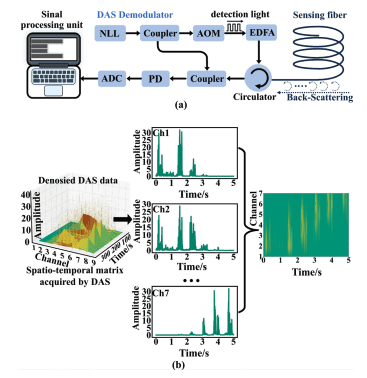
Distributed Acoustic Sensing (DAS) technology is rapidly expanding into fields from security to environmental monitoring, but current artificial intelligence models struggle to perform reliably across different sensing environments and often require extensive labelled data. Kun Gui, Hongliang Ren, Shang Shi, and colleagues propose a new foundational model, MAEPD, designed to overcome these limitations. The team pre-trained the model on a vast dataset of diverse DAS signals, including human gait, pipeline monitoring, and even whale vocalizations, using a self-supervised learning technique that captures underlying patterns without needing labelled examples. Crucially, the researchers demonstrate that a technique called Visual Prompt Tuning allows the model to adapt to specific tasks, such as gait recognition, with remarkable efficiency, achieving 96. 94% accuracy while fine-tuning less than one percent of its parameters. This approach represents a significant step towards creating broadly applicable and scalable signal recognition models for the growing field of Distributed Acoustic Sensing.
This model utilizes a Masked Autoencoder, a technique where the system learns by predicting missing information, to capture the underlying structure of DAS signals. MAEPD undergoes pretraining on a large dataset of over 635,000 samples, encompassing diverse signals such as walking patterns, pipeline monitoring data, security perimeter recordings, whale vocalizations, and seismic activity. Current research focuses on applying artificial intelligence, particularly deep learning, to enhance the interpretation of DAS data, moving beyond simple signal detection to more sophisticated analysis, classification, and understanding. Key areas of investigation include self-supervised learning, where models learn from unlabeled data, and feature extraction techniques to identify meaningful patterns within DAS signals. Researchers are also exploring methods for classifying events, detecting anomalies, and improving signal quality through noise reduction.
The potential applications of DAS are broad, ranging from geophysics and structural health monitoring to security, wildlife tracking, and urban sensing. This technology can be used to monitor seismic activity, detect damage in structures, secure perimeters, identify animal vocalizations, and track traffic patterns. Furthermore, DAS shows promise for indoor occupancy tracking. This limitation arises from variations in data collection and the scarcity of labeled data. To overcome these challenges, scientists have developed MAEPD, a new foundational model for DAS signal recognition, leveraging self-supervised learning to learn from unlabeled data by predicting missing information. By training on a massive dataset of over 635,000 DAS signal patches, encompassing gait analysis, pipeline monitoring, perimeter security, whale vocalizations, and seismic activity, MAEPD learns the underlying structure of DAS signals, creating a robust knowledge base.
This pre-training allows the model to generalize effectively across different DAS applications. Instead of retraining the entire model for each new task, this method freezes the core, pre-trained parameters and fine-tunes only a small number of adjustable settings. In tests evaluating individual identification based on walking patterns, this approach achieved a classification accuracy of 96. 94%, surpassing traditional full fine-tuning methods by 0.
Importantly, the model also demonstrated strong performance in detecting pipeline leaks and securing perimeters, confirming its versatility and potential as a foundational model for a wide range of DAS applications. This advancement represents a significant step towards more adaptable and efficient DAS systems, reducing the need for extensive, task-specific data labeling and enabling broader deployment of this powerful sensing technology. The model addresses challenges arising from variations in data collection environments and limited labeled data by employing a Masked Autoencoder for pre-training, enabling it to learn deep features from a broad range of DAS signals. Experiments demonstrate that VPT, specifically the VPT-Deep approach, achieves high accuracy in gait recognition and pipeline leakage detection, surpassing traditional full fine-tuning methods.
Notably, VPT-Deep achieves a 96. 94% classification accuracy with only 0. 322% of the model’s parameters fine-tuned, while also reducing training time by 45%. The research highlights that performance is optimized with varying numbers of visual prompt vectors depending on the size of the training dataset, and further investigation may be needed to determine the most effective configuration across different applications.
👉 More information
🗞 A Foundation Model for DAS Signal Recognition and Visual Prompt Tuning of the Pre-trained Model for Downstream Tasks
🧠 ArXiv: https://arxiv.org/abs/2508.04316