

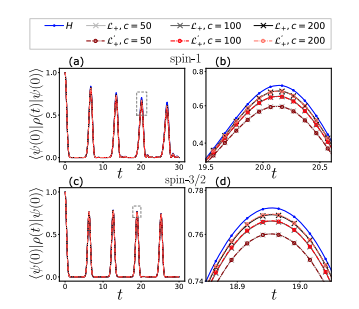
Research demonstrates that many-body scar eigenstates, previously considered violations of the eigenstate thermalization hypothesis (ETH), actually adhere to thermalisation governed by grand canonical statistics when viewed as an open system. This revised ETH reconciles constrained, non-ergodic systems with established thermalisation paradigms, offering a unified description of many-body dynamics.
The behaviour of complex quantum systems, particularly their tendency to reach thermal equilibrium, remains a central question in modern physics. While the eigenstate thermalization hypothesis (ETH) typically predicts that excited states of a many-body system resemble thermal distributions, certain systems exhibit ‘quantum many-body scars’ – eigenstates that defy this expectation and retain memory of the initial conditions. Researchers at the Anhui Province Key Laboratory of Quantum Network, University of Science and Technology of China, including Jia-wei Wang, Xiang-Fa Zhou, Guang-Can Guo, and Zheng-Wei Zhou, now present a refined understanding of this phenomenon in their paper, Thermalization of Quantum Many-Body Scars in Kinetically Constrained Systems. Their work extends the ETH by framing thermal properties within the grand canonical ensemble, a statistical approach that considers systems exchanging energy with a reservoir, and demonstrates a connection between the persistence of scars and their slow decay within a dissipative process modelled using a Lindblad-like master equation. This revised framework successfully unifies the behaviour of both scar and thermal eigenstates, offering a cohesive explanation for thermalisation in constrained many-body systems.
Researchers are refining understandings of many-body scar states, atypical quantum states that resist standard predictions of thermalisation, by extending the eigenstate thermalization hypothesis (ETH). The ETH posits that eigenstates of a quantum many-body system, when averaged over, statistically resemble those of a thermal ensemble, implying that the system explores all accessible states equally. However, scar states demonstrably violate this expectation, retaining memory of the initial conditions and failing to exhibit the expected thermal behaviour.
This new work addresses this discrepancy by framing
This new work addresses this discrepancy by framing the analysis within an open quantum system, acknowledging the inevitable interaction with an external environment. Researchers employ the grand canonical ensemble, a statistical ensemble used in thermodynamics that allows for fluctuations in both energy and particle number, to describe the thermal properties of these scar states. This contrasts with the more commonly used canonical ensemble, which assumes a fixed number of particles. The grand canonical ensemble is particularly suited to systems where particle exchange with the environment is possible, such as those exhibiting dissipation.
The dynamics of these kinetically constrained systems are modelled using a Lindblad master equation, a mathematical framework describing the evolution of open quantum systems. This equation accounts for the system’s interaction with its environment, treating it as a dissipative process where energy and information can leak out. The research reveals a direct correlation between the violation of the ETH in scar eigenstates and their slow decay rate within this dissipative process. Essentially, scar states decay more slowly because they are less effectively coupled to the environment, retaining their non-ergodic characteristics.
By focusing on decay rates, researchers offer a novel perspective on the thermal properties of scar states. The analysis demonstrates that when considered within the grand canonical ensemble, scar eigenstates exhibit thermalisation consistent with established statistical mechanics. This challenges the conventional view of scar states as exceptions to the ETH, instead positioning them as integral components of a broader thermalisation framework.
The successful reformulation of the ETH encompasses both
The successful reformulation of the ETH encompasses both scar and thermal states under a unified rule, bridging the gap between non-ergodic and ergodic behaviours. This revised hypothesis provides a more comprehensive understanding of thermalisation in many-body systems, potentially leading to generalized thermalisation paradigms and expanding the scope of existing theoretical frameworks. The work underscores the importance of considering open system dynamics and employing appropriate statistical ensembles to describe the behaviour of complex quantum systems accurately.
The findings suggest the grand canonical ensemble offers a more accurate description of the statistical properties of systems exhibiting many-body localisation and scar states than the canonical ensemble. This refined understanding has implications for diverse areas of physics, including condensed matter physics, where many-body localisation is a key area of research, and quantum information theory, where understanding thermalisation is crucial for developing robust quantum technologies. This work opens new avenues for research and exploration into the fundamental principles governing complex quantum systems.
🗞 Thermalization of Quantum Many-Body Scars in Kinetically Constrained Systems
🧠 DOI: https://doi.org/10.48550/arXiv.2506.18298


