Understanding the behaviour of complex materials requires accurately modelling how electrons interact with each other, external forces, and energy loss, a challenge that has long occupied physicists. Thomas Blommel, Enrico Perfetto, Gianluca Stefanucci, and Vojtech Vlcek now present a new theoretical framework that tackles this problem head-on, offering a unified approach to modelling correlated electron systems subject to both external driving and dissipation. Their work introduces a powerful diagrammatic technique, built upon established many-body perturbation theory, that elegantly incorporates energy flow and fluctuations into calculations, while crucially maintaining compatibility with existing computational methods. This advancement promises to unlock more accurate and efficient first-principles modelling of a wide range of physical phenomena, from the behaviour of materials far from equilibrium to the dynamics of quantum devices, offering a significant step forward in condensed matter physics and quantum technology.
Time-Dependent Many-Body Quantum Dynamics Simulations
This research focuses on understanding the behaviour of many interacting quantum particles and how their properties evolve over time. Scientists utilize the GW approximation, with advancements including improved self-consistency and complex interactions, and Nonequilibrium Green’s Functions (NEGF), developing efficient algorithms for complex calculations. A key theme is simulating the time-dependent behaviour of electrons and excitations in materials, crucial for understanding light absorption, carrier dynamics, and exciton behaviour. Researchers are also exploring methods for modelling open quantum systems, those interacting with their environment, using techniques like Lindblad dynamics.
This work is driven by the need for improved computational methods that scale efficiently with system size and can be implemented on modern supercomputers, ultimately providing a theoretical framework for interpreting ultrafast spectroscopic experiments. Scientists are tackling challenges such as achieving accurate self-consistency in GW calculations and incorporating vertex corrections to account for complex many-body interactions. They are developing linear-scaling algorithms to enable simulations of larger systems and utilizing the Kadanoff-Baym equations as a central tool in NEGF calculations. Parallelization strategies are crucial for harnessing the power of modern supercomputers, and diagrammatic expansions are used to systematically improve the accuracy of calculations.
Keldysh-Lindblad Theory for Open Quantum Systems
Scientists have developed a new theoretical framework for modelling open quantum systems by combining many-body perturbation theory with a method for describing dissipation. This work introduces a Keldysh-Lindblad formalism, employing novel diagrammatic rules to represent quasiparticle flows and fluctuations, enabling a systematic and improvable treatment of correlated, driven, and dissipative systems. This approach accurately captures the behaviour of systems exchanging energy and information with their surroundings, a crucial aspect often neglected in traditional quantum calculations. The core of this breakthrough lies in extending the Kadanoff-Baym equations (KBE) to incorporate dissipation, while crucially maintaining the structure of the original equations.
This allows existing numerical methods to be directly applied to these newly formulated equations, significantly streamlining computational efforts. Researchers demonstrated this by deriving dissipative versions of the second Born and GW approximations, identifying the physical content of the resulting self-energy components, and gaining a deeper understanding of how dissipation affects the electronic structure and dynamics of materials. Furthermore, the study demonstrates that time-linear approximations to the full KBE retain their closed structure, enabling efficient simulations of relaxation and decoherence processes. By combining Nonequilibrium Green’s Functions (NEGF) with the Keldysh-Lindblad formalism, scientists achieve systematic improvability and advantageous power-law scaling with system size. This approach overcomes limitations of other methods, making it well-suited for material-specific predictions based on first-principles calculations.
Keldysh-Lindblad Formalism for Dissipative Quantum Systems
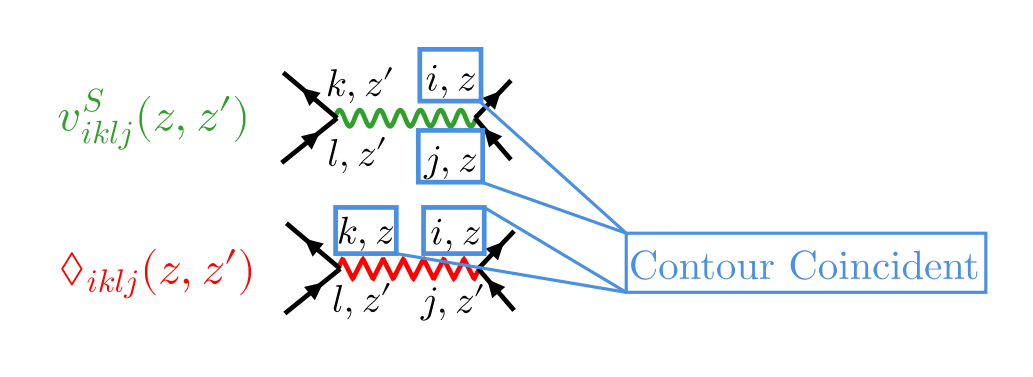
Scientists have developed a new theoretical framework for modelling complex quantum systems that incorporates both interactions and dissipation, achieving a unified approach to many-body perturbation theory for open systems. This work introduces a Keldysh-Lindblad formalism, employing novel diagrammatic rules to represent quasiparticle flows and fluctuations, thereby enabling a systematic and improvable treatment of correlated, driven, and dissipative systems. The method accurately captures the behaviour of systems interacting with their environment, a crucial aspect often neglected in traditional quantum calculations. The core of this breakthrough lies in the introduction of two new Feynman rules that simplify the evaluation of complex diagrams representing dissipative interactions.
These rules preserve the essential symmetries of closed-system theories while allowing for a compact and manageable description of open systems, meaning established numerical techniques can be readily applied to study dissipation and decoherence. Researchers demonstrate this by deriving dissipative versions of the second Born and GW approximations, identifying the physical meaning of the resulting self-energy components. Furthermore, the team proved that time-linear approximations to the full Kadanoff-Baym equations retain their structural integrity, allowing for efficient simulations of relaxation and decoherence dynamics. This is particularly important for understanding how quantum systems lose coherence, a key challenge in quantum computing and materials science. The framework introduces new interaction functions, including particle loss, gain, and scattering, which are incorporated into a symmetrized function alongside the conventional Coulomb interaction.
Dissipative Many-Body Perturbation Theory Demonstrated
This work presents a new many-body perturbation theory capable of describing systems that exchange energy and particles with their environment, while accurately accounting for interactions and correlations within the system itself. By combining the Lindblad formalism with a diagrammatic approach, researchers have developed a compact and systematically improvable method for calculating the behaviour of these ‘open’ quantum systems. Crucially, this framework preserves the mathematical structure of existing equations used to model closed quantum systems, meaning established numerical techniques can be readily applied to study dissipation and decoherence. The team demonstrated this approach by deriving dissipative versions of common approximations, identifying how particle fluctuations and flows contribute to the system’s self-energy, a key quantity determining its properties.
They found that, unlike traditional models, screening effects now incorporate fluctuations in particle number arising from interactions with the environment. This generalized formalism allows for the calculation of decoherence rates and energy dissipation directly from fundamental principles, potentially revealing complex interplay between coherent dynamics and dissipation. While the current work focuses on specific approximations, the framework is broadly applicable and opens avenues for incorporating more complex, higher-order interactions. The researchers acknowledge that future work will be needed to explore the behaviour of larger systems and fully capture the emergent behaviours arising from these interactions.
🗞 Many-Body Perturbation Theory for Driven Dissipative Quasiparticle Flows and Fluctuations
🧠 ArXiv: https://arxiv.org/abs/2510.19124