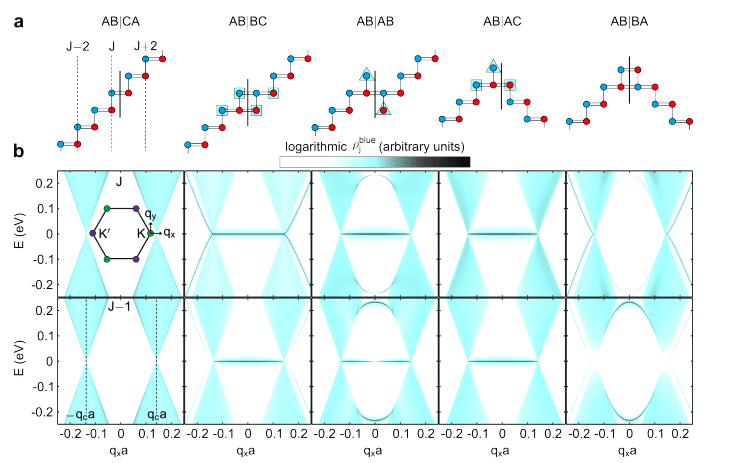
In their April 9, 2025, study titled Rhombohedral Graphite Junctions as a Platform for Continuous Tuning Between Topologically Trivial and Non-Trivial Electronic Phases, researchers Luke Soneji, Simon Crampin, and Marcin Mucha-Kruczynski demonstrate how sliding rhombohedral graphite crystals can transition between topological states, offering a platform to explore both trivial and non-trivial electronic phases.
The research proposes rhombohedral graphite junctions as a platform for transitioning between topologically trivial and non-trivial regimes. By sliding crystals relative to each other, both phases can be explored, with the emergence of topological states linked to atomic stacking symmetry at interfaces. This approach enables the manipulation of electronic topology without altering the chemical composition or lattice symmetry.
The field of quantum materials has seen remarkable progress, particularly in the study of layered materials like graphene and its derivatives. Trilayer graphene heterostructures have emerged as a promising platform for exploring novel electronic properties. This article delves into the innovative research on these systems, focusing on developing theoretical models to understand their electronic behaviour and the implications for quantum materials science.
The Tight-Binding Model for Trilayer Graphene
Applying a tight-binding model to describe the electronic structure of trilayer graphene heterostructures is at the heart of this research. This approach simplifies the complex interactions between atoms in the material by approximating the bonding and antibonding states, allowing researchers to predict how electrons behave within these systems. By considering the unique stacking configurations of trilayers, such as ABAB or ABC stacking, the model provides a framework for understanding interlayer coupling and its impact on electronic properties.
Interlayer Coupling and Valley-Dependent Behavior
One of the key findings of this research is the significant role played by interlayer coupling in determining the electronic characteristics of trilayer graphene. The interactions between adjacent layers lead to distinct energy bands susceptible to the relative orientation and displacement of the layers. This sensitivity gives rise to valley-dependent properties, where electrons in different regions of the Brillouin zone exhibit unique behaviours. Such properties hold great potential for applications in valleytronics, a field that seeks to exploit the valley degree of freedom for information processing.
Sliding Junctions and Local Density of States
The study also investigates the effects of sliding junctions, where misalignment between layers creates interfaces with novel electronic states. These junctions are shown to significantly influence the local density of states (LDOS), which describes the distribution of available energy levels at a given point in space. By analyzing how the LDOS varies across these interfaces, researchers gain insights into the localization and delocalization of electrons, as well as the emergence of topological states.
Extended Results and Rhombohedral Trilayers
Building on these observations, extended results demonstrate how stacking configurations, such as rhombohedral trilayers, further modulate the electronic properties. These findings highlight the importance of crystallographic orientation in determining the material’s behavior, offering new avenues for tuning its electronic structure through controlled synthesis and manipulation.
Implications for Quantum Materials Research
The implications of this research extend beyond trilayer graphene, providing a broader understanding of how interlayer interactions influence electronic properties in layered materials. By developing robust theoretical models and experimental techniques, researchers can explore similar phenomena in other quantum materials, paving the way for discovering new states of matter and innovative applications.
In conclusion, this work underscores the importance of combining theoretical modelling with experimental insights to unravel the complexities of quantum materials. As our understanding of trilayer graphene heterostructures grows, so does the potential for harnessing their unique properties in next-generation electronic devices.
👉 More information
🗞 Rhombohedral graphite junctions as a platform for continuous tuning between topologically trivial and non-trivial electronic phases
🧠 DOI: https://doi.org/10.48550/arXiv.2504.06759