This study, published in Physical Review Letters by researchers from JILA and NIST, explores how expanding atomic interactions beyond the conventional two-level system can enhance quantum entanglement. Traditional models often consider atoms as two-level systems—ground and excited states—where photons mediate interactions through dipole-dipole coupling. However, this study investigates multi-level atomic structures, particularly in strontium atoms, to unlock more complex quantum behaviors.
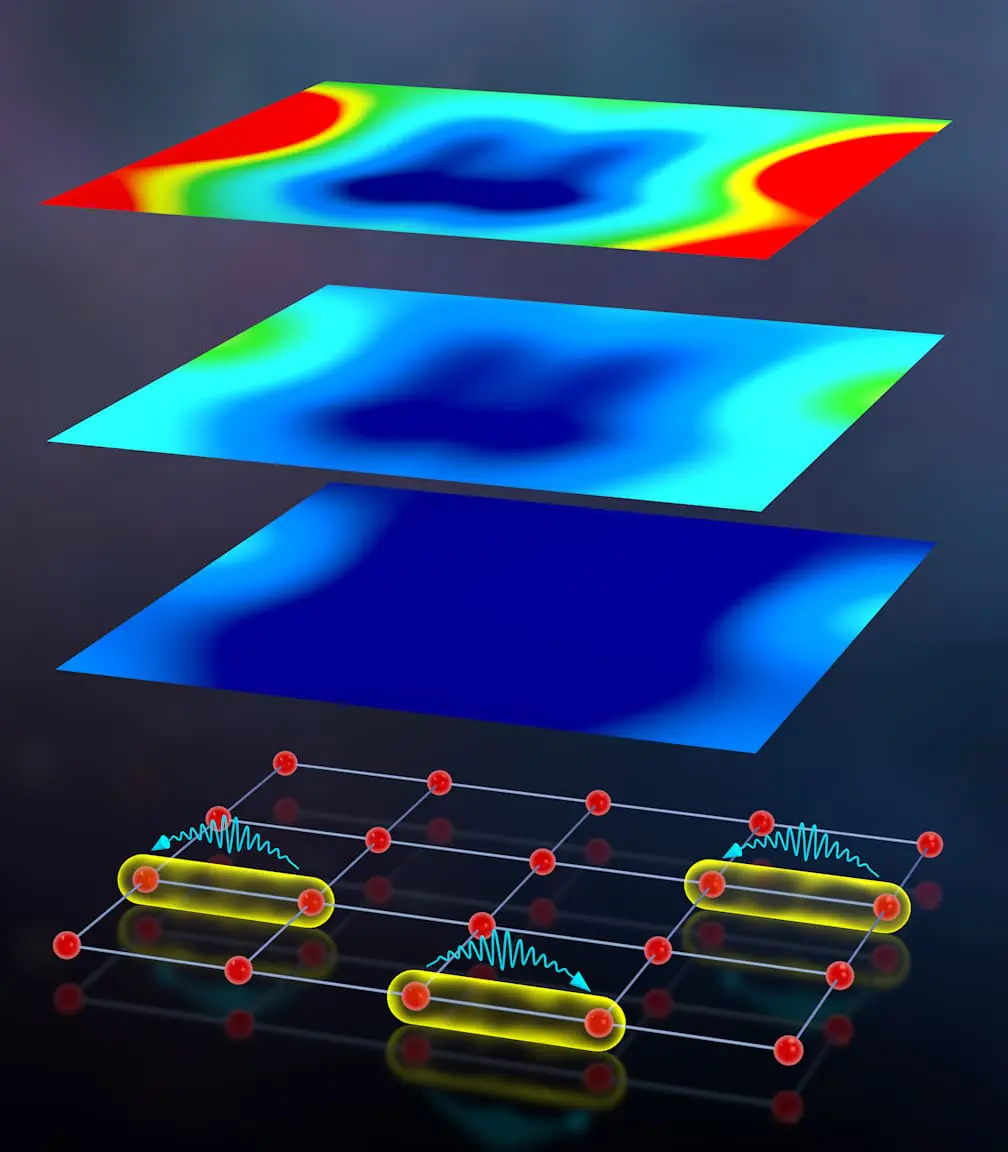
The researchers isolated four energy levels—two ground (or metastable) and two excited states—arranged in one-dimensional (1D) and two-dimensional (2D) optical lattices. By working with metastable states, which have much longer lifetimes than typical excited states, they demonstrated that entanglement can persist even after external laser excitation is turned off. This finding is crucial for quantum technologies, as stable entanglement is essential for computing and secure communications.
A key aspect of the study was the exploration of spin models, where entanglement manifests as spin squeezing—a property useful for quantum metrology. By carefully controlling photon polarization and propagation, the team was able to direct specific entangled spin-wave patterns within the atomic array.
Despite the promising results, the study also highlights computational challenges. The long-range dipole-dipole interactions create complex correlations that standard simulation techniques struggle to handle, particularly over extended time scales. As a result, the team is looking toward future studies involving larger atomic systems and additional photon-mediated interactions, such as those that occur in optical cavities or nanophotonic environments.
These findings open new possibilities for designing highly entangled, scalable quantum systems, bringing quantum technologies closer to practical applications. The research was supported by multiple institutions, including the NSF, NIST, and the Quantum Systems Accelerator.
The key findings of the study are:
- Entanglement growth: The researchers found that entanglement can grow between atoms in the system, even when they are not directly interacting with each other.
- Spin-squeezing: The team observed a specific type of entanglement called spin-squeezing, which is useful for quantum metrology and has potential applications in simulating many-body physics.
- Long-range interactions: The study highlighted the importance of long-range dipole-dipole interactions in generating entanglement between atoms.
- Scalability: The researchers demonstrated that their system can be scaled up to larger numbers of atoms, making it a promising candidate for quantum computing and information processing applications.
External Link: Click Here For More