Researchers demonstrated controlled manipulation of Majorana zero modes—potential qubits—within an altermagnet-superconductor heterostructure. By rotating the material’s magnetic orientation, they simulated quantum gate operations—including Z and CNOT—and established a scalable architecture for building complex quantum circuits utilising topological qubits.
The pursuit of robust quantum computation necessitates physical systems resilient to environmental noise. A promising avenue lies in topological qubits, leveraging exotic states of matter where information is encoded in the topology of the system, rather than in individual particles. Researchers at the University of Melbourne detail a novel heterostructure – combining an ‘altermagnetic’ material with a superconductor – capable of hosting and manipulating ‘Majorana zero modes’ (MZMs), quasiparticles theorised to function as robust qubits. By controlling the magnetic orientation within the altermagnet, they demonstrate the potential to braid these MZMs – a process that effectively performs quantum gate operations – and simulate basic quantum logic on a scalable platform. This work, presented in a paper by Themba Hodge, Eric Mascot, and Stephan Rachel, is titled ‘Altermagnet-Superconductor Heterostructure: a Scalable Platform for Braiding of Majorana Modes’.
Altermagnetic Heterostructures Facilitate Scalable Topological Quantum Computation
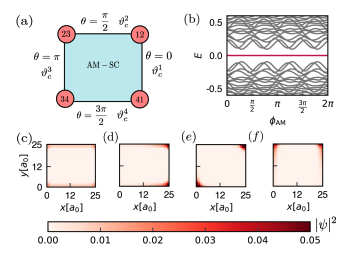
Recent investigations demonstrate the potential of altermagnetic materials to host and manipulate Majorana zero modes (MZMs), quasiparticles considered promising candidates for robust qubits. This work details heterostructures comprising an altermagnetic film coupled to a superconducting substrate, revealing a pathway towards scalable topological quantum computation. Researchers demonstrate the ability to harbour MZMs within these structures and to precisely control their position along the material’s topological boundary through manipulation of the altermagnetic Néel vector – the direction of its collective magnetic moments.
This research establishes a framework for realising topological quantum computation, integrating materials science, condensed matter theory, and quantum information processing. The combination of altermagnetic materials, superconducting proximity effects – where the properties of a superconductor induce quantum behaviour in a neighbouring material – and precise control over MZM position represents a significant step towards building fault-tolerant quantum computers capable of tackling complex computational problems.
The study highlights the inherent scalability of this architecture, readily lending itself to expansion and offering a viable route towards constructing multi-qubit systems essential for practical quantum computation. By leveraging the ability to precisely position and manipulate MZMs, this approach circumvents challenges associated with maintaining qubit coherence – a critical requirement for reliable quantum processing.
Researchers investigated the impact of material properties and device geometry on MZM performance, aiming to optimise the design for enhanced qubit coherence and gate fidelity. They explored different altermagnetic materials and superconducting substrates, seeking combinations that maximise the topological protection of MZMs and minimise decoherence effects. Topological protection refers to the inherent robustness of MZMs against local perturbations, crucial for maintaining quantum information. This work contributes to the development of robust and scalable quantum computing platforms.
The study demonstrates the feasibility of manipulating MZMs within altermagnetic-superconductor heterostructures, enabling the implementation of quantum gates and establishing a strong theoretical understanding of the underlying physics. Simulations confirm the potential for universal quantum computation using this platform, with the demonstrated Z and CNOT gates – fundamental operations in quantum computing – combined with the inherent topological protection of MZMs, suggesting a robust architecture for quantum information processing.
Researchers also addressed the challenges of fabricating and controlling these complex heterostructures, developing advanced nanofabrication techniques and control schemes. They explored methods for precisely patterning the altermagnetic material and superconducting substrate, creating high-quality interfaces that enhance MZM performance.
The research team acknowledges the importance of addressing potential sources of error and decoherence in these devices, developing strategies for mitigating their effects. They explore methods for shielding the MZMs from external noise and imperfections, improving their coherence time and gate fidelity.
The team plans to extend this research by exploring more complex device architectures and control schemes, aiming to create more powerful and versatile quantum computing platforms. They envision building multi-qubit systems based on MZMs, demonstrating the potential for solving complex computational problems that are beyond the reach of classical computers. This work promises to advance fields such as materials science, drug discovery, and artificial intelligence.
👉 More information
🗞 Altermagnet-Superconductor Heterostructure: a Scalable Platform for Braiding of Majorana Modes
🧠 DOI: https://doi.org/10.48550/arXiv.2506.08095