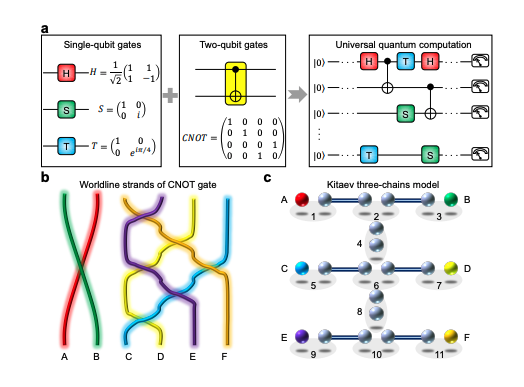
The pursuit of stable and reliable quantum computation receives a significant boost from new research demonstrating a highly accurate quantum gate using exotic particles called Majorana fermions. Jia-Kun Li and colleagues at the University of New South Wales, alongside Pachos, report the successful implementation of a CNOT gate, a fundamental operation in quantum computing, within a platform designed to simulate these elusive particles. The team achieves a fidelity exceeding 99.2 percent, a crucial step forward because Majorana fermions offer inherent resilience to the errors that plague conventional quantum bits. This breakthrough addresses a key obstacle in building scalable quantum computers and highlights the promise of this approach to achieving robust, high-fidelity quantum operations.
Photonic Simulation of Majorana Mode Exchange
This research details the experimental implementation of a topologically protected quantum computation scheme using photons to simulate Majorana zero modes. The researchers aimed to build a platform for fault-tolerant quantum computation by mimicking the behaviour of these exotic quasiparticles, crucial for topological quantum computation. Instead of physically realising Majorana modes, a significant materials science challenge, they simulate their behaviour using photons within a carefully designed photonic circuit. Key achievements include the successful simulation of Majorana exchange, a fundamental operation for topological quantum computation, achieved by manipulating the photons’ polarisation and spatial modes.
The simulation leverages the principles of topological protection, encoding quantum information in a way that is robust against local disturbances and noise. They also successfully demonstrated the generation and manipulation of Berry phases, crucial for implementing quantum gates in this scheme, and achieved a high degree of control over the photonic states. The photonic platform offers potential for scalability, making this approach promising for building larger and more complex quantum processors. This work provides a viable alternative to the challenging task of physically realising Majorana modes in materials and represents a significant step forward in the development of topological quantum computation. It showcases the potential of photonic platforms for implementing complex quantum algorithms and exploring new quantum computing paradigms. In essence, the paper demonstrates a proof-of-principle experiment that brings topological quantum computation closer to reality by leveraging the unique properties of photons to simulate exotic quasiparticles.
Majorana Braiding Achieves High-Fidelity CNOT Gate
Researchers have achieved a significant breakthrough in quantum computing by experimentally demonstrating a highly accurate CNOT gate using simulated Majorana zero modes on a photonic platform. This gate, a fundamental building block for all quantum computations, relies on encoding information in a way that is naturally resilient to errors and disturbances. The team implemented the gate by manipulating these simulated Majorana modes through a process called braiding, effectively entangling two logical qubits encoded within three specially designed chains. The core innovation lies in leveraging the unique properties of Majorana zero modes, which offer inherent topological protection against decoherence, a major obstacle in building stable quantum computers.
While complete topological protection wasn’t fully realised in this simulation, the method still exhibited remarkable robustness to common sources of noise, significantly improving gate performance. The results demonstrate a CNOT gate fidelity exceeding 0. 992, a level of accuracy that surpasses many current approaches and addresses a critical limitation in the development of scalable quantum computers. Achieving such high fidelity is crucial because even small error rates can quickly accumulate and render complex calculations unreliable. The use of a photonic platform further enhances the system, providing immunity to thermal noise and enabling precise control over the quantum states. By demonstrating a high-fidelity CNOT gate, the researchers have paved the way for more complex quantum algorithms and brought the prospect of practical, fault-tolerant quantum computation closer to reality.
Robust CNOT Gate with Simulated Majorana Modes
This research demonstrates the successful experimental realisation of a robust CNOT quantum gate using a platform that simulates Majorana zero modes. The team encoded logical qubits within these simulated modes and implemented the gate through both intra-chain and inter-chain braiding operations, achieving high-fidelity quantum state preparation and manipulation. The results show a CNOT gate fidelity exceeding 0. 992, representing a significant step forward in the field of topological quantum computing. The key finding is the inherent robustness of these topologically encoded quantum gates against noise and decoherence, common challenges in quantum computation.
This resilience stems from the properties of the Majorana zero modes and extends beyond conventional error correction techniques. While acknowledging that the current implementation does not offer complete topological protection, the observed stability represents a crucial proof of concept for building more reliable quantum systems. Future work will focus on scaling this system to multi-qubit operations and integrating additional quantum gates, paving the way for more complex quantum information processing tasks.
🗞 High-fidelity realisation of CNOT gate in Majorana-based optical platform
🧠 ArXiv: https://arxiv.org/abs/2508.14641