

Research demonstrates a connection between a one-dimensional spin model and p-wave superconductivity, revealing a topological phase transition characterised by Majorana fermions. Local spin observables and edge susceptibility identify this transition, with edge magnetisation acting as a topological invariant marker. Bipartite fluctuations correlate resonating valence bonds with charge fluctuations.
The behaviour of electrons in certain materials can give rise to exotic states of matter, including topological phases characterised by unusual surface properties and the potential for robust quantum computation. Recent research focuses on understanding how magnetic transitions influence the emergence of Majorana fermions, quasiparticles that are their own antiparticles and promising candidates for building topological qubits. Karyn Le Hur, Fan Yang, and Magali Korolev, from institutions including the CPHT, CNRS, Institut Polytechnique de Paris, and Stockholm University, investigate these transitions through the lens of spin models and their connection to p-wave superconductivity. Their work, entitled “Topological Signatures of Magnetic Phase Transitions with Majorana Fermions through Local Observables and Quantum Information”, details how local spin measurements and calculations of edge susceptibility can reveal the presence of a topological phase and characterise the associated Majorana fermions, potentially offering a route to their detection and manipulation in engineered systems such as optical lattices and circuits.
Recent investigations into a one-dimensional spin model reveal a connection between resonating valence bonds and a strong-coupling analogue of the Schrieffer-Su-Heeger model, a theoretical framework originally developed to describe conducting polymers. This system undergoes a quantum phase transition, a fundamental shift in its physical properties, and researchers are meticulously charting how the signatures of this transition appear in measurable local spin observables, quantities that characterise the magnetic state of individual atomic spins, and their derivatives. The observed behaviour closely parallels that found in p-wave superconducting wires, materials exhibiting superconductivity through a different mechanism than conventional materials.
The study confirms that the system’s behaviour aligns
The study confirms that the system’s behaviour aligns with a topological phase transition, a transition characterised by changes in the global properties of the system rather than local order. Evidence for this lies in the emergence of half-Skyrmions, topological defects representing localised disturbances in the spin texture. These defects, akin to knots in a material, are detectable through careful analysis of the aforementioned local spin observables. Crucially, local spin susceptibility, a measure of how easily the material becomes magnetised, exhibits a logarithmic divergence as the system nears the critical point of the transition, a hallmark of critical behaviour indicating a dramatic change in the system’s properties.
Researchers introduce a novel analytical method, termed “bipartite fluctuations”, to establish a clear link between the information encoded within resonating valence bonds—quantum superpositions of paired electron spins—and the charge fluctuations present in a p-wave superconductor. This connection highlights a fundamental unity between these seemingly disparate physical phenomena, suggesting a deeper underlying principle governs both.
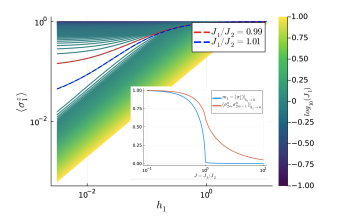
Calculations focus on the behaviour of local spin susceptibility, revealing the aforementioned logarithmic divergence near the critical point. This divergence correlates directly with the emergence of linear edge magnetization, a magnetisation that appears along the edges of the system, and is proportional to both the applied magnetic field and the logarithm of the difference between the coupling constants, parameters that determine the strength of interactions between spins. This suggests potential avenues for realising and engineering similar systems in platforms such as superconducting circuits and optical lattices, artificially created structures using light, opening doors for future research and potential technological applications.
Researchers demonstrate a direct correspondence between edge spin
Researchers demonstrate a direct correspondence between edge spin susceptibility and the metallic behaviour of Majorana fermions, exotic particles that are their own antiparticles, at the topological phase transition. They posit that edge spin magnetization, even under weak transverse magnetic fields, serves as a reliable indicator of the system’s topological invariant, a mathematical quantity that characterises the topological state of the system and remains unchanged under continuous deformations. This provides a potential method for identifying and characterising topological phases of matter.
🗞 Topological Signatures of Magnetic Phase Transitions with Majorana Fermions through Local Observables and Quantum Information
🧠 DOI: https://doi.org/10.48550/arXiv.2506.11731


