Unconventional magnets, materials exhibiting spin splitting without overall magnetism, are attracting considerable attention for their potential in novel electronic devices, and recent research sheds new light on how these materials conduct electricity. Neelanjan Chakraborti, Sudeep Kumar Ghosh, and colleagues at the Indian Institute of Technology, Kanpur, and the National Institute of Technology Silchar, demonstrate a previously unknown mechanism driving electrical current within these magnets, linked to the material’s underlying quantum geometry. The team reveals that a newly identified property, the Zeeman geometric tensor, generates a unique current that exists independently of conventional electrical effects, offering a new way to probe and control spin-split band structures. This discovery, relevant to materials like RuO₂, CrSb, and MnTe, provides a powerful framework for identifying and characterizing unconventional magnetic phases and opens exciting possibilities for designing future spintronic technologies.
Non-Collinear Magnetism and Crystal Symmetry Relationships
Recent research explores altermagnetism, a fascinating form of magnetism arising from specific crystal structures and unique spin arrangements. Unlike conventional magnets, altermagnetism features magnetic moments that aren’t aligned in the same direction, leading to unusual electronic properties and potential applications in advanced technologies. This field is gaining momentum due to its promise for novel spintronic devices, topological materials, and fundamental discoveries in physics. Investigations center on phenomena like the Anomalous Hall Effect and Planar Hall Effect, related to electron behavior and magnetic moment alignment.
A crucial aspect of this research is the role of Spin-Orbit Coupling and the potential for topological properties, alongside detailed studies of charge dynamics within these materials. Researchers also examine nonlinear transport effects, which could unlock new functionalities for spintronic applications. Current research focuses on materials like Rutile Oxide and those with Kagome lattice structures, employing sophisticated theoretical and computational approaches to predict material properties and understand the relationship between crystal structure and magnetism. Ongoing debates and challenges include determining the true nature of magnetism in Rutile Oxide and developing methods for controlling altermagnetic properties, crucial for realizing practical applications. The field is highly interdisciplinary, drawing on materials science, condensed matter physics, and theoretical modeling.
Calculating Intrinsic Gyrotropic Magnetic Current via ZQGT
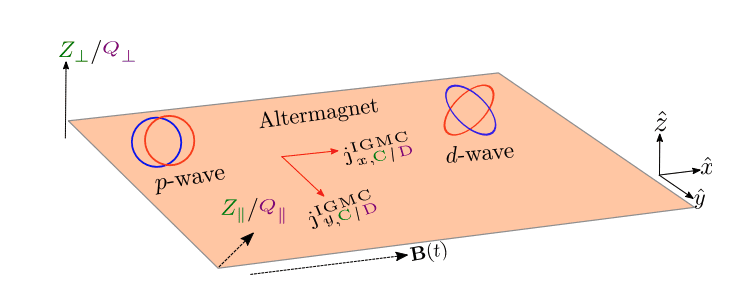
Researchers have developed a new method to study unconventional magnets, materials exhibiting zero net magnetization but possessing spin-dependent momentum. This approach utilizes the Zeeman quantum geometric tensor (ZQGT), a theoretical framework extending conventional quantum geometry to incorporate spin rotation, and allows for the description of spin responses to magnetic fields. The team aims to understand how this tensor influences transport properties and provides experimentally detectable signatures of the materials’ unique spin-split band structures. The core of this methodology involves calculating the intrinsic gyrotropic magnetic current (IGMC), a current generated within the material itself in response to an applied magnetic field.
This calculation relies on the ZQGT, which captures the complex structure of electron states and links it to the observed currents, explicitly incorporating the quantum metric and its interplay with spin rotations. By analyzing three distinct types of unconventional magnets, a d-wave altermagnet, a p-wave magnet, and a mixed d-wave altermagnet, the team revealed how the ZQGT generates both longitudinal and transverse currents, offering a unique contrast to conventional scenarios. This methodology allows for the prediction of displacement and conduction IGMCs, providing a powerful means of distinguishing unconventional magnetic phases and probing hidden spin-split band structures, offering a new pathway for the development of next-generation spintronic devices and quantum materials.
Intrinsic Gyrotropic Current from Quantum Geometry
Researchers have discovered a new form of quantum geometry, termed the Zeeman quantum geometric tensor (ZQGT), within unconventional magnets, materials exhibiting unusual magnetic properties and lacking net magnetization. This discovery reveals a previously unknown mechanism driving electrical currents based on the interplay between momentum and spin. Unlike conventional materials, these unconventional magnets exhibit currents generated by the material’s internal quantum properties, specifically how electron spin rotates as the electron moves. The ZQGT governs a unique type of current, an intrinsic gyrotropic magnetic current (IGMC), which is generated purely by the material’s internal structure and is independent of external forces.
Investigations into altermagnets and mixed altermagnets reveal that the resulting currents manifest in different ways, exhibiting longitudinal, transverse, or combined conduction and displacement patterns. Notably, this current generation persists even when other known mechanisms, based on Berry curvature, are absent, highlighting the ZQGT as a distinct and powerful driver of electrical conduction. Detailed analysis demonstrates that the ZQGT gives rise to both symmetric Berry curvature and antisymmetric Zeeman quantum metric, properties not found in standard quantum geometry. These unique characteristics arise from the way the ZQGT incorporates both electron momentum and spin rotation, and are linked to the material’s symmetry.
The strength of the ZQGT-driven currents is comparable to, and in some cases exceeds, those generated by conventional mechanisms, offering a potentially more efficient means of controlling electrical conduction. These findings have significant implications for the development of next-generation materials and devices. By understanding and harnessing the ZQGT, researchers can design materials with tailored electrical properties, potentially leading to more efficient and compact electronic devices, as well as novel spintronic applications that utilize electron spin rather than charge for information processing. The ability to distinguish between different unconventional magnetic phases based on the characteristics of the ZQGT also provides a new diagnostic tool for materials scientists.
Gyrotropic Current Links Magnetism and Symmetry
This work identifies a novel transport mechanism, the intrinsic gyrotropic magnetic current (IGMC), arising from the Zeeman geometric tensor (ZQGT) in unconventional magnets. Researchers demonstrate that the ZQGT governs a linear response to momentum translation and spin rotation, offering a new way to understand how these materials conduct electricity and magnetism. By analyzing altermagnets and unconventional p-wave magnets, the team established a direct connection between a material’s crystalline symmetry, its spin-split band structure, and its resulting transport properties. Notably, the predicted IGMC can persist even when conventional indicators of magnetism, such as Berry curvature, are absent, providing a valuable tool for probing materials where traditional methods fail. The study reveals that different magnetic configurations exhibit unique current components; for example, certain materials support transverse Hall-like currents, while others exhibit longitudinal displacement currents. These findings position the ZQGT as a powerful framework for diagnosing unconventional magnetic phases through their symmetry-determined transport signatures.
👉 More information
🗞 Intrinsic Linear Response from Zeeman Quantum Geometry in 2D Unconventional Magnets
🧠 ArXiv: https://arxiv.org/abs/2508.14745