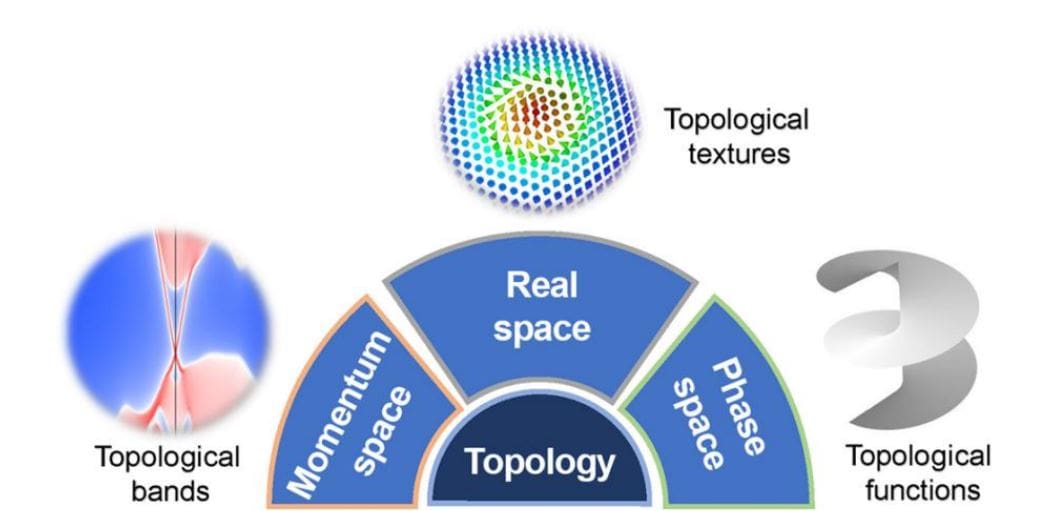
The interplay between magnetism and electricity defines a fascinating area of condensed matter physics, and recent work explores a novel topological framework for understanding this relationship. Ying Zhou, Ziwen Wang, Fan Wang, and colleagues investigate how this topology manifests in multiferroic materials, substances exhibiting both magnetic and electric ordering. Their research reveals a deeper understanding of magnetoelectric physics, uncovering behaviours such as unique surface effects and controllable switching driven by external fields. This achievement expands the possibilities for designing energy-efficient and precisely controlled devices for spintronics and advanced data storage, potentially revolutionising these technologies.
Multiferroics and Emergent Topological Magnetism
This research details investigations into multiferroic materials, focusing on their complex interplay of magnetic and electric properties and, increasingly, their connection to topological phenomena. Multiferroic materials simultaneously exhibit ferroelectric and ferromagnetic order, a relatively rare combination due to competing properties. These materials are highly sought after for potential applications in next-generation electronic devices, due to the possibility of controlling magnetism with electricity and vice versa. Researchers have extensively studied bismuth ferrite (BiFeO3), focusing on its complex magnetic structure, including cycloidal spin density waves, and how these waves contribute to its multiferroic behavior.
A growing area of research focuses on the connection between multiferroicity and topological properties, such as skyrmions and topological insulators. The team also explores how ferroelectric domain walls and other defects can exhibit topological properties. The research emphasizes the importance of cycloidal spin density waves in driving magnetoelectric coupling in BiFeO3 and related materials. Scientists are actively developing methods to manipulate magnetic order, such as switching magnetization or creating skyrmions, using electric fields. Applying strain to these materials proves a powerful technique for tuning their properties and enhancing multiferroic behavior. Creating heterostructures and thin films allows researchers to engineer new functionalities and improve the performance of multiferroic materials. The ongoing search for new multiferroic materials with stronger coupling and more desirable properties continues, alongside efforts to understand how topological properties can be harnessed to create new functionalities.
Simulating Magnetoelectric Free-Energy Landscapes and Switching
Scientists have advanced understanding of magnetoelectric topology in type-II multiferroics, revealing behaviors beyond traditional theories. This work investigates how magnetic and electric fields interact to create unique topological phenomena, potentially enabling energy-efficient devices for spintronics and information storage. Researchers developed a method for simulating the free-energy landscapes of these materials under varying magnetic and electric fields to understand the switching behavior of polarization. These simulations reveal that the system does not necessarily return to its original state after a single cycle of applied fields, but requires a sequential cycle to reset, a behavior mathematically described using concepts from Roman and Riemann surfaces.
The team meticulously mapped these free-energy landscapes, determining transition paths via a steepest descent method, ensuring a more accurate representation of the material’s response. Researchers classified three prototypical materials, TbMn3Cr4O12, GdI2 monolayer, and GdMn2O5, based on their crystalline symmetry, order parameters, and topological invariants, providing a framework for understanding each material’s behavior. This detailed analysis paves the way for designing new materials with tailored topological properties, potentially leading to breakthroughs in quantum computing and low-power electronics.
Topological Magnetoelectricity and Monolayer Stability Demonstrated
Recent research has revealed novel topological magnetoelectricity in certain materials, expanding understanding of how magnetism and electricity interact. Investigations into the GdI2 monolayer revealed a low exfoliation energy, suggesting it can be mechanically isolated for study. Each Gd²⁺ ion possesses a magnetic moment stabilized by magnetocrystalline anisotropy energy. The monolayer is a ferromagnetic insulator with a Curie temperature near room temperature and a band gap. Crucially, the orientation of the Gd spin breaks spatial inversion symmetry, inducing polarization that follows a specific relationship.
This establishes a fixed ratio between electric and magnetic winding numbers, meaning an odd number of electric field cycles causes a robust 180° magnetization flip, while an even number restores the original state. Dynamic simulations revealed that a constant electric field induces polarization reversal accompanied by a magnetization rotation, with a characteristic switching time. Alternating electric fields at low frequencies fully drive both polarization and spin, while higher frequencies result in only small oscillations. Applying a series of electric field pulses drives a full rotation of the spin after eight pulses, completing two cycles of polarization. These findings suggest that similar topological behaviors can emerge in other materials lacking inversion symmetry and exhibiting strong spin-orbit coupling, including 2H-MX2-type monolayers and VSi2N4 monolayers.
Multiferroics Exhibit Novel Topological Switching Behaviour
Recent research has revealed a new area of topological physics within multiferroic materials, expanding beyond traditional condensed matter concepts. Investigations into three distinct materials, TbMn3Cr4O12, GdI2 monolayer, and GdMn2O5, demonstrate that magnetoelectric switching can exhibit non-trivial behavior under periodic fields, resulting in topological phenomena. Specifically, these systems do not necessarily return to their original state after a single cycle of magnetic or electric field application, instead requiring a sequential cycle to reset, a behavior mathematically described using concepts like Roman and Riemann surfaces. This work establishes a conceptually new branch of topology-related physics, potentially offering opportunities for advanced device development. The ability to manipulate these topological magnetoelectric effects could lead to quantum computing devices that guarantee quantized and dissipationless switching of states, crucial for low-power and robust electronics, and transformative information storage technologies. Future research will focus on innovative materials design, including exploring ferromagnetic compounds, engineering heterostructures, and employing computational screening, to achieve room-temperature multiferroics with robust topological magnetoelectric effects.
👉 More information
🗞 Magnetoelectric topology: the rope weaving in parameter space
🧠 ArXiv: https://arxiv.org/abs/2511.23054