Magnetic skyrmions, nanoscale swirling magnetic textures, represent a potentially revolutionary technology for future data storage and processing, and scientists are actively seeking ways to control and stabilize these structures. Sabri Koraltan, Joe Sunny, and Emily Darwin, along with colleagues at their respective institutions, now demonstrate a novel approach to skyrmion formation by investigating magnetic films deposited on curved surfaces. Their work reveals that these curvilinear films exhibit distinct magnetic behaviour compared to conventional planar films, forming spiraling stripe states that can be readily transformed into individual, metastable skyrmions using localized magnetic fields. This achievement offers an accessible platform for studying the combined effects of interfacial and curvature-induced magnetic interactions, and importantly, paves the way for writing and controlling skyrmions on complex three-dimensional magnetic structures.
Curved Surfaces Control Skyrmion Nucleation
Researchers investigate the creation of magnetic skyrmions, nanoscale swirling magnetic textures with potential applications in data storage and processing. The team focuses on inducing these skyrmions on surfaces with curved geometries, a departure from traditional planar studies, to explore how geometry influences their formation and stability. They employ advanced techniques, including micro-focused Brillouin light scattering and magnetometry, to observe and characterise the skyrmion nucleation process. The method involves applying local magnetic fields using a scanning probe tip to overcome energy barriers and initiate skyrmion formation on the curvilinear surfaces.
The study demonstrates that the curvature of the surface significantly alters the critical field required for skyrmion nucleation, reducing it compared to flat surfaces. This reduction in the critical field arises from the curvature-induced modification of the magnetic anisotropy and the resulting decrease in the energy needed to form a skyrmion. Researchers observe that skyrmions preferentially nucleate at specific locations on the curved surface, dictated by the interplay between the applied magnetic field, the surface geometry, and the intrinsic magnetic properties of the material. The team achieves controlled nucleation of single skyrmions and demonstrates the ability to manipulate their position and density by adjusting the applied field and the surface curvature. This work contributes a fundamental understanding of skyrmion nucleation on curved geometries, paving the way for the design of novel magnetic devices with enhanced performance and functionality. Researchers anticipate that these results will inspire new approaches to skyrmion-based technologies and suggest that the principles established in this study can be extended to other curved magnetic nanostructures.
Skyrmions and Complex 3D Magnetic Textures
Current research focuses on nanomagnetism, particularly exploring skyrmions and three-dimensional magnetic structures. Skyrmions, topologically protected magnetic textures, are investigated for potential applications in data storage and spintronics. Studies cover methods for creating, deleting, and moving skyrmions using magnetic field gradients and engineered nanostructures. Researchers also investigate higher-order skyrmions and explore the stability and interactions of skyrmions with each other and with material defects. A significant focus lies on confining and controlling skyrmions within nanoscale geometries, such as nanowires and nanodisks.
Alongside skyrmion research, scientists are actively creating and characterizing three-dimensional magnetic structures, moving beyond traditional planar geometries. This includes developing techniques to build complex 3D magnetic architectures and using advanced methods like X-ray microscopy and magnetic force microscopy to probe their magnetic properties. Researchers are investigating novel magnetic textures in 3D, such as Bloch points and high-order vorticity structures. Crucially, nanofabrication techniques, including nanocap arrays and lithographic methods, are employed to create the necessary structures for these investigations.
Scientists are working to precisely control the number and spatial arrangement of skyrmions within nanostructures and exploiting bistable magnetic states for potential memory applications. Understanding how curvature and topology influence magnetic properties and skyrmion behaviour is a key focus. Scientists are creating magnetic textures that exist in free space and developing methods to reliably create skyrmions at specific locations. The ultimate goal is to design 3D magnetic structures with tailored properties for spintronic devices, utilizing advanced microscopy techniques to visualize and analyse nanoscale magnetic structures. Ongoing efforts aim to define the future directions and challenges in the field of 3D nanomagnetism.
Curved Films Host and Control Skyrmions
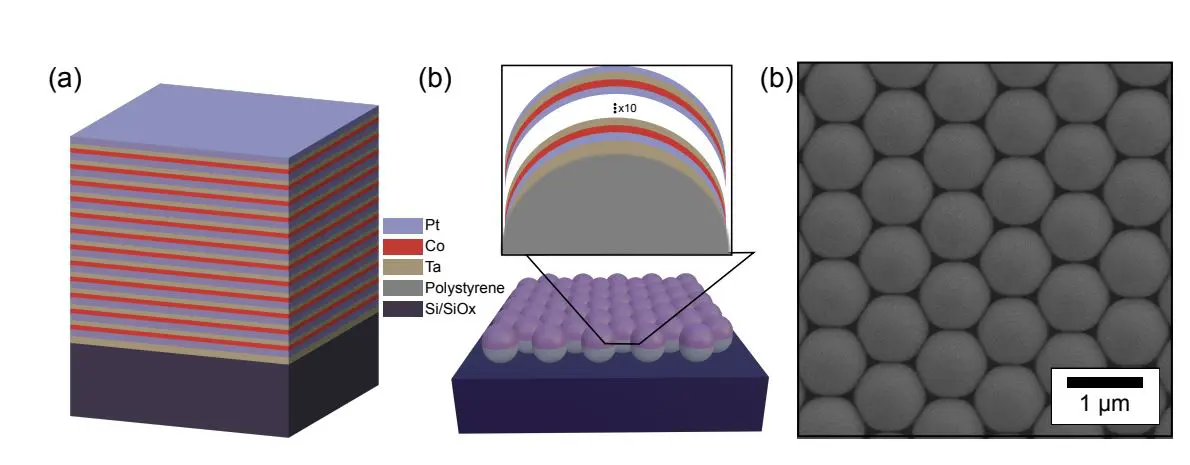
Researchers have demonstrated the formation of magnetic skyrmions on curved magnetic films, offering a novel platform for studying and manipulating these nanoscale spin textures. By fabricating multilayer magnetic films on self-assembled polystyrene particles, the team observed distinct magnetic behaviour compared to planar films, specifically the emergence of spiraling three-dimensional stripe domains. Importantly, these stripe domains could be induced to rupture into individual, metastable skyrmions through the application of a local magnetic field from a magnetic force microscope tip. This process demonstrates a pathway to create and position single skyrmions on curved surfaces, potentially enabling new approaches to magnetic memory and logic.
The study reveals that while the curved films do not spontaneously form skyrmions under an applied field, they provide an accessible means of stabilizing them using external stimuli. Researchers acknowledge that achieving full control over skyrmion formation remains a challenge, but believe this curvilinear platform holds promise for unconventional computing schemes, where the system’s nonlinear magnetic response could mimic biological synapses. Future work will focus on improving control over skyrmion nucleation and exploring the interplay between interfacial and curvature-induced magnetic interactions, ultimately advancing the understanding and application of these nanoscale spin textures.
🗞 Nucleation of magnetic skyrmions on curvilinear surfaces using local magnetic fields
🧠 ArXiv: https://arxiv.org/abs/2511.22557