The ability to control and access normally hidden states within materials represents a significant challenge in modern physics, yet unlocking these ‘dark excitons’ is crucial for developing advanced technologies that manipulate information and energy. Sophie Bork, Richard Leven, and Vincent Wirsdörfer, from TU Dortmund University, along with Alessandro Ferretti from Politecnico di Milano and Rafael R. Rojas-Lopez and Mattia Benini from TU Dortmund University, now demonstrate a method for directly observing and controlling these elusive states. Their research reveals that coupling excitons with magnons, quantum units of spin, provides a pathway to access dark excitons within the antiferromagnetic material CrSBr, a breakthrough previously hindered by the states’ inherent invisibility to conventional optical techniques. This discovery establishes a general principle whereby magnetic order enables control over dark excitons, paving the way for the creation of novel hybrid platforms capable of converting microwave signals into optical ones and vice versa.
Dark Excitons Control Magnetism Indirectly
This research presents a comprehensive investigation into the interplay between light, magnetism, and quantum particles within a two-dimensional material. The study demonstrates a strong connection between dark excitons, bound pairs of electrons and holes that do not directly absorb light, and magnons, collective excitations of spin. This coupling allows for the indirect optical control of magnetic properties, opening new avenues for manipulating materials with light and enhancing their sensitivity to external stimuli with potential implications for advanced technologies. The work provides fundamental insights into the behaviour of light, excitons, and magnetism in two-dimensional materials, potentially leading to the development of novel spintronic devices and components for quantum information processing.
Two-dimensional materials, such as CrSBr, possess unique electronic and optical characteristics due to their atomic-scale thickness. Excitons form when a material absorbs light, creating an electron-hole pair, while magnons represent quantized spin waves, representing collective excitations of magnetic moments. This research focuses on opto-magnetics, the interaction between light and magnetism. The study employed ultrafast spectroscopy, using extremely short pulses of light to probe the dynamics of excitons and magnons. Pump-probe spectroscopy excites the material with one pulse and measures changes with a second, while low-temperature measurements minimize thermal noise.
Magnetic fields were applied to tune the material’s magnetic properties, and polarization-resolved spectroscopy analyzed the polarization of light to gain information about the orientation of excitons and magnons. Theoretical modeling supports the experimental results and provides a deeper understanding of the underlying physics. Researchers observed clear changes in the material’s optical response when both excitons and magnons were excited, indicating a strong interaction. They demonstrated that energy can be transferred between excitons and magnons, significantly enhancing magneto-optical effects, meaning the material’s optical properties are more strongly affected by magnetic fields.
The observed effects depend on the polarization of light, providing further evidence for the coupling mechanism. Theoretical calculations confirm the experimental findings and provide a detailed understanding of the coupling process. The ability to control magnetism with light could lead to new spintronic devices with improved performance and functionality. The coupling between excitons and magnons could be used to create qubits for quantum information processing, and the enhanced magneto-optical effects could be used to develop highly sensitive opto-magnetic sensors. This work opens up new avenues for fundamental research into the interplay between light, excitons, and magnetism in two-dimensional materials, guiding the design of new materials with tailored opto-magnetic properties.
Femtosecond Reflectivity Probes Exciton-Magnon Coupling in CrSBr
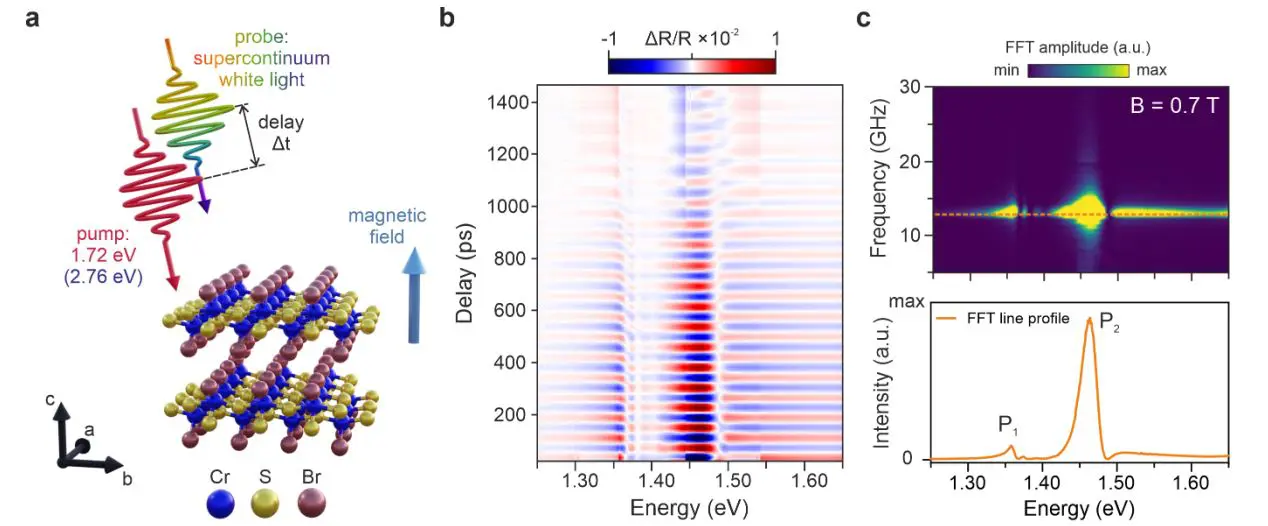
This study pioneered a femtosecond reflectivity technique to investigate exciton-magnon coupling in the antiferromagnetic material CrSBr, enabling access to previously hidden dark excitons. Researchers employed a broadband supercontinuum probe beam and a pump beam tuned to both near-resonant and high-energy conditions, maintaining constant fluence. This allowed for probing the material under different excitation conditions while maximizing sensitivity to anisotropic optical responses by aligning pump and probe polarizations. Transient reflectivity dynamics were recorded across magnetic fields, and incoherent background subtraction revealed clear oscillations.
Fast Fourier transform analysis consistently identified a dominant frequency of 12. 74GHz, with intensity maxima appearing near 1. 36 eV and 1. 46 eV. Detailed analysis revealed two distinct peaks, demonstrating broad coupling between magnons and excitonic states.
The team mapped the magnetic field dependence of this mode, observing a systematic decrease in oscillation frequency with increasing field and confirming its identification as an in-phase magnon. Researchers examined the phase behaviour of the transient signal to further characterize the observed resonances. A π-phase change was identified at 1. 368 eV, confirming the assignment to the Wannier exciton of CrSBr. Critically, the 1. 46 eV feature also exhibited a π-phase shift, providing compelling evidence for its excitonic origin and establishing it as a dark exciton, consistent with recent resonant inelastic x-ray scattering results. This phase shift arises from the coherent modulation of a discrete optical transition by the magnon, a key innovation of the study’s methodology.
Dark Excitons Revealed Through Magnon Coupling
Scientists have achieved optical access to dark excitons within the antiferromagnetic material CrSBr, unlocking new possibilities for manipulating information in solid-state materials. The research demonstrates that coupling excitons and magnons provides a pathway to observe and control these typically hidden states. Broadband femtosecond reflectivity measurements revealed a distinct dark exciton at 1. 46 eV, a state absent in conventional static optical spectra but made visible through its coherent interaction with a 12. 74GHz magnon.
Experiments involved directing a pump beam at the CrSBr crystal, with photon energies tuned to both near-resonant and high-energy regimes, while monitoring the reflected probe beam across a broad spectrum. Analysis of the reflected signal revealed clear oscillations, with enhanced amplitudes at 1. 36 eV and, crucially, at 1. 46 eV, confirming the presence of the dark exciton. Fast Fourier transform analysis of the oscillatory data identified a dominant frequency of 12. 74GHz with minimal energy dispersion, pinpointing the coherent hybridization between the exciton and magnon. Further investigation demonstrated that high-photon-energy excitation strongly renormalizes.
🗞 Magnetic Order Unlocks Optical Access to Dark Excitons in CrSBr
🧠 ArXiv: https://arxiv.org/abs/2511.20268