Superconducting qubits represent a leading technology in the pursuit of practical quantum computation, and recent advances have pushed their performance beyond critical error-correction thresholds. Chen-Hsun, alongside colleagues at Delft University of Technology, investigates a significant challenge to scaling these systems: unwanted interactions between the control lines used to tune qubit properties. The team demonstrates that closely packed control lines induce magnetic crosstalk, subtly altering qubit frequencies and diminishing the precision of quantum gate operations. By carefully characterizing these interactions and developing a method to digitally compensate for them, the researchers achieve a dramatic reduction in crosstalk, from approximately 0. 57% to just 0. 013%, effectively restoring control over the qubits and paving the way for larger, more reliable superconducting processors. This advance represents a crucial step towards building quantum computers capable of tackling complex computational problems.
Tunable Couplers Enhance Qubit Control and Fidelity
Superconducting qubits are rapidly advancing as a platform for quantum computing, achieving increasingly complex operations and exceeding key thresholds for error correction. A crucial element driving this progress is the development of tunable couplers, which allow researchers to dynamically control the interactions between qubits. This precise control is essential for implementing complex quantum algorithms and building adaptable quantum systems, representing a significant step towards practical quantum computers. Continued advancements in qubit control and connectivity are vital for scaling up quantum processors and unlocking the full potential of quantum information processing.
Flux Crosstalk Mitigation and High Fidelity Gates
Recent research focuses on achieving extremely precise control over superconducting qubits to perform complex quantum computations, requiring the minimization of errors from various sources. A significant challenge is flux crosstalk, unwanted interactions between qubits caused by magnetic fields leaking from control lines. This crosstalk introduces errors, particularly in larger qubit arrays, and necessitates sophisticated calibration procedures to characterize and correct for systematic errors. The use of tunable couplers is a key strategy for implementing gates and controlling qubit connectivity.
Crosstalk Cancellation Enables Scalable Superconducting Qubits
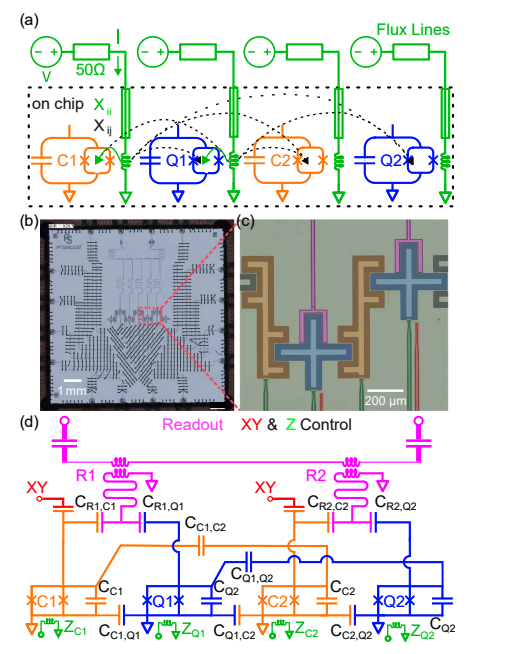
Scaling Quantum Computing Through Crosstalk Cancellation Superconducting qubits offer a promising path towards powerful quantum computers. A key component is the tunable coupler, which precisely controls qubit interactions and enhances gate fidelity. However, increasing the number of qubits and couplers on a single chip introduces a challenge: magnetic flux crosstalk. This occurs when controlling one qubit or coupler inadvertently affects neighboring elements, degrading performance and hindering accurate calibration. Recent research demonstrates a method for characterizing and suppressing this flux crosstalk in a multi-qubit-coupler chip.
The team developed a technique, termed “Multi-Z-Line Control”, that precisely measures unwanted frequency shifts caused by crosstalk between control lines. By constructing a “cancellation matrix” based on these measurements, they were able to compensate for the crosstalk, reducing it from a substantial 56. 5 parts per million to an astonishingly low 0. 13 parts per million, approaching the level of statistical error. This level of crosstalk suppression directly impacts the performance of quantum gates, specifically the CZ SWAP gate, resulting in a symmetrical operation unaffected by flux bias. This near-zero crosstalk represents a significant step towards building larger, more reliable superconducting quantum processors, paving the way for more complex and powerful quantum algorithms.
Crosstalk Cancellation Enables High Fidelity Gates
This research successfully characterizes and mitigates magnetic flux crosstalk in a superconducting processor. Unwanted interactions between control lines, which degrade qubit performance, can be substantially reduced from 56. 5 permille to 0. 13 permille, approaching the level of statistical error. This was achieved through the development of a cancellation matrix, which precisely compensates for non-local flux effects, enabling independent control of each qubit and coupler. The effectiveness of this approach is confirmed by improved fidelity in two-qubit gate operations, specifically the CZ SWAP measurement, which exhibited a symmetrical response after compensation. These results demonstrate the potential for scaling superconducting processors by minimizing interference between control lines, a crucial step towards building larger and more reliable quantum computers.
🗞 Characterizing and Mitigating Flux Crosstalk in Superconducting Qubits-Couplers System
🧠 ArXiv: https://arxiv.org/abs/2508.03434