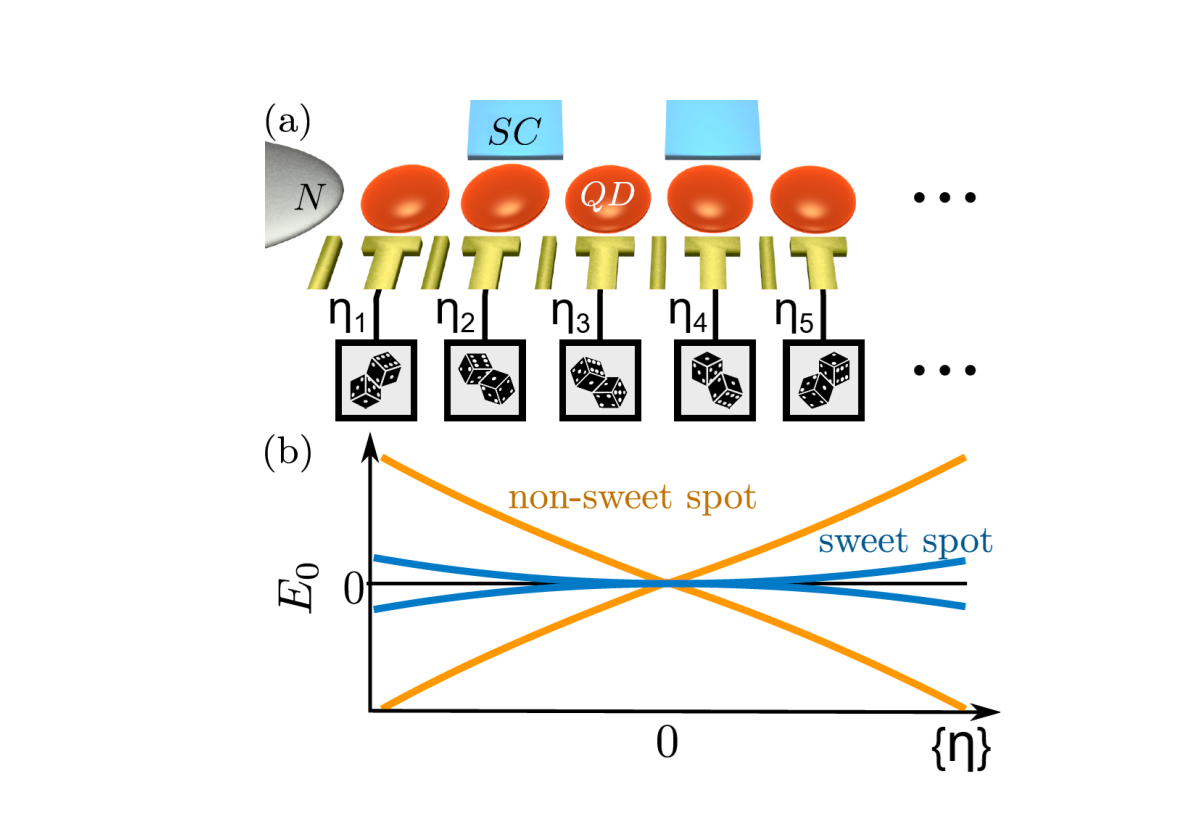
Quantum systems hold immense promise for future technologies, but maintaining their delicate states in the face of environmental noise remains a significant challenge. Rodrigo A. Dourado, Nicolás Martínez-Valero, Jacob Benestad, and colleagues demonstrate a novel machine-learning technique to overcome this obstacle by actively seeking out configurations inherently resistant to disruption. The team’s method involves intentionally introducing noise into a quantum system and then using an algorithm to identify the settings that best preserve its stability, effectively ‘tuning’ it to a protected state. This approach, illustrated using short quantum dot-based chains, successfully converges to configurations exhibiting well-separated Majorana bound states, and importantly, proves robust even when subjected to realistic imperfections and variations in system parameters, offering a reliable pathway towards building more resilient quantum devices.
Majorana Qubits in Topological Superconductors
Scientists are actively investigating Majorana zero modes, exotic quasiparticles with the potential to revolutionize quantum computing. These particles, predicted to exist in topological superconductors, offer inherent protection against decoherence, a major obstacle in building stable qubits. A key platform for realizing these topological qubits is the Kitaev chain, a one-dimensional system that, under specific conditions, hosts Majorana zero modes at its ends. Researchers are focused on understanding and controlling these systems to unlock their potential for quantum information processing. The strength of a Majorana zero mode is quantified by its Majorana polarization, a measure of how closely it resembles a true Majorana particle.
Achieving high Majorana polarization is crucial for reliable qubit operation. While strictly topological superconductors are ideal, scientists also explore “poor man’s Majoranas,” emulated in more readily accessible systems. Current research focuses on creating and characterizing these systems, and developing methods to control and manipulate the Majorana modes they host. Significant effort is dedicated to building Kitaev chains using quantum dots coupled to superconductors. This approach offers a balance between controllability and feasibility.
Researchers are scaling up these chains beyond simple two-site configurations, aiming to create more complex systems with multiple qubits. Recent advancements include the realization and characterization of three-site chains, offering increased flexibility for qubit manipulation. Controlling the superconducting phase of each component in the chain is also proving vital for creating robust Majorana modes. Characterizing Majorana modes involves sophisticated measurements of their properties. Tunneling spectroscopy probes the electronic structure of Kitaev chains, while gate reflectometry measures the charge state of quantum dots.
Researchers are refining these techniques and developing new methods, such as generalized Majorana polarization measurements, to better understand and optimize the performance of these systems. Manipulating Majorana modes is also a key focus, with scientists exploring the use of microwave or voltage pulses to perform quantum operations. A crucial step towards building functional qubits is the ability to measure the parity, whether even or odd, of the Majorana modes. Achieving single-shot parity readout remains a major goal. Precise control over the phase of the superconducting coupling between quantum dots is also essential for qubit manipulation.
To improve performance, scientists employ optimization algorithms to tune experimental parameters and maximize Majorana polarization. Identifying “sweet spots” in parameter space, where the Majorana modes are most robust, is a key area of investigation. Current research heavily emphasizes scaling up to multi-site Kitaev chains, improving Majorana localization and coherence, and developing advanced characterization techniques. Researchers are also implementing and optimizing qubit control schemes. The ultimate goal is to build a scalable and fault-tolerant quantum computer based on the unique properties of Majorana zero modes, despite challenges related to fabrication complexity, decoherence, and scalability.
Tuning Kitaev Chains With Machine Learning
Scientists have developed a novel machine-learning method for identifying and tuning to protected quantum states, focusing on systems susceptible to noise. This approach directly targets noise resilience as a tuning metric, expecting broad applicability across various quantum platforms. The team investigated short quantum dot-based Kitaev chains, subjecting them to random fluctuations in parameters to simulate realistic experimental conditions. The covariance matrix adaptation evolutionary strategy (CMA-ES) was employed to minimize the typical ground state splitting of the Kitaev chain, driving the system towards a protected configuration featuring well-separated Majorana bound states.
This involved injecting local noise, represented as fluctuations in quantum dot levels, while the CMA-ES algorithm searched for optimal parameter configurations. The resulting energy splitting served as a loss function, guiding the optimization process towards stable, protected states. Researchers rigorously tested this method, considering factors like finite Zeeman fields, electron-electron repulsion, asymmetric couplings, and chain length variations. This comprehensive testing ensured the method’s reliability across a range of experimental scenarios. The approach successfully identified configurations where Majorana bound states were localized at opposite ends of the chain, exhibiting zero energy and separation from higher excited states, confirming the effectiveness of noise resilience as a direct tuning metric for protected states.
Machine Learning Finds Robust Quantum States
Scientists demonstrate a reliable method for tuning quantum systems to protected states, crucial for building robust quantum computers. This work focuses on Kitaev chains, a promising platform for hosting Majorana bound states, which are inherently resistant to noise. The team developed a machine-learning algorithm that actively searches for configurations most resilient to disturbances, effectively pinpointing “sweet spots” where these protected states thrive. The method involves injecting noise into the system and directly seeking configurations that minimize the impact of this noise on the ground state splitting, a key indicator of protection.
Researchers applied this technique to short quantum dot-based Kitaev chains, subjecting them to random fluctuations in parameters. The covariance matrix adaptation evolutionary strategy was employed to minimize the typical ground state splitting, driving the system towards configurations featuring well-separated Majorana bound states. Experiments reveal that the algorithm successfully identifies sweet spots even in complex scenarios, including finite Zeeman fields, electron-electron repulsion, and asymmetric couplings. Results demonstrate that the algorithm consistently converges on configurations exhibiting both zero energy splitting and high polarization, confirming the presence of well-localized Majorana bound states.
Across 50 independent optimization runs, the median energy splitting consistently approached zero, while the Majorana polarization remained high, indicating robust protection against parameter fluctuations. Further analysis shows a clear correlation between minimized energy splitting, high Majorana polarization, and a significant excitation gap, confirming the stability of the protected states. The team verified the robustness of the method by varying the length of the Kitaev chain and monitoring the resulting sweet spot characteristics. This automated tuning protocol delivers a powerful tool for realizing and controlling protected quantum states.
Protected States Found Via Noise Minimisation
Researchers have developed a novel method for identifying and tuning to protected quantum states, which are inherently more resilient to noise and disturbances. This approach centres on directly probing a system’s robustness by introducing noise and searching for configurations that minimise the impact of these disturbances. The team successfully demonstrated this technique using short chains of quantum dots designed to mimic a Kitaev system, a model known for hosting Majorana bound states, which are promising for fault-tolerant quantum computation. By minimising the energy splitting between ground states under random fluctuations, the method consistently converged to configurations exhibiting well-defined, protected states.
The robustness of this technique was confirmed through tests incorporating factors such as electron-electron interactions, variations in chain length, and asymmetric couplings. Importantly, the method relies on measuring only the ground-state energy splitting, a parameter readily accessible through existing experimental techniques like conductance spectroscopy or Ramsey-type experiments. While the initial demonstration focused on quantum dot-based systems, the researchers emphasize the general applicability of this approach to identifying protected states in various quantum platforms.
🗞 Machine-learned tuning to protected states by probing noise resilience
🧠 ArXiv: https://arxiv.org/abs/2511.01531