

The fundamental nature of spacetime remains one of the great unsolved problems in physics, and now Jan Ambjorn, Zbigniew Drogosz, and Jakub Gizbert-Studnicki, along with colleagues from institutions including the Niels Bohr Institute and Jagiellonian University, are pioneering a new approach to understanding its quantum properties. The team investigates how machine learning algorithms can analyse complex data generated by simulations of four-dimensional spacetime, specifically focusing on identifying transitions between different geometric phases. Their work demonstrates that these automated algorithms not only successfully recognise these transitions, but often surpass the accuracy of traditional methods relying on established physical parameters, offering a powerful new tool for exploring the quantum structure of spacetime and potentially unlocking deeper insights into gravity itself.
Machine Learning Identifies Quantum Gravity Phase Transitions
Scientists have achieved remarkable success in identifying phase transitions within complex, dynamically generated spacetime geometries using automated machine learning algorithms. The work centers on Causal Dynamical Triangulations (CDT), a method for simulating quantum gravity, and investigates how machine learning can recognise transitions between different geometric phases. Researchers performed Monte Carlo simulations, meticulously scanning parameter spaces to identify four distinct phases, separated by both first and higher-order phase transitions. To test the capabilities of machine learning, the team generated data characterizing quantum spacetime geometries for a fixed spatial toroidal topology and a fixed number of spatial slices, and repeated measurements across a range of lattice volumes to assess volume dependence.
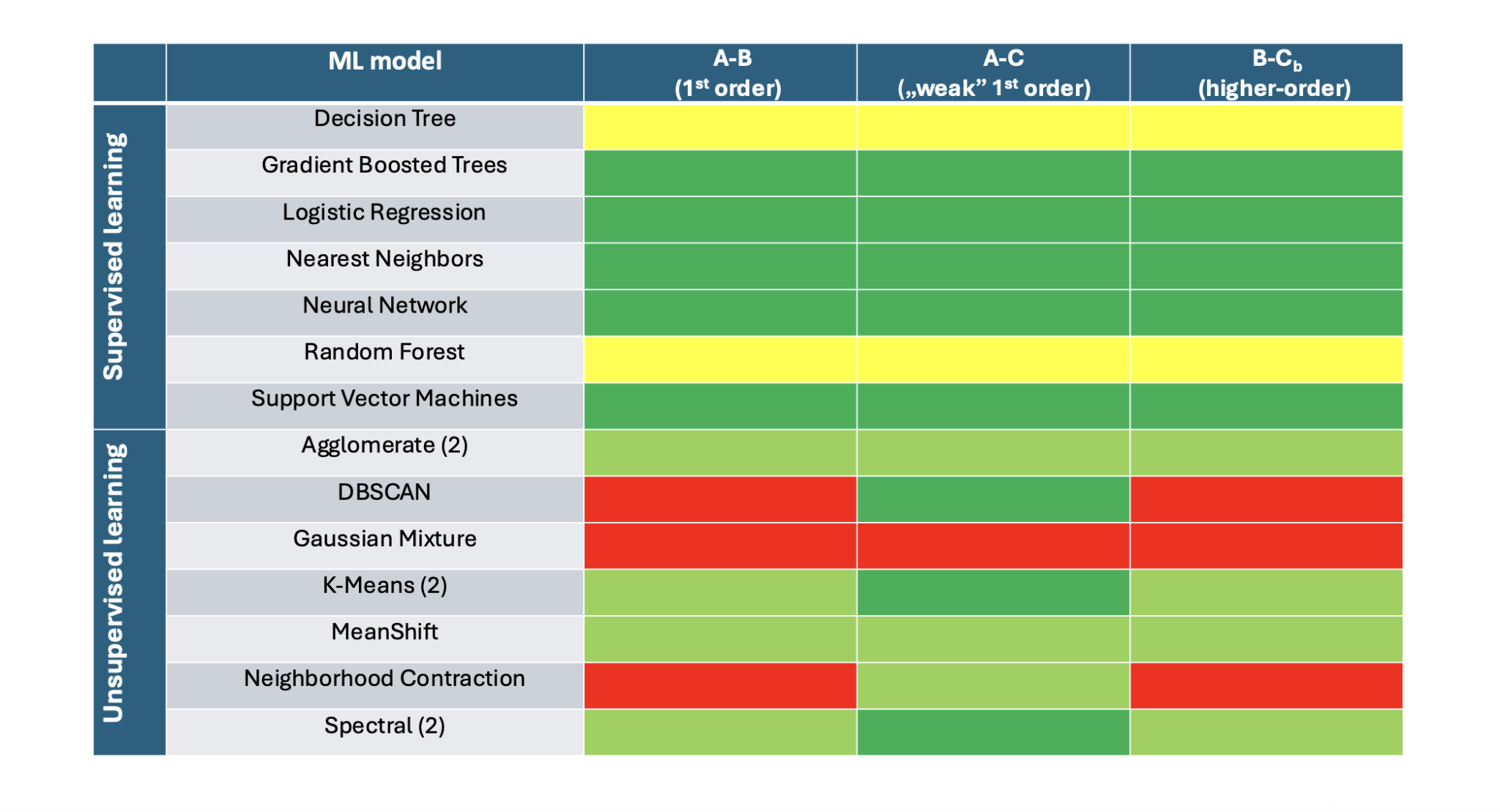
A set of 30 features, characterizing purely geometric properties of the triangulations, served as input for the machine learning algorithms, excluding any information about simulation parameters. The team tested fourteen distinct machine learning models, encompassing both supervised and unsupervised approaches, achieving high accuracy, greater than 99. 9%, in classifying data from three specific phase transitions. For example, the models successfully identified phase transition points where the probability of belonging to a given phase changed sharply, coinciding with a peak in the susceptibility of the classification probability.
These results demonstrate that machine learning algorithms can effectively pinpoint phase transitions in complex quantum gravity simulations, offering a powerful new tool for exploring the fundamental nature of spacetime. While unsupervised learning models showed promise, particularly those configured to identify two clusters, some exhibited a tendency to over-segment the data, creating an excessive number of clusters that did not accurately reflect the underlying phases. The authors acknowledge that further investigation is needed to optimise unsupervised learning approaches and refine their ability to accurately delineate phases. Future research will focus on improving the performance of these models and exploring their broader applicability to other lattice quantum gravity approaches and lattice quantum field theories. This work establishes a promising foundation for utilising machine learning as a powerful tool for analysing complex systems in theoretical physics.
👉 More information
🗞 Machine learning in lattice quantum gravity
🧠 ArXiv: https://arxiv.org/abs/2510.02159


