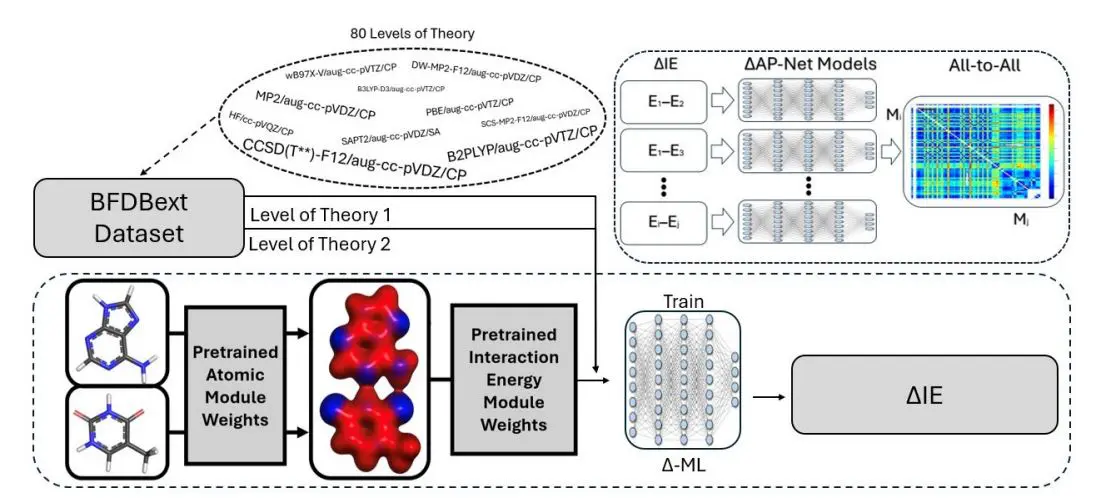
Accurately calculating the interactions between molecules is crucial for many scientific fields, yet these calculations often demand significant computational resources. Austin M. Wallace, C. David Sherrill, and Giri P. Krishnan, all from the Georgia Institute of Technology, address this challenge with a new framework that intelligently selects the most appropriate computational method for a given task. Their approach employs machine learning models, trained on data from advanced atomic-level simulations, to predict the performance of different methods relative to a highly accurate, but computationally expensive, benchmark. This allows researchers to identify efficient and reliable methods, achieving remarkable accuracy, with errors below 0. 1 kcal/mol, while substantially reducing computational cost. Importantly, the team’s work not only improves efficiency but also reveals underlying relationships between different computational theories, demonstrating the power of machine learning to enhance our understanding of molecular interactions.
This work addresses the significant challenge of selecting an appropriate computational method, balancing accuracy with computational cost, particularly when assessing how molecules interact. The team trained these ∆-ML models on features extracted from a pre-trained atom-pairwise neural network, enabling the prediction of error, the difference between a given method’s result and the highly accurate, but computationally expensive, “gold standard” coupled cluster with single, double, and perturbative triple excitations at the estimated complete basis set limit. The core of this approach involves predicting the difference in error between different levels of theory, rather than attempting to directly predict absolute interaction energies, leveraging information from a pre-trained network to reduce computational burden and improve predictive power.
Researchers demonstrated the effectiveness of this framework using an extended BioFragment dataset, comprising interaction energies for common biomolecular fragments and small organic dimers, allowing for rigorous testing across a range of chemical systems. The study achieved remarkably small mean-absolute-errors, consistently below 0. 1 kcal/mol, regardless of the quantum chemical method being evaluated. This level of accuracy represents a substantial improvement in the ability to reliably predict interaction energies without resorting to computationally prohibitive methods. Furthermore, by analyzing all-to-all ∆-ML models, scientists identified groupings of methods that align with established theoretical hypotheses, providing evidence that machine learning models can effectively learn and transfer corrections between different levels of theory. Researchers developed a system based on machine learning models, trained to estimate the error of one theoretical method relative to a highly accurate, but computationally expensive, “gold standard” method. The models successfully predict these errors across a range of methods with a mean absolute error below 0. 1 kcal/mol, even when comparing very different theoretical approaches. Notably, the machine learning models can utilize inexpensive calculations to predict results comparable to those from high-level methods, offering a pathway to balance accuracy and efficiency.
By combining error prediction with estimates of computational
By combining error prediction with estimates of computational time, the framework enables users to select appropriate methods based on desired accuracy and available resources, rather than relying on chemical intuition. The researchers acknowledge that expanding the dataset with greater chemical diversity and fewer theoretical levels could further enhance the generalizability of the framework. 1 kcal/mol regardless of the method used. This work addresses a significant challenge in molecular modeling, where selecting an appropriate computational method based on both accuracy and computational cost remains difficult. The team’s approach utilizes an ensemble of machine learning models, trained on data extracted from a pre-trained neural network, to predict the difference in accuracy between various methods relative to the gold standard, CCSD(T)/CBS.
The research demonstrates that these machine learning models can accurately estimate errors across a wide range of theoretical levels, identifying computationally efficient approaches for a given desired level of accuracy using only a subset of the available data. Experiments using an extended BioFragment dataset, encompassing interaction energies for common biomolecular fragments and small organic dimers, confirm the framework’s precision. The team analyzed all-to-all machine learning models, revealing groupings of methods that align with established theoretical hypotheses, providing evidence that these models can effectively learn corrections between any two levels of theory. This breakthrough delivers a powerful tool for researchers, enabling them to efficiently navigate the complex landscape of computational chemistry methods.
By accurately predicting the performance of different methods, scientists can select the most appropriate approach for their specific needs, balancing accuracy with computational feasibility. The framework’s ability to map between 80 different levels of theory provides unprecedented insight into the relationships between these methods, potentially leading to the development of even more accurate and efficient computational techniques. The results confirm the potential of machine learning to significantly accelerate and improve the accuracy of molecular modeling, with broad implications for fields such as drug discovery and materials science.
👉 More information🗞-ML Ensembles for Selecting Quantum Chemistry
🗞 -ML Ensembles for Selecting Quantum Chemistry Methods to Compute Intermolecular Interactions
🧠 ArXiv: https://arxiv.org/abs/2511.17753