

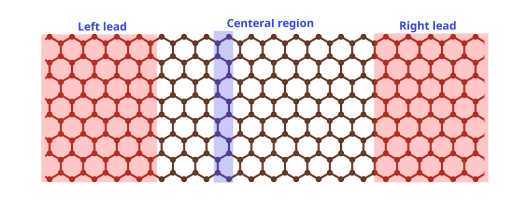
Machine learning models accurately predict transmission coefficients and local density of states in disordered two-dimensional materials like germanene, silicene and stanene. A geometry-driven feature space enables generalisation across materials, though extrapolation to unseen configurations remains a limitation for tree-based models.
Understanding electron behaviour within the complex structures of two-dimensional materials is crucial for advancing nanoelectronics and spintronics. Predicting quantum transport properties – how electrons move through these materials – presents a significant computational challenge, particularly when disorder, such as magnetic impurities, is present. Researchers are now applying machine learning techniques to circumvent these limitations, creating predictive models from extensive datasets generated using established quantum mechanical calculations. In a new study published in New Journal of Physics, Seyed Mahdi Mastoor and Amirhossein Ahmadkhan Kordbacheh, both from Iran University of Science and Technology, detail their development of scalable machine learning models to predict the transmission coefficient and local density of states in disordered two-dimensional hexagonal materials. Their work, titled “Scalable Machine Learning Models for Predicting Quantum Transport in Disordered 2D Hexagonal Materials”, utilises a combination of tight-binding Hamiltonian calculations and the Non-Equilibrium Green’s Function (NEGF) formalism to generate a dataset encompassing over 400,000 configurations of germanene, silicene, and stanene nanoribbons.
Machine Learning Predicts Quantum Transport in Disordered 2D Materials
Machine learning models successfully predict key quantum transport properties – the transmission coefficient and local density of states – in two-dimensional (2D) hexagonal materials containing magnetic disorder. This work demonstrates the potential to accelerate materials discovery for nanoelectronics and spintronics.
Researchers generated a dataset of over 400,000 configurations of graphene, germanene, silicene, and stanene nanoribbons. These configurations systematically varied geometry, impurity concentration, and energy levels. The team then employed machine learning to predict how electrons move through these materials, a property crucial for device performance.
A key innovation lies in the development of a ‘feature space’ – a set of numerical descriptors – that captures the geometry and characteristics of the materials. This feature space allows the trained models to generalise effectively across different material types and device sizes, moving beyond material-specific training approaches.
The accuracy of the machine learning models was ensured by using data generated from robust physics-based simulations. The team employed a tight-binding Hamiltonian – a simplified quantum mechanical model – combined with the Non-Equilibrium Green’s Function (NEGF) formalism, a method used to calculate the electronic properties of systems far from equilibrium.
Both Random Forest regression and classification models were evaluated. Regression, which predicts continuous values, consistently outperformed classification in capturing the nuanced behaviour of quantum transport. However, analysis revealed limitations in the ability of these tree-based models to extrapolate beyond the range of the training data. This suggests that predicting behaviour in entirely new configurations remains a challenge.
Detailed investigation into the impact of different features on model performance highlighted the importance of geometric descriptors and impurity characteristics in determining transport properties. This provides valuable insight into the underlying physics governing electron movement within these materials.
The study establishes a foundation for using scalable machine learning to accelerate the design and optimisation of nanoelectronic and spintronic devices. The ability to rapidly screen and identify materials with desired properties could significantly reduce the time and cost associated with materials discovery.
Future work will focus on physics-informed or graph-based learning architectures to address the extrapolation limitations of current models. These advanced architectures promise improved generalisation capabilities and the ability to accurately predict quantum transport behaviour in previously unseen configurations.
👉 More information
🗞 Scalable Machine Learning Models for Predicting Quantum Transport in Disordered 2D Hexagonal Materials
🧠 DOI: https://doi.org/10.48550/arXiv.2506.07983


