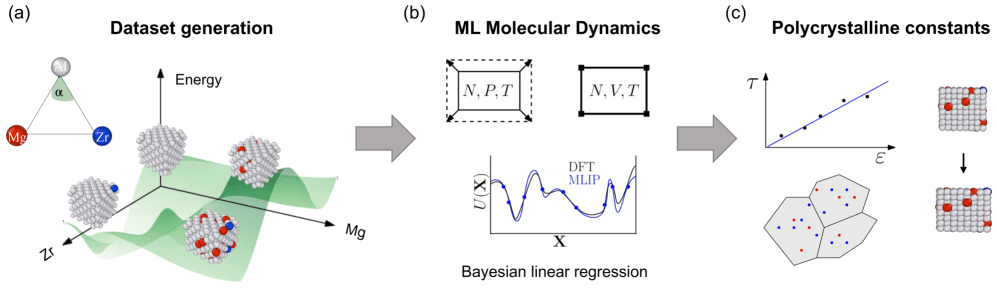
The quest for stronger, lighter alloys drives innovation in materials science, and aluminum alloys remain central to energy-efficient engineering applications. Lukas Volkmer and Max, from the Institute for Materials Science, alongside their colleagues, present a new approach to modelling the elastic properties of aluminum-magnesium-zirconium solid solutions. Their research integrates machine learning with atomistic simulations to develop accurate interatomic potentials, significantly reducing the computational cost of predicting alloy behaviour. The resulting models demonstrate remarkable agreement with experimental ultrasonic measurements, offering a reliable method for exploring complex alloy compositions and accelerating the design of materials with tailored properties, paving the way for future multiscale simulations that incorporate realistic microstructural features.
This study explores the elastic properties of aluminum-magnesium-zirconium solid solutions by integrating advanced machine learning techniques with quantum-mechanical atomistic simulations, accurately predicting these properties crucial for designing materials with tailored mechanical behaviour. This approach combines the predictive power of machine learning with the accuracy of quantum-mechanical calculations, offering a computationally efficient method for materials discovery and accelerating the development of next-generation structural materials with enhanced performance characteristics.
Machine Learning Potentials for Polycrystalline Elasticity
Researchers have developed a detailed methodology for creating machine learning interatomic potentials (MLIPs) and applying them to calculate the elastic properties of polycrystalline materials. These MLIPs accurately represent the interactions between atoms, allowing for efficient calculation of a material’s response to stress. The method describes the local atomic environment using mathematical descriptors, capturing the probability of finding atoms at specific distances and angles, and then uses Bayesian linear regression to refine the potential based on accurate quantum mechanical data. This allows for the calculation of elastic constants, which define a material’s stiffness, by applying controlled strain and measuring the resulting stress.
The team carefully considered how to quantify uncertainties in the calculations, propagating errors from the initial measurements to ensure the reliability of the final results. They employed least squares fitting to determine key stiffness constants and calculated standard errors to estimate the uncertainty in these values. This robust methodology provides a foundation for accurately predicting the mechanical properties of complex polycrystalline materials.
Machine Learning Predicts Aluminum Alloy Elasticity
Researchers have developed new computational methods to accurately predict the elastic properties of aluminum alloys, materials crucial for lightweight structural engineering applications. These methods combine advanced machine learning techniques with atomistic simulations, offering a significant improvement over traditional approaches. The team focused on aluminum alloys containing magnesium and zirconium, exploring how varying the composition affects the material’s response to stress and strain. The core of this work lies in the creation of highly accurate interatomic potentials using machine learning.
Two distinct machine learning approaches were employed, both dramatically reducing the computational burden while maintaining a high degree of accuracy, as confirmed by comparison with experimental ultrasonic measurements. This allows for detailed exploration of the compositional landscape of these alloys, revealing how even small changes in magnesium and zirconium content influence their elastic behavior. The research demonstrates the reliability and transferability of these machine learning-powered potentials, meaning they can be applied to a wide range of alloy compositions without significant loss of accuracy. This is a substantial advancement, as it enables the rapid screening of potential alloy designs with tailored mechanical properties. The team systematically investigated the stiffness of the alloys under various stresses and extended these calculations to predict the macroscopic properties of polycrystalline materials. The results provide a comprehensive understanding of how alloy composition affects both the fundamental elastic constants and the overall mechanical behavior of the material, establishing a foundation for future studies incorporating more complex microstructural features.
Alloy Properties Predicted with Machine Learning
This study successfully developed machine learning interatomic potentials (MLIPs) to efficiently and accurately simulate the mechanical properties of aluminum-magnesium-zirconium alloys. By combining on-the-fly learning with quantum mechanical calculations, researchers created transferable potentials that significantly reduce computational cost while maintaining accuracy, as confirmed by comparison with ultrasonic measurements. The simulations demonstrate that increasing magnesium and zirconium content leads to a decrease in certain elastic constants, likely due to distortions within the aluminum matrix. These new MLIPs offer a valuable tool for accelerating the design of aluminum alloys with tailored properties and are potentially extendable to other alloying elements, such as silicon. While the current work focuses on homogeneous phases, the authors acknowledge discrepancies between simulations and experiments for certain compositions, potentially due to the presence of multiple structural phases within the alloy’s microstructure. Future research should focus on extending these potentials to include multiphase systems and interface effects, paving the way for more comprehensive multiscale modeling and the development of advanced materials like mechanical metamaterials.
👉 More information
🗞 On-the-Fly Machine Learning of Interatomic Potentials for Elastic Property Modeling in Al-Mg-Zr Solid Solutions
🧠 ArXiv: https://arxiv.org/abs/2508.06311