

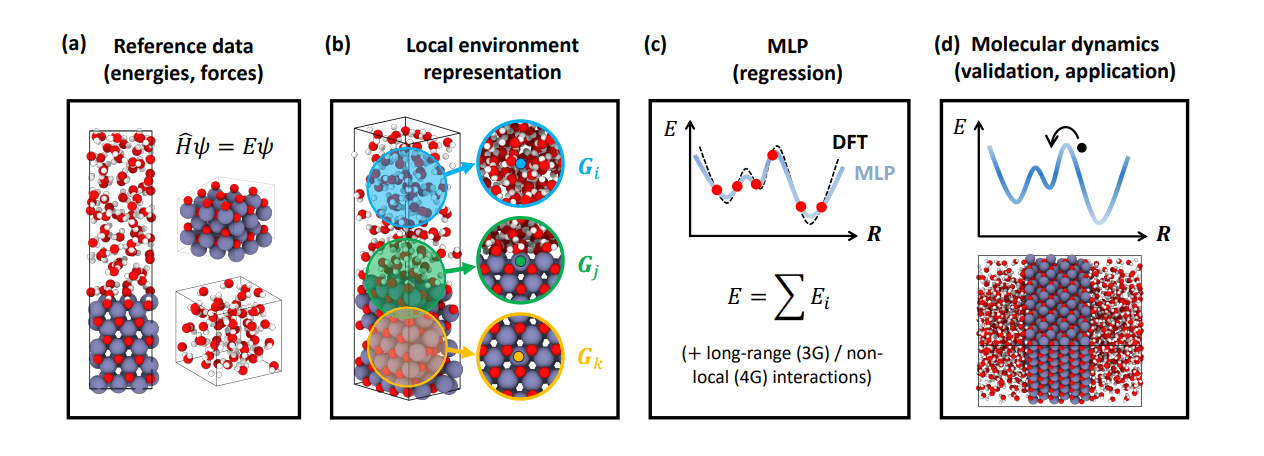
The behaviour of water at the surface of solid oxides is central to many important processes, from industrial catalysis to natural corrosion, yet accurately modelling these interactions presents a significant challenge to scientists. Jan Elsner, K. Nikolas Lausch, and Jörg Behler, all from Ruhr-Universität Bochum, have been at the forefront of a new approach that overcomes these limitations. Their work demonstrates the power of machine learning potentials, which learn the complex energy landscape governing these oxide-water interfaces from highly accurate, but computationally expensive, electronic structure calculations. This allows researchers to simulate the behaviour of water molecules at oxide surfaces with unprecedented accuracy and over timescales previously inaccessible, revealing crucial details about water dissociation, proton transfer, and the dynamic nature of these vital interfaces.
Researchers now employ machine learning potentials, trained on data from high-accuracy quantum mechanical calculations, to enable large-scale simulations with unprecedented accuracy. This methodology involves constructing a comprehensive dataset of energies and forces for various oxide-water configurations using density functional theory, then training a neural network to accurately reproduce these calculations. This trained machine learning potential then facilitates molecular dynamics simulations of oxide-water interfaces, allowing detailed investigation of interfacial structure, dynamics, and reactivity. The simulations reveal insights into how water molecules adsorb onto oxide surfaces, the formation of interfacial layers, and how surface defects influence water dissociation. These results demonstrate the potential of machine learning potentials to overcome computational limitations in simulating complex oxide-water systems, providing a powerful tool for understanding and predicting interfacial phenomena relevant to diverse applications including corrosion, catalysis, and geochemistry.
Water Interfaces and Multiscale Molecular Simulations
Computational modelling of water and its interfaces is a rapidly advancing field, crucial for understanding phenomena in electrochemistry and materials science. Researchers employ a range of techniques, including density functional theory, to lay the foundation for calculations, though accurately representing material properties like band gaps often requires corrections. Molecular dynamics simulations track the movement of atoms and molecules over time, while increasingly, neural network potentials are used to accelerate these simulations and enable larger system sizes by capturing complex interactions. Accurately modelling water requires accounting for quantum mechanical effects, particularly those related to the atomic nuclei.
Path integral molecular dynamics and ring-polymer molecular dynamics are essential for incorporating these nuclear quantum effects, which significantly impact water’s structure, dynamics, and reactivity. Grand canonical simulations and constant potential electrode simulations are used to model electrochemical interfaces at constant chemical potential and applied potential, respectively. A key focus of research is understanding nuclear quantum effects, including zero-point energy, tunnelling, and delocalization. Van der Waals interactions and hydrogen bonding are also crucial for accurately modelling water and its interactions with surfaces.
Understanding dielectric properties and electrification at interfaces is vital for applications in catalysis and electrochemistry. Researchers study a variety of systems, including water/oxide interfaces, electrode/electrolyte interfaces, solid-liquid interfaces, and water confined within nanoscale spaces, which exhibits unique properties. These studies support research in areas like electrocatalysis, water dissociation, surface chemistry, corrosion, energy storage, materials design, and modelling of electric double layers.
Machine Learning Models Oxide-Water Interface Dynamics
Recent advances in computational modelling have enabled detailed investigations of oxide-water interfaces, which are critical to understanding processes in diverse fields including catalysis and corrosion. Researchers have successfully applied machine learning potentials, trained using high-level electronic structure calculations, to simulate these complex systems with significantly reduced computational cost. These simulations reveal insights into the behaviour of water molecules at oxide surfaces, including their dissociation and recombination, proton transfer mechanisms, and the dynamic nature of aqueous interfaces. The simulations demonstrate the ability to model realistic interface behaviour, including system sizes and timescales necessary for statistically meaningful results, something previously unattainable with traditional methods.
Notably, the modelling accurately reproduces trends observed in capacitance measurements, attributing them to the differing affinities of ions to surface oxygen atoms. The accuracy of the simulation is inherently limited by the choice of density functional used to train the machine learning potential. Neglecting nuclear quantum effects introduces a source of uncertainty, and path integral molecular dynamics offers a means to address this limitation. Future work should focus on benchmarking density functionals against experimental data and incorporating nuclear quantum effects to further improve the reliability of these simulations.
👉 More information
🗞 Atomistic Simulations of Oxide-Water Interfaces using Machine Learning Potentials
🧠 ArXiv: https://arxiv.org/abs/2510.26467

