
Researchers at the University of Tokyo, led by Tomohito Amano and Shinji Tsuneyuki, have developed a new machine-learning model that can quickly and accurately predict the dielectric function of materials. This breakthrough has significant implications for the development of novel dielectric materials, which are crucial components in cutting-edge technologies such as 6G networks.
Dielectric materials, which don’t conduct electricity well but aren’t insulators either, have great potential to improve modern electronic systems. However, calculating their dielectric function from first-principles using quantum mechanics has been a computationally slow and heavy process.
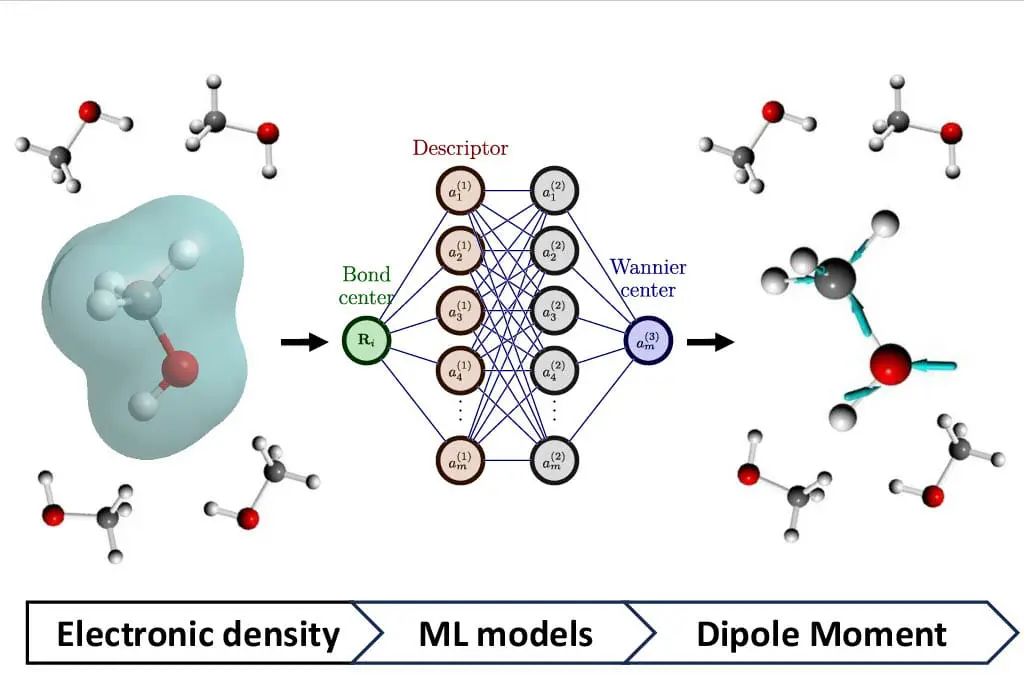
The new model addresses this challenge by generating training data through first-principle calculations of the electronic state of various materials, focusing on chemical bonds between atoms rather than individual molecules. With its high accuracy and reduced computational burden, this model opens up possibilities for large-scale and long-time simulations, paving the way for faster development of dielectric materials.
Predicting Dielectric Function with Machine Learning
The development of novel dielectric materials is crucial for advancing various cutting-edge technologies, including 6G networks. However, calculating the dielectric function of these materials from first-principles using quantum mechanics can be a computationally slow and heavy process. To address this challenge, researchers Tomohito Amano, Shinji Tsuneyuki, and Tamio Yamazaki have developed a new machine learning model that can quickly and accurately predict the dielectric function of materials.
The dielectric function measures the polarization of negative and positive charges within materials, which is essential for understanding the behavior of dielectric materials. The researchers’ model uses a chemical bond-based approach, where the algorithm is trained on data generated from first-principle calculations of the electronic state of various materials. This approach allows the model to capture the complex interactions between atoms in a material, resulting in accurate predictions of the dielectric function.
The model’s accuracy was tested by comparing its results with empirical data of simple molecules such as methanol and ethanol. The results showed that the model can describe the electronic state of various materials with an accuracy close to that of first-principle calculations, but with a fraction of the computational burden. This makes it possible for the first time to address the macroscopic origin of the dielectric properties of many-molecule systems.
The researchers’ work has significant implications for the development of novel dielectric materials. By speeding up the prediction of dielectric function, the model can facilitate the discovery of new materials with tailored properties. This can lead to breakthroughs in various fields, including high-speed communication and energy storage.
Dielectric Materials: The Unsung Heroes of Modern Electronics
Dielectric materials may not be as widely known as semiconductors, but they have great potential to improve modern electronic systems. These materials do not conduct electricity well, but they are not insulators either. Instead, when placed in an electric field, positive charges within the material shift toward the field and negative charges away from it, resulting in dielectric polarization.
The study of dielectrics is important for both fundamental and applied science. On the fundamental side, dielectrics can help elucidate the microscopic origin of how materials respond to electric fields. On the applied side, low-dielectric polymer materials have garnered attention recently for their potential use in high-speed communication.
Dielectric materials are already used in various applications, including capacitors, antennas, and sensors. However, the development of novel dielectric materials with tailored properties is crucial for advancing these technologies further. The researchers’ machine learning model can play a significant role in this development by speeding up the prediction of dielectric function.
Machine Learning Model: A Game-Changer for Dielectric Materials Development
The researchers’ machine learning model is based on a chemical bond-based approach, where the algorithm is trained on data generated from first-principle calculations of the electronic state of various materials. This approach allows the model to capture the complex interactions between atoms in a material, resulting in accurate predictions of the dielectric function.
The model’s accuracy was tested by comparing its results with empirical data of simple molecules such as methanol and ethanol. The results showed that the model can describe the electronic state of various materials with an accuracy close to that of first-principle calculations, but with a fraction of the computational burden.
The model’s ability to speed up the prediction of dielectric function makes it possible for the first time to address the macroscopic origin of the dielectric properties of many-molecule systems. This can lead to breakthroughs in various fields, including high-speed communication and energy storage.
Future Directions: Expanding the Model’s Capabilities
Despite the model’s achievements, the researchers are already looking ahead to expand its capabilities. One direction is to apply the model to more complex molecules, including polymers. This can lead to the development of novel dielectric materials with tailored properties.
Another direction is constructing a universal neural network that can be used in industry. This can facilitate the widespread adoption of the model and accelerate the discovery of new dielectric materials.
The researchers’ work has significant implications for the development of novel dielectric materials. Expanding the model’s capabilities can further accelerate the discovery of new materials with tailored properties, leading to breakthroughs in various fields.
External Link: Click Here For More