

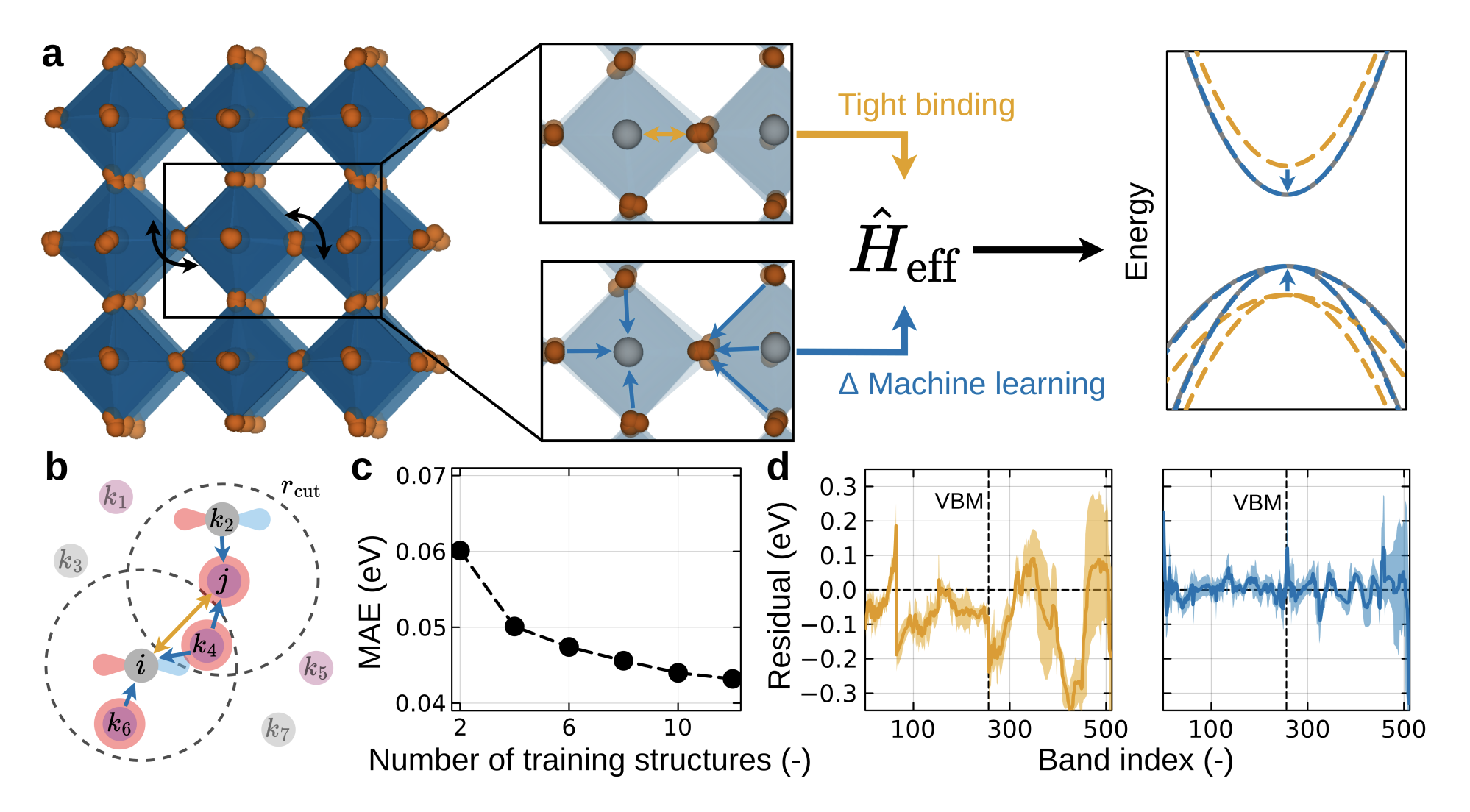
Predicting how materials interact with light, a crucial step in designing new technologies, remains a significant computational challenge, particularly for complex systems at realistic conditions. Martin Schwade, Shaoming Zhang, and Frederik Vonhoff, along with colleagues at the Technical University of Munich and the Munich Data Science Institute, present a new machine learning framework, HAMSTER, that addresses this problem. The team’s approach combines the efficiency of approximate models with the accuracy of first-principles calculations, requiring far less data than traditional neural networks. By focusing on the underlying Hamiltonian, which describes the energy of the system, HAMSTER accurately predicts optoelectronic properties across a range of temperatures and compositions, even for materials containing tens of thousands of atoms, and offers a more interpretable pathway to materials discovery.
Perovskite Stability Predicted Using Machine Learning
Researchers are employing machine learning techniques, specifically neural networks, to predict the properties of perovskite materials and accelerate the discovery of improved compositions for solar cells. This work focuses on understanding the relationship between a material’s structure and its performance, aiming to enhance both efficiency and stability. The team utilizes computational modeling and simulations to investigate perovskite behaviour at the atomic level, calculating electronic structure, optical properties, and stability characteristics. The research involves high-throughput screening, a computational method used to evaluate a large number of potential perovskite compositions and identify promising candidates for experimental testing.
These computational methods are combined with machine learning, including Bayesian Optimization, to accelerate the discovery process. Experimental validation confirms the accuracy of the computational predictions through the synthesis and characterization of perovskite materials. This approach has led to the development of more accurate machine learning models capable of predicting perovskite properties, and the identification of new compositions with potentially improved performance. The research also provides insights into the mechanisms of defect formation, a critical factor influencing material stability. By combining computational modeling and machine learning, the team significantly accelerates the process of materials discovery, paving the way for more efficient and durable solar cells.
Physics-Informed Machine Learning Predicts Optoelectronic Properties
Researchers have developed HAMSTER, a novel physics-informed machine learning framework capable of predicting the optoelectronic properties of complex chemical systems with unprecedented accuracy and efficiency. This breakthrough addresses a critical challenge in materials science, where traditional computational methods are often limited by their prohibitive cost when applied to large-scale, realistic simulations. The team’s approach significantly enhances data efficiency by integrating underlying physical principles into the machine learning process, requiring substantially less first-principles data than existing frameworks. The core of HAMSTER lies in a unique Hamiltonian learning strategy, where the model learns the differences between a physically-motivated approximate model and the true, ground-truth Hamiltonian.
Starting with a well-established tight-binding model, the framework captures the influence of dynamic atomic environments on electronic structure using only a small number of explicit calculations. The team meticulously identified different types of interactions within the effective Hamiltonian, distinguishing between on-site, off-site, and environment-dependent contributions. To define the dynamic modifications of matrix elements, the scientists developed a novel environment descriptor, combining information about local atomic environments and interaction types. This descriptor incorporates a cutoff radius to focus on nearby atoms and utilizes a smooth cutoff function to ensure a gradual decay of contributions from distant atoms. Experiments demonstrate that HAMSTER accurately predicts optoelectronic properties across varying temperatures and compositions, even for systems containing tens of thousands of atoms, a scale previously inaccessible to many computational techniques.
Hamiltonian Learning Predicts Optoelectronic Properties
Researchers have developed HAMSTER, a novel physics-informed machine learning framework capable of predicting the optoelectronic properties of complex chemical systems with unprecedented accuracy and efficiency. This breakthrough addresses a critical challenge in materials science, where traditional computational methods are often limited by their prohibitive cost when applied to large-scale, realistic simulations. The team’s approach significantly enhances data efficiency by integrating underlying physical principles into the machine learning process, requiring substantially less first-principles data than existing frameworks. The core of HAMSTER lies in a unique Hamiltonian learning strategy, where the model learns the differences between a physically-motivated approximate model and the true, ground-truth Hamiltonian.
Starting with a well-established tight-binding model, the framework captures the influence of dynamic atomic environments on electronic structure using only a small number of explicit calculations. Results show that the model achieves high accuracy by focusing on capturing the subtle modifications to the Hamiltonian caused by atomic fluctuations. The team employs a kernel model, learning from interactions between atoms and their surrounding environments, and utilizes a carefully designed environment descriptor that respects the symmetries of the Hamiltonian. Validation tests on gallium arsenide demonstrate that HAMSTER significantly reduces errors compared to traditional tight-binding models, achieving a more accurate representation of the electronic structure. This advancement promises to accelerate the discovery and design of new materials with tailored optoelectronic properties, opening doors for innovations in solar energy, electronics, and beyond.
Physics-Informed Machine Learning Predicts Perovskite Properties
This work introduces HAMSTER, a new machine learning framework that accurately predicts the optoelectronic properties of complex chemical systems, such as halide perovskites, across a range of conditions. By combining physics-based approximations with machine learning, HAMSTER requires only limited first-principles calculations, achieving comparable accuracy to methods demanding much larger datasets, while also providing a transparent and interpretable Hamiltonian representation. The research highlights the potential of physics-informed machine learning to overcome computational limitations in materials science, enabling quantitative predictions for systems inaccessible to conventional first-principles methods. The demonstrated data efficiency and predictive power position this approach as a practical strategy for investigating complex materials and exploring phenomena like carrier transport and defect physics. This framework offers a promising pathway for accelerating materials discovery and design, enabling the development of advanced technologies in areas such as solar energy and optoelectronics.
🗞 Physics-informed Hamiltonian learning for large-scale optoelectronic property prediction
🧠 ArXiv: https://arxiv.org/abs/2508.20536


