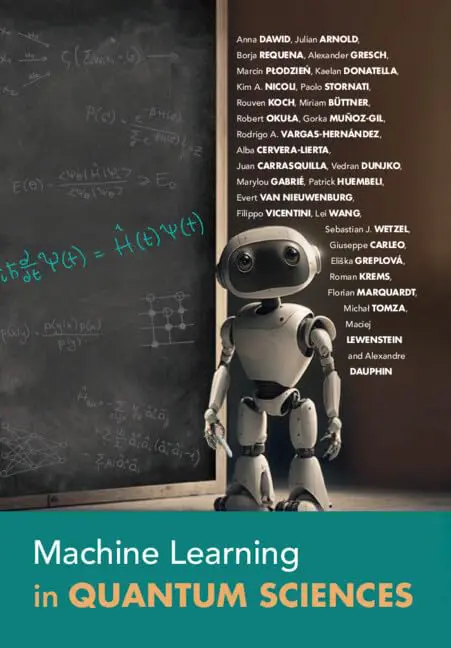
Published in June 2025 by Cambridge University Press, Machine Learning in Quantum Sciences provides an introduction to both machine learning techniques, including deep neural networks, and their application to problems in quantum physics and chemistry. Co-authored by 29 researchers from over ten countries, the book, originating from the 2021 Summer School on Machine Learning for Quantum Physics and Chemistry at the University of Warsaw, details applications ranging from reinforcement learning for experiment control to neural network representations of complex quantum states. It aims to serve as a resource for PhD students and researchers seeking to integrate modern machine learning methods into their work, building on the increasing recognition of artificial intelligence as a tool for scientific discovery, as evidenced by recent awards in the field.
Bridging Quantum and Classical Realms: Advances in Machine Learning for Quantum Systems
A new textbook synthesises recent advances in machine learning and their application to the challenging field of quantum physics, offering a comprehensive resource for researchers and students alike. The book details how machine learning algorithms address complex problems in quantum mechanics, ranging from characterising quantum systems to optimising control protocols and accelerating quantum simulations. Researchers from the University of Warsaw played a central role in its creation, fostering an environment of interdisciplinary collaboration that integrated expertise from both established researchers and those early in their careers.
The book systematically explores how machine learning techniques circumvent the need for detailed theoretical modelling, enabling the characterisation of complex quantum systems through data-driven approaches. It details how algorithms learn the parameters of a system directly from experimental measurements, effectively predicting its behaviour and providing insights into its physical properties. This approach proves particularly valuable when dealing with systems where traditional theoretical methods are intractable or computationally expensive, opening new avenues for scientific discovery.
Machine learning algorithms optimise quantum control protocols, essential for applications like quantum computation and quantum sensing, by designing pulse sequences that maximise the probability of achieving a desired quantum state. These algorithms minimise the effects of noise and decoherence, critical challenges in maintaining the delicate quantum states necessary for these technologies. Reinforcement learning proves particularly effective in this context, allowing algorithms to learn optimal control strategies through trial and error, adapting to the specific characteristics of each quantum system. Researchers are actively exploring new reinforcement learning algorithms to improve the performance and robustness of quantum control systems.
The integration of machine learning with quantum simulation methods offers a promising avenue for tackling computationally demanding problems, leveraging the strengths of both paradigms. Variational quantum eigensolvers (VQEs), for example, utilise classical machine learning algorithms to optimise the parameters of a quantum circuit, enabling the approximate solution of the Schrödinger equation for complex molecules and materials. This hybrid quantum-classical approach overcomes the limitations of purely classical or quantum methods, paving the way for more accurate and efficient simulations.
Researchers address the challenges of data scarcity and noise, crucial for the successful application of machine learning to quantum systems, by developing techniques to extract meaningful information from limited and imperfect datasets. Quantum experiments often generate limited data, which may be corrupted by noise and imperfections, requiring sophisticated algorithms to filter out the noise and identify the underlying patterns. Techniques such as transfer learning and active learning help algorithms learn effectively from small datasets and prioritise the acquisition of the most informative data.
The University of Warsaw’s Faculty of Physics provided both logistical and intellectual foundations for the creation of the book, fostering an environment conducive to interdisciplinary collaboration. The faculty’s commitment to fostering cooperation ensured a wide range of perspectives, integrating contributions from both established researchers and those early in their careers. This collaborative spirit facilitated the development of a comprehensive resource that bridges the gap between machine learning and quantum physics.
More information
External Link: Click Here For More