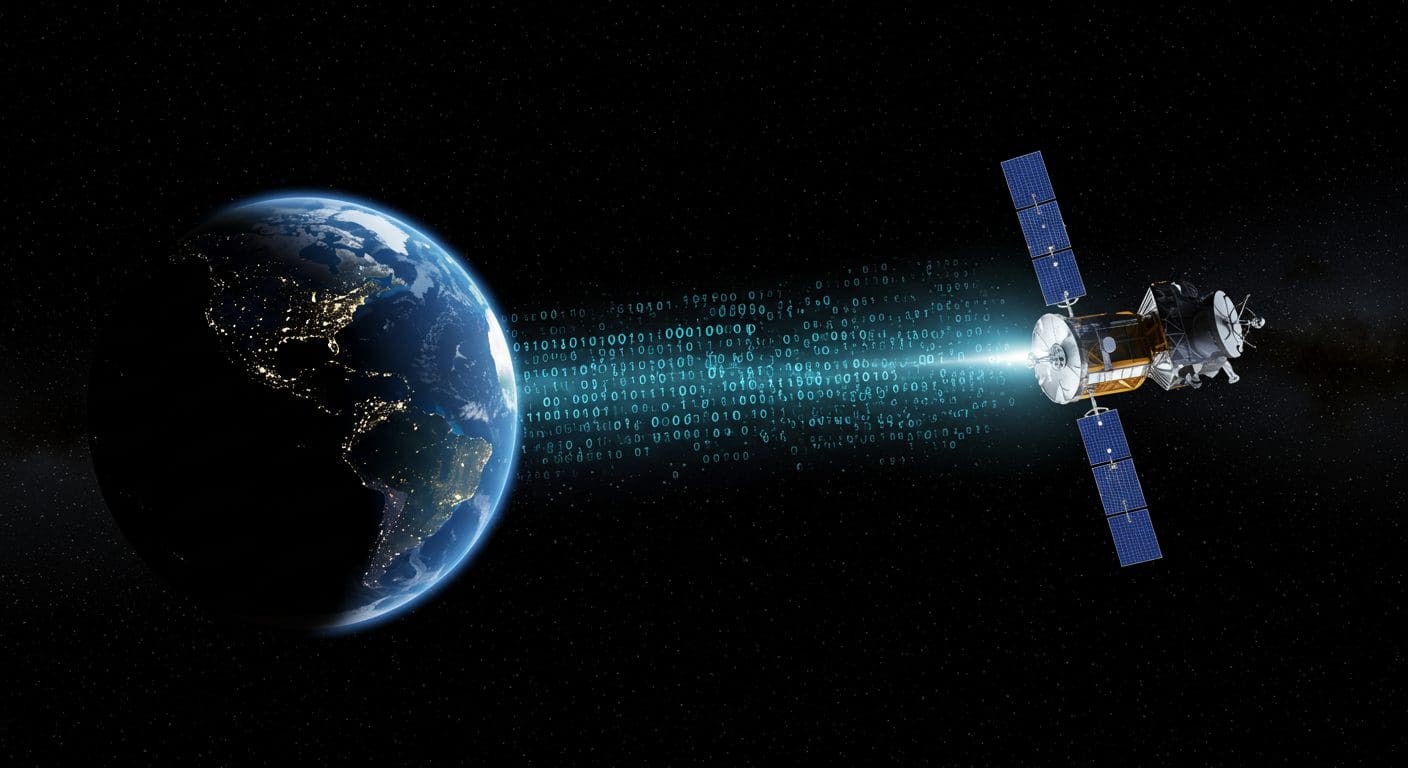
The challenge of transmitting secure quantum keys over long distances via satellite is significantly advanced by new research into correcting distortions caused by atmospheric turbulence, a major obstacle to reliable quantum communication. Nathan K. Long, Ziqing Wang, and colleagues from the University of New South Wales, along with Benjamin P. Dix-Matthews, Alex Frost, John Wallis, and Kenneth J. Grant from the University of Western Australia, demonstrate a machine learning-based method to counteract discrepancies between reference pulses and signal beams during transmission. Their approach decomposes these beams into fundamental light patterns, allowing the algorithm to accurately estimate and eliminate differences in their wavefronts, a critical step for continuous-variable quantum key distribution (CV-QKD). Detailed simulations reveal that this new algorithm not only compensates for relative wavefront errors but also maintains performance when distortions are minimal, ultimately enabling positive key rates in channels where traditional methods would fail and information would be lost.
Satellite Quantum Key Distribution with Turbulence Mitigation
This research explores continuous-variable quantum key distribution (CV-QKD) via satellite, focusing on mitigating atmospheric turbulence using adaptive optics and machine learning. Utilizing a satellite is crucial for overcoming the limitations of terrestrial fiber optic networks and establishing a secure quantum communication link between a satellite and a ground station. CV-QKD encodes information in the amplitude and phase of light, making it well-suited for long-distance communication and compatibility with existing telecommunication infrastructure. Atmospheric turbulence is the primary obstacle, causing wavefront distortions that degrade signals and increase quantum bit error rates.
The research addresses this through adaptive optics systems, which correct for these distortions in real-time, improving signal quality. Machine learning further enhances performance by predicting wavefront distortions, allowing for proactive correction, optimizing system parameters, and creating more accurate turbulence models. Signal loss due to atmospheric absorption and scattering, along with various noise sources, are also considered. The research utilizes numerical simulations to model the satellite link and evaluate mitigation strategies, employing tools like WavePy and MATLAB. Realistic atmospheric models, including the US Standard Atmosphere 1976, are used to simulate turbulence and other atmospheric effects.
The combination of machine learning and adaptive optics represents a significant innovation, promising improved robustness for satellite-based CV-QKD. Realistic turbulence modeling and a comprehensive simulation framework integrating wave optics, atmospheric modeling, and machine learning are valuable contributions. Successful implementation could enable secure global communication, protect sensitive data, and contribute to the development of a future quantum internet, while also advancing adaptive optics techniques applicable to astronomy and free-space optical communication. In summary, this research represents a significant step towards realizing practical satellite-based CV-QKD. The combination of advanced simulation techniques, machine learning-enhanced adaptive optics, and realistic atmospheric modeling is a promising approach for overcoming the challenges of long-distance quantum communication.
Atmospheric Turbulence Modeling for Satellite Quantum Key Distribution
Researchers developed a sophisticated method for modeling atmospheric turbulence to improve the security of quantum key distribution (QKD) systems operating between satellites and ground stations. This new methodology accurately simulates differences in wavefront errors between signal and reference beams, addressing a limitation of traditional approaches that assume identical distortions. The core of this approach lies in a detailed, multi-layered model of the atmosphere, dividing it into numerous slabs to account for changing density and turbulence with altitude. Unlike simpler models, this system calculates properties like scintillation index and Fried parameter for each individual slab, measuring atmospheric distortion.
These calculations consider altitude, zenith angle, and wind profiles, creating a realistic representation of the atmospheric channel. A key innovation is the incorporation of altitude-dependent parameters, recognizing that turbulence characteristics change significantly with height. The model calculates the refractive index structure parameter, describing the strength of turbulence, as a function of wind speed and altitude. This allows for a more precise representation of how the atmosphere distorts light beams traveling long distances from a satellite to a ground station. To account for potential differences between reference and signal beams, the methodology doesn’t assume identical wavefront distortions. Instead, it allows for independent calculation of these errors, enabling the team to assess the impact of discrepancies caused by imperfections in optical hardware or calibration. This capability is crucial for developing effective wavefront correction algorithms, essential for maintaining secure communication in challenging atmospheric conditions.
Machine Learning Corrects Atmospheric Quantum Distortions
Researchers have developed a new method to improve the secure transmission of quantum information through atmospheric channels, such as those between a satellite and a ground station. The team’s innovation involves using machine learning algorithms to actively compensate for differences in distortion between the signal and reference beams. They employ a multi-plane light converter to decompose both beams into their fundamental components, allowing the system to precisely measure the differences in how each beam’s components are affected by atmospheric turbulence. The machine learning algorithms then learn to predict and correct for these differences, effectively sharpening the signal and improving its coherence.
Through detailed simulations of satellite-to-Earth communication, the researchers demonstrated that their approach can establish secure key rates in scenarios where traditional methods would fail. The system accurately identifies and compensates for relative distortions, ensuring the signal remains clear despite atmospheric interference. The improvement is substantial; the team’s simulations show positive key rates are achievable with their method in channels that would otherwise result in complete information loss. By actively correcting for the mismatch in wavefront distortions, this new technique represents a significant step towards realizing practical and secure quantum communication networks, particularly for emerging quantum internet technologies.
Machine Learning Corrects Satellite QKD Wavefront Errors
This research addresses a critical challenge in continuous-variable quantum key distribution (CV-QKD), particularly for satellite-to-Earth communication, caused by wavefront errors that distort signals during transmission. The team investigated how discrepancies between wavefront distortions affecting reference pulses and the actual data signals can severely limit key transfer rates. They developed novel machine learning-based wavefront correction algorithms that decompose both reference and data signals into Hermite-Gaussian modes, enabling accurate estimation and compensation for these relative wavefront errors. Through detailed simulations of Earth-satellite channels, the algorithms consistently improved secure key rates, even in conditions where information loss would otherwise occur. This advancement increases the practical feasibility of implementing satellite-based quantum communication networks, bringing the realization of a Quantum Internet closer. The method effectively identifies and corrects for wavefront discrepancies without negatively impacting performance when distortions are similar across both signals and reference pulses.
👉 More information
🗞 Quantum Wavefront Correction via Machine Learning for Satellite-to-Earth CV-QKD
🧠 ArXiv: https://arxiv.org/abs/2508.10326