

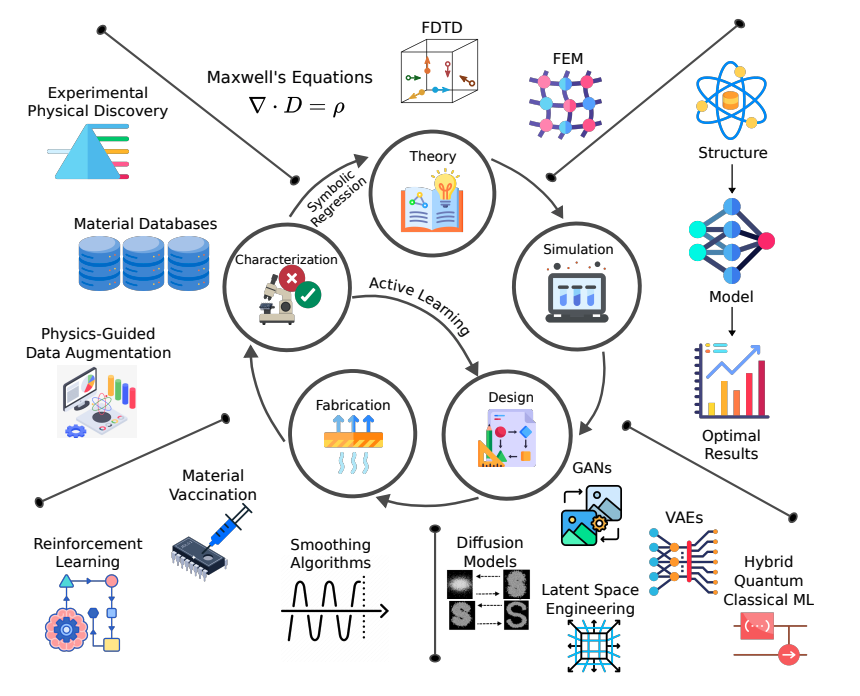
The efficient development of photonic devices, crucial components in modern telecommunications, imaging and sensing technologies, presents a significant computational and logistical challenge. Traditional design processes, reliant on iterative simulations, fabrication and characterisation, are often hampered by extensive optimisation landscapes and uncertainties inherent in both modelling and manufacturing. Recent advances in machine learning offer potential solutions, providing data-driven strategies to accelerate this process, from predicting device behaviour to optimising fabrication parameters. A comprehensive review of these methods is now presented by Yuheng Chen et al, from institutions including Purdue University and the University of Maryland in their article, ‘Machine-Learning-Assisted Photonic Device Development: A Multiscale Approach from Theory to Characterization’.
The work details how surrogate modelling, generative networks, reinforcement learning and active learning techniques are being integrated into photonic device development to improve efficiency and overcome existing limitations. Machine learning substantially accelerates photonic device development and optimisation, transforming a traditionally computationally intensive field into one driven by data-driven insights and automated processes. Researchers integrate these techniques into photonic device development (PDD), addressing limitations inherent in conventional approaches and unlocking new possibilities for innovation. This implementation functions as a surrogate estimator, modelling complex relationships between design parameters and device performance to significantly accelerate computations.
Generative modelling expands datasets and mitigates the impact of noisy measurements, while reinforcement learning automates fabrication processes, optimising them for efficiency and precision. Leveraging powerful generative models explores design spaces and predicts device behaviour, enabling researchers to iterate through designs and identify optimal candidates with unprecedented speed. Fast simulation and characterisation modelling, facilitated by machine learning, reduces reliance on time-consuming physical experiments, streamlining the development process and accelerating the pace of discovery. Furthermore, machine learning-driven active learning strategies efficiently guide experimental discovery, prioritising promising materials and configurations for investigation and maximising the impact of limited resources. Active learning is a process where a model strategically selects the most informative data points to be labelled, thereby improving its performance with fewer training examples.
The application of machine learning extends beyond optimisation,
The application of machine learning extends beyond optimisation, enhancing the robustness of PDD by accounting for uncertainties in structural or optical characterisation and improving the reliability of predictions. This interdisciplinary approach, combining materials science, physics, computer science, and engineering, promises to accelerate the development of complex photonic devices and systems, fostering innovation across telecommunications, imaging, sensing, and information processing. By leveraging large materials databases, such as the Materials Project and MaterialsAtlas, research accelerates materials discovery and facilitates the identification of promising candidates for photonic applications, reducing the time and cost associated with materials selection.
Symbolic regression emerges as a powerful tool for uncovering underlying physical relationships from data, offering insights beyond those provided by conventional modelling and deepening our understanding of device behaviour. Researchers address the challenges posed by large optimisation landscapes and uncertainties in device characterisation, employing data augmentation techniques to effectively expand the training dataset and improve the generalisation capability of machine learning models. Generalisation refers to a model’s ability to accurately predict outcomes for new, unseen data. This enhanced capability ensures that models perform reliably even when presented with data that differs from the training set, increasing their robustness to noise and variations in manufacturing processes.
Bayesian optimisation plays a vital role, guiding the search for optimal device designs within complex parameter spaces and efficiently navigating the vast design landscape. The combination of these methods significantly reduces both the computational cost and the time required to develop new photonic devices, accelerating the pace of innovation and enabling the creation of more advanced optical technologies. Future work should focus on developing more sophisticated generative models capable of accurately representing complex device behaviours across a wider range of operating conditions, expanding the applicability of machine learning to a broader range of photonic devices.
Investigating the potential of active learning strategies will
Investigating the potential of active learning strategies will further enhance experimental discovery. Exploring the integration of these machine learning methods with digital twins—virtual representations of physical devices—could enable real-time optimisation and predictive maintenance, further accelerating the development and deployment of advanced photonic systems and ensuring their long-term reliability. A critical area for future investigation involves the development of explainable artificial intelligence (XAI) techniques to provide deeper insights into the decision-making processes of machine learning models, fostering trust in the technology and facilitating further innovation. Understanding why a particular design is predicted to perform well is crucial for building confidence in the results and enabling researchers to refine their designs more effectively.
The study highlights the application of reinforcement learning to optimise fabrication processes, moving beyond reliance on manual tuning and control and achieving unprecedented precision in device manufacturing. Reinforcement learning is a type of machine learning where an agent learns to make decisions by receiving rewards or penalties for its actions, ultimately optimising its behaviour to maximise cumulative reward.
🗞 Machine-Learning-Assisted Photonic Device Development: A Multiscale Approach from Theory to Characterization
🧠 DOI: https://doi.org/10.48550/arXiv.2506.20056


