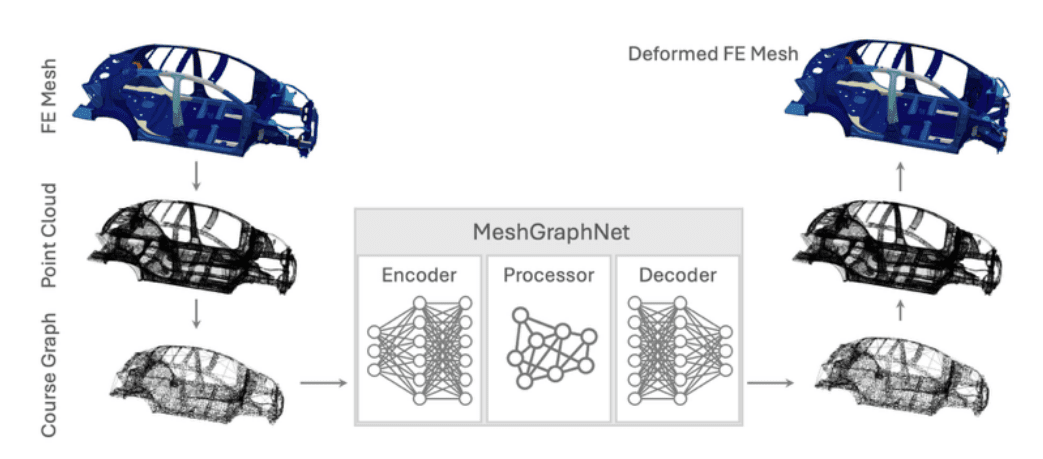
Predicting how a vehicle crumples during a crash is vital for automotive safety, but traditional computer simulations are incredibly demanding in terms of processing power and time. Mohammad Amin Nabian from NVIDIA, Sudeep Chavare from General Motors LLC, and Deepak Akhare from NVIDIA, along with their colleagues, address this challenge by exploring machine learning techniques to rapidly and accurately model crash dynamics. Their work demonstrates the feasibility of using neural networks, specifically MeshGraphNet and Transolver, to predict structural deformation during a crash, offering a significant reduction in computational cost compared to conventional methods. By training these models on a detailed dataset of 150 vehicle crash simulations, the team shows that machine learning can capture essential deformation trends, paving the way for faster design iterations and improved crashworthiness evaluation in the automotive industry.
Machine Learning Speeds Vehicle Crash Simulations
Researchers are revolutionizing vehicle safety assessment by developing machine learning models that dramatically accelerate crash simulations. Traditional simulations, using finite element analysis, are computationally expensive and time-consuming, hindering rapid design exploration. This new approach employs machine learning as a “surrogate model,” learning to predict structural behavior and significantly reducing simulation time without substantial loss of accuracy. This breakthrough promises to accelerate vehicle design, enabling engineers to explore a wider range of safety features and optimize vehicle structures more efficiently.
The team investigated two advanced neural network architectures, MeshGraphNet and Transolver, to model the complex dynamics of vehicle crashes. These networks analyze the vehicle structure as a graph, representing its components and connections, allowing the model to learn how forces propagate during a collision. To accurately capture the changing behavior of the vehicle over time, scientists explored different training strategies, including methods that predict future states based on past behavior and techniques that enhance the stability of the model. The research utilized a comprehensive dataset of 150 detailed crash simulations, representing a structurally rich vehicle assembly with realistic manufacturing variations.
By training the machine learning models on this extensive dataset, the team demonstrated the feasibility of predicting overall deformation trends with reasonable fidelity. Importantly, the surrogate models deliver orders-of-magnitude reductions in computational cost, enabling rapid design exploration and early-stage optimization in crashworthiness evaluation. This allows engineers to evaluate a far greater number of design alternatives, accelerating the development of safer and more efficient vehicles. While current models do not yet match the full accuracy of traditional finite element analysis, they represent a significant step towards a future where AI-powered simulations can transform automotive safety design. Future research will focus on improving the prediction of velocity and acceleration, modeling material failure, and reducing the amount of data required for training. This work establishes a foundation for AI-driven simulation, paving the way for faster, more innovative automotive safety design.
Crash Prediction Using Neural Network Surrogates
Researchers have pioneered a new approach to vehicle crashworthiness assessment by developing machine learning-based surrogate models that significantly reduce computational demands. By learning to predict structural deformation during crash scenarios, these models offer a faster alternative to traditional, computationally intensive finite element simulations. The study employed the PhysicsNeMo framework to investigate MeshGraphNet and Transolver, two state-of-the-art neural network architectures, for modeling crash dynamics. This innovative approach promises to accelerate vehicle design and enable engineers to explore a wider range of safety features.
To capture the transient nature of crash events, scientists examined three distinct strategies for modeling how structures change over time: time-conditional modeling, a standard autoregressive approach, and a stability-enhanced autoregressive scheme incorporating rollout-based training. The models were trained on a comprehensive dataset of 150 Body-in-White (BIW) crash simulations, representing a structurally rich vehicle assembly with realistic manufacturing variations. This meticulous data preparation ensured the models were trained on a dataset representative of real-world vehicle structures and manufacturing tolerances. The models successfully captured overall deformation trends with reasonable fidelity, demonstrating the feasibility of applying machine learning to structural crash dynamics.
Although not yet achieving the full accuracy of traditional finite element analysis, the models deliver orders-of-magnitude reductions in computational cost, enabling rapid design exploration and early-stage optimization in crashworthiness evaluation. This breakthrough allows engineers to explore a far wider range of design alternatives, accelerating the development of safer and more efficient vehicles. This research demonstrates a paradigm shift from physics-first to data-first approaches in scientific computation, offering a transformative capability for the automotive industry. Future work will likely focus on improving the accuracy of the models, expanding their application to a wider range of crash scenarios, and incorporating more complex physics into the simulations.
Machine Learning Predicts Vehicle Crash Deformation
Researchers have demonstrated the feasibility of using machine learning as a computationally efficient alternative to traditional finite element analysis for assessing vehicle crashworthiness. By developing and evaluating neural network models, MeshGraphNet and Transolver, they have shown that it is possible to predict structural deformation during crash scenarios with significantly reduced computational cost. This breakthrough promises to accelerate vehicle design and enable engineers to explore a wider range of safety features. The study utilized a comprehensive dataset of 150 Body-in-White (BIW) crash simulations, representing a structurally rich vehicle assembly with realistic manufacturing variations.
The models ingest undeformed mesh geometry and component characteristics to predict the spatiotemporal evolution of deformation during a crash. Experiments reveal that these machine learning models successfully capture overall deformation trends with reasonable fidelity. The team investigated three distinct strategies for modeling transient dynamics, time-conditional approaches, standard autoregressive methods, and a stability-enhanced autoregressive scheme, to optimize predictive performance. The breakthrough delivers orders-of-magnitude reductions in computational cost, enabling rapid design exploration and early-stage optimization in crashworthiness evaluation.
This allows engineers to evaluate a far greater number of design alternatives and converge on optimal solutions more efficiently. This research establishes a foundation for AI-driven simulation, paving the way for faster, more innovative automotive safety design. Future work will likely focus on improving the accuracy of the models, expanding their application to a wider range of crash scenarios, and incorporating more complex physics into the simulations.
Machine Learning Predicts Crash Deformation Rapidly
This research successfully demonstrates the feasibility and effectiveness of machine learning surrogate models for predicting the complex, non-linear dynamics of automotive crash events. The developed framework accurately predicts full-field structural deformation of a complex Body-in-White system, showing strong agreement with detailed finite element simulations. By replacing computationally intensive numerical solvers with a trained machine learning model, simulation time is dramatically reduced. The team investigated two neural network architectures, Transolver and MeshGraphNet, alongside different strategies for modeling how structures change over time.
Results indicate both architectures show promise for modeling crash dynamics, with Transolver demonstrating good accuracy and stability in predicting long-term deformation, while MeshGraphNet offers a competitive and interpretable alternative, particularly excelling at modeling local interactions within a mesh. Comparisons of different methods for modeling transient dynamics revealed that both autoregressive rollout training and time-conditional schemes can achieve accurate predictions. This acceleration in simulation time has the potential to transform automotive design and engineering. Crashworthiness analysis can now be integrated into the earliest design stages.
👉 More information
🗞 Automotive Crash Dynamics Modeling Accelerated with Machine Learning
🧠 ArXiv: https://arxiv.org/abs/2510.15201