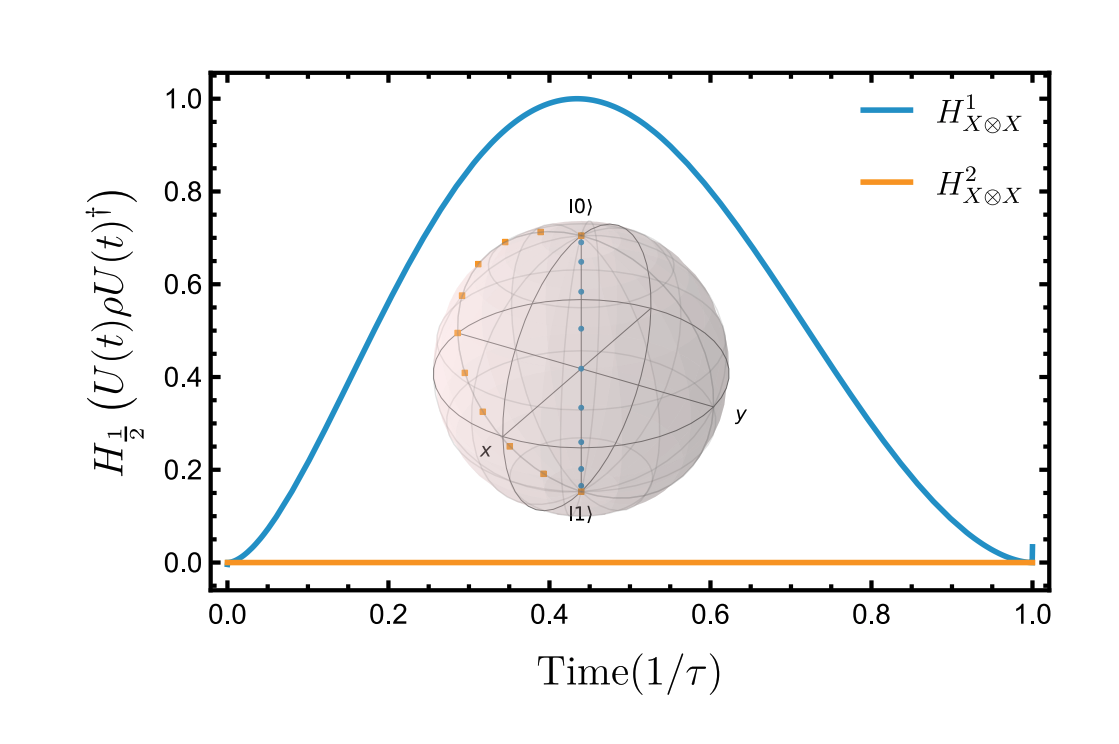
Quantum computation relies on manipulating qubits, the quantum analogue of classical bits, using precisely timed electromagnetic fields. The energy required for these manipulations presents a fundamental limitation to scalability and practical implementation. Josey Stevens, from Johns Hopkins University Applied Physics Laboratory and University of Maryland, Baltimore County, alongside Sebastian Deffner from University of Maryland, Baltimore County and the National Quantum Laboratory, investigate this energetic cost in their work, entitled ‘Hamiltonian quantum gates – energetic advantage from entangleability’. They demonstrate a direct relationship between the energy needed to perform quantum gates – operations on qubits – and the ‘entangleability’ of the Hamiltonian, the mathematical description of the system’s energy, which governs the gate’s operation. Their analysis reveals a trade-off between energetic efficiency and the complexity of implementing a universal set of quantum gates, those capable of performing any quantum computation.
Quantum computation necessitates the precise manipulation of qubits via controlled Hamiltonian gates, driven by classical electromagnetic fields, and recent research establishes a quantifiable relationship between the energy required for gate implementation and the resultant error rate, offering insights into the energetic cost of quantum computation. The investigation centres on the ‘entangleability’ of Hamiltonians, a measure of their capacity to generate quantum entanglement—a phenomenon where two or more particles become linked and share the same fate, even when separated by large distances—between qubits. Findings reveal that Hamiltonians exhibiting higher entangleability facilitate more energetically efficient gate implementation. This suggests that optimising gate designs to enhance their entanglement capabilities represents a promising route towards reducing the overall energy consumption of quantum circuits, and it underscores the importance of such optimisation for achieving scalability.
Specifically, the study demonstrates the theoretical possibility of constructing a universal quantum computer—a machine capable of approximating any quantum computation—with arbitrarily low energetic requirements, though this energetic efficiency is accompanied by increased complexity. This implies a trade-off between energy consumption and the resources required to control and manage the quantum system, a critical consideration for practical implementation. Researchers rigorously connect the electric field energy driving the gate with the expected error, establishing a lower bound on the energy needed to achieve a given level of gate fidelity—a measure of how accurately a quantum gate performs its intended operation.
This is not merely a theoretical result, but provides a practical constraint on the design of quantum hardware and control systems, informing the development of more efficient and sustainable quantum technologies. The authors demonstrate that energy expenditure is directly linked to the potential for error during gate operation, providing a crucial metric for evaluating the feasibility of different gate designs. This analysis moves beyond simply achieving gate operation to considering energetic efficiency, a vital step towards realising practical and scalable quantum computation. The research highlights that minimising energy consumption is not simply a matter of engineering efficiency, but is fundamentally linked to the accuracy and reliability of quantum operations.
👉 More information
🗞 Hamiltonian quantum gates — energetic advantage from entangleability
🧠 DOI: https://doi.org/10.48550/arXiv.2507.01758