

The behaviour of matter under time-varying conditions reveals fascinating new physics, and recent research explores how topological properties change when a system is driven dynamically. Tomasz Maslowski from Rzeszów University of Technology, Jesko Sirker from the University of Manitoba, and Nicholas Sedlmayr from M. Curie-Skłodowska University, and their colleagues, investigate this phenomenon in two-dimensional materials, demonstrating a clear link between a material’s internal, bulk properties and its behaviour at the boundary. The team shows that when a topologically non-trivial system evolves over time, unique energy bands appear, and these bands directly contribute to the material’s dynamic free energy at its edges. This establishes a ‘dynamical bulk-boundary correspondence’, offering a new understanding of how topological materials respond to time-dependent forces and potentially paving the way for novel applications in quantum technologies.
Quantum phase transitions occur when a system’s energy landscape changes dramatically at critical moments in time. These transitions have been observed in diverse materials, including those exhibiting topological properties and superconductivity. Recent research highlights a dynamic interplay between a system’s internal behaviour and the characteristics of its boundaries, revealing a previously unobserved connection between these properties and the system’s evolution over time. This work extends our understanding of how materials respond to rapid changes and opens new avenues for exploring novel quantum phenomena.
Dynamical Phase Transitions and Quantum Quenches
A comprehensive review of research papers reveals a growing body of work focused on Dynamical Quantum Phase Transitions (DQPTs) and related topics. These studies explore how systems evolve after a sudden change in their properties, known as a quantum quench, and the critical behaviour that emerges. The research encompasses several key themes, including the fundamental principles of DQPTs, the role of topology in these transitions, and the impact of disorder and interactions on system behaviour. Central to this field is the investigation of quantum quenches, which are used to induce DQPTs. Researchers explore different types of quenches and their effects on material properties.
A strong connection exists between DQPTs and topological materials, with many studies focusing on topological insulators and superconductors. Entanglement, a measure of quantum correlation, serves as a key indicator of criticality in DQPTs, and researchers employ various entanglement measures to characterize these transitions. The Loschmidt echo, a tool quantifying the stability of a system after a quench, and the Fisher zeros, locations within the Loschmidt echo related to critical points, are also central to understanding DQPTs. A significant portion of the research addresses DQPTs in systems that interact with their environment, introducing decoherence and dissipation.
The effect of disorder on DQPTs is also explored, including the possibility of many-body localization, which can suppress transitions. While many studies focus on lower-dimensional systems, there is growing interest in DQPTs in three dimensions. The research is motivated by potential applications in quantum technologies and the study of real materials. The field can be broadly categorized into theoretical foundations, studies of topological systems, investigations of disordered systems, analyses of open quantum systems, and explorations of entanglement, higher dimensions, specific models, computational methods, and recent advances.
The research demonstrates a strong interdisciplinary nature, drawing from condensed matter physics, quantum information theory, statistical mechanics, and quantum optics. The number of papers on DQPTs has increased significantly in recent years, indicating a growing interest in this area. There is a trend towards studying DQPTs in more realistic systems, including those with disorder, dissipation, and interactions. The research has potential applications in quantum technologies, such as quantum computing, quantum sensing, and quantum materials. Numerical simulations play a crucial role in understanding DQPTs due to the complexity of many-body systems.
Dynamic Bulk-Boundary Correspondence in Two Dimensions
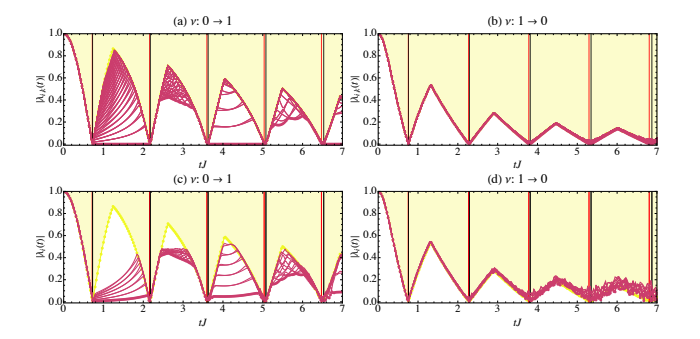
Researchers have discovered a deep connection between the internal properties of materials undergoing rapid change and the behaviour of their boundaries, establishing a dynamical bulk-boundary correspondence. This phenomenon occurs during dynamical quantum phase transitions, and is analogous to the well-known relationship between a material’s bulk properties and its surface states. The research extends previous observations in simpler systems to two-dimensional materials, revealing a more complex interplay between internal dynamics and boundary effects. The team investigated how the return rate, a measure of how much a system resembles its initial state after a period of change, behaves at critical times.
They found that the existence of specific energy levels within the Loschmidt matrix directly influences the return rate at the material’s edges. Specifically, the presence of “in-gap bands” within the Loschmidt matrix between critical times leads to a measurable contribution to the return rate at the boundary. This boundary contribution manifests as a distinct signature in the return rate, allowing researchers to distinguish it from the overall behaviour of the material. By comparing materials with different boundary conditions, the team demonstrated that the boundary return rate scales predictably with the system size.
In the case of a two-dimensional material, the ribbon geometry exhibits a boundary return rate that scales linearly with its length, while the flake geometry shows a scaling proportional to its area. Interestingly, the research reveals that these boundary effects are not simply a consequence of edge states being fixed at zero energy, as observed in one-dimensional systems. Instead, the in-gap bands within the Loschmidt matrix dynamically change over time, leading to a more nuanced behaviour at the boundaries. The magnitude of this boundary contribution, even in the presence of these dynamic in-gap bands, is significant enough to be reliably measured and distinguished from the bulk behaviour of the material, confirming the existence of a robust dynamical bulk-boundary correspondence in two dimensions. This discovery provides new insights into the behaviour of materials undergoing rapid change and could have implications for the design of novel quantum devices.
Quench Dynamics Reveal Boundary-Driven Topological Phases
This research investigates dynamical phase transitions and topological properties in two-dimensional materials following rapid changes in their properties, known as quenches. The team demonstrates that when these quenches occur in topologically non-trivial systems, significant contributions to a quantity called the dynamical free energy arise from the boundaries of the material. These boundary contributions are linked to the appearance of special energy levels, or in-gap modes, within the Loschmidt matrix between critical times during the quench. The findings establish a dynamical analogue of the bulk-boundary correspondence, a well-known principle in topological materials, extending it to time-evolving systems.
Specifically, the research shows that the presence of these in-gap modes directly causes large periodic contributions to the boundary dynamical free energy, suggesting this quantity could serve as an indicator of different dynamical topological phases. The team confirmed the robustness of these modes against disorder, supporting their topological origin. Future research will focus on directly connecting the observed boundary behaviour to a dynamically changing topological index, which would quantify the number of in-gap modes present at any given time. Additionally, they aim to identify other, potentially more easily measurable, physical quantities that could be used to observe this effect experimentally.
🗞 A Dynamical Bulk-Boundary Correspondence in Two Dimensional Topological Matter
🧠 ArXiv: https://arxiv.org/abs/2508.11521


