
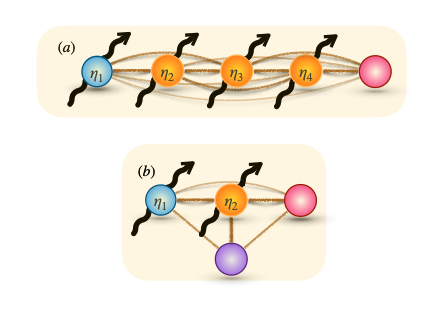
Research demonstrates weighted graph states, generated by interacting Ising spin systems with distance-dependent interaction strength, successfully implement single and two-qubit gates exceeding classical limits. Optimisation reveals a threshold interaction fall-off rate above which gate fidelity consistently improves, proving resilience to measurement noise and interaction disorder.
Quantum computation, a paradigm leveraging the principles of quantum mechanics to solve complex problems intractable for classical computers, continues to seek robust and scalable physical platforms for its realisation. A promising approach centres on measurement-based quantum computation (MBQC), where entangled states, such as weighted graph states (WGS), serve as the computational resource, with computation driven by a sequence of measurements. Recent research, detailed in an article by Debkanta Ghosh, Keshav Das Agarwal, Pritam Halder, and Aditi Sen(De) all from the Harish-Chandra Research Institute, a constituent institution of the Homi Bhabha National Institute, demonstrates the potential of utilising variable-range interacting Ising spin systems to generate these WGS. Their work, entitled “Measurement-based quantum computation with variable-range interacting systems”, reveals that carefully engineered interactions, where strength diminishes with distance following a power law, can facilitate the implementation of single- and two-qubit gates with fidelity surpassing classical limits, even when accounting for realistic imperfections in measurement and system disorder. The study identifies a critical threshold for interaction fall-off rate, above which robust gate operation is consistently achieved, suggesting a viable pathway towards resilient quantum computation utilising long-range interacting systems.
Recent research demonstrates the successful implementation of single- and two-qubit gates utilising weighted graph states (WGS) generated by variable-range Ising spin systems, establishing a viable pathway for measurement-based quantum computation (MBQC). A qubit, or quantum bit, is the basic unit of quantum information, analogous to a bit in classical computing, but leveraging quantum mechanical phenomena like superposition and entanglement. MBQC operates by preparing a highly entangled multi-qubit state, the WGS, and then performing a series of single-qubit measurements on individual qubits to drive the computation forward. The fidelity of these gates surpasses classical limits through strategically chosen measurements, demonstrating the potential for quantum advantage and opening new avenues for quantum information processing.
The study identifies a threshold fall-off rate for the interaction between spins, above which the fidelity of both universal single- and two-qubit gates consistently exceeds acceptable accuracy levels. This interaction strength diminishes with distance following a power law, meaning the further apart two spins are, the weaker their interaction. Establishing this quantifiable parameter is critical for optimising the physical realisation of such quantum systems, allowing researchers to fine-tune the system for optimal performance. Researchers optimise gate implementation by adjusting local unitary operations, mathematical transformations applied to qubits, while maintaining the core measurement scheme inherent to MBQC, demonstrating the importance of careful calibration and control.
The robustness of this gate implementation protocol is a key outcome, exhibiting resilience against realistic imperfections, namely noise in the measurement process and disorder in the interaction strengths between spins. Researchers model noise using unsharp measurements, acknowledging that perfect measurement is unattainable in practice, and demonstrate continued high fidelity despite these imperfections, strengthening the practical viability of WGS generated through long-range interacting systems. This resilience suggests WGS-based quantum computation can function effectively in noisy environments, offering a promising avenue for building more reliable quantum computers.
Further investigation focuses on the relationship between the fall-off rate and the achievable gate fidelity, determining the precise scaling of fidelity with the fall-off rate will be crucial for designing and optimising future quantum devices. Researchers explore alternative methods for mitigating measurement noise and interaction disorder, such as error correction protocols tailored to WGS, presenting a promising avenue for future work. Expanding the scope to consider more complex quantum algorithms implemented using this WGS-based MBQC scheme is a logical next step, assessing the scalability of the approach and identifying potential bottlenecks in generating and manipulating large-scale WGS will be essential for realising practical quantum computation.
This work builds upon existing research into persistent entanglement, a state where entanglement is maintained over extended periods, and offers a pathway towards scalable quantum computation. The ability to generate and manipulate WGS with high fidelity represents a significant step towards building quantum computers capable of tackling complex problems beyond the reach of classical computers.
👉 More information
🗞 Measurement-based quantum computation with variable-range interacting systems
🧠 DOI: https://doi.org/10.48550/arXiv.2506.11909