Understanding the behaviour of electrons in cuprate superconductors remains a central challenge in condensed matter physics, and recent work by Hiroyuki Yamase from the National Institute for Materials Science, along with colleagues, offers a significant advance in this field. The team investigates how electrons move and interact within these materials, focusing on the importance of long-range Coulomb interactions, the electrical forces between charged particles, beyond the traditionally considered on-site interactions. Their findings demonstrate that these Coulomb forces fundamentally reshape the electronic properties of cuprates, influencing everything from the behaviour of individual electrons to the emergence of the superconducting state, and potentially explaining why some multi-layered cuprates achieve higher superconducting temperatures than others. This research establishes a new theoretical framework, extending existing models to incorporate these crucial long-range interactions, and provides a deeper understanding of the complex interplay between charge dynamics and superconductivity in these fascinating materials.
The team investigates how electrons move and interact within these materials, focusing on the importance of long-range Coulomb interactions, the electrical forces between charged particles, beyond the traditionally considered on-site interactions. Their findings demonstrate that these Coulomb forces fundamentally reshape the electronic properties of cuprates, influencing everything from the behaviour of individual electrons to the emergence of the superconducting state, and potentially explaining why some multi-layered cuprates achieve higher superconducting temperatures than others. This research establishes a new theoretical framework, extending existing models to incorporate these crucial long-range interactions, and provides a deeper understanding of the complex interplay between charge dynamics and superconductivity in these fascinating materials.
Layered t-J-V Model Captures Coulomb Interactions
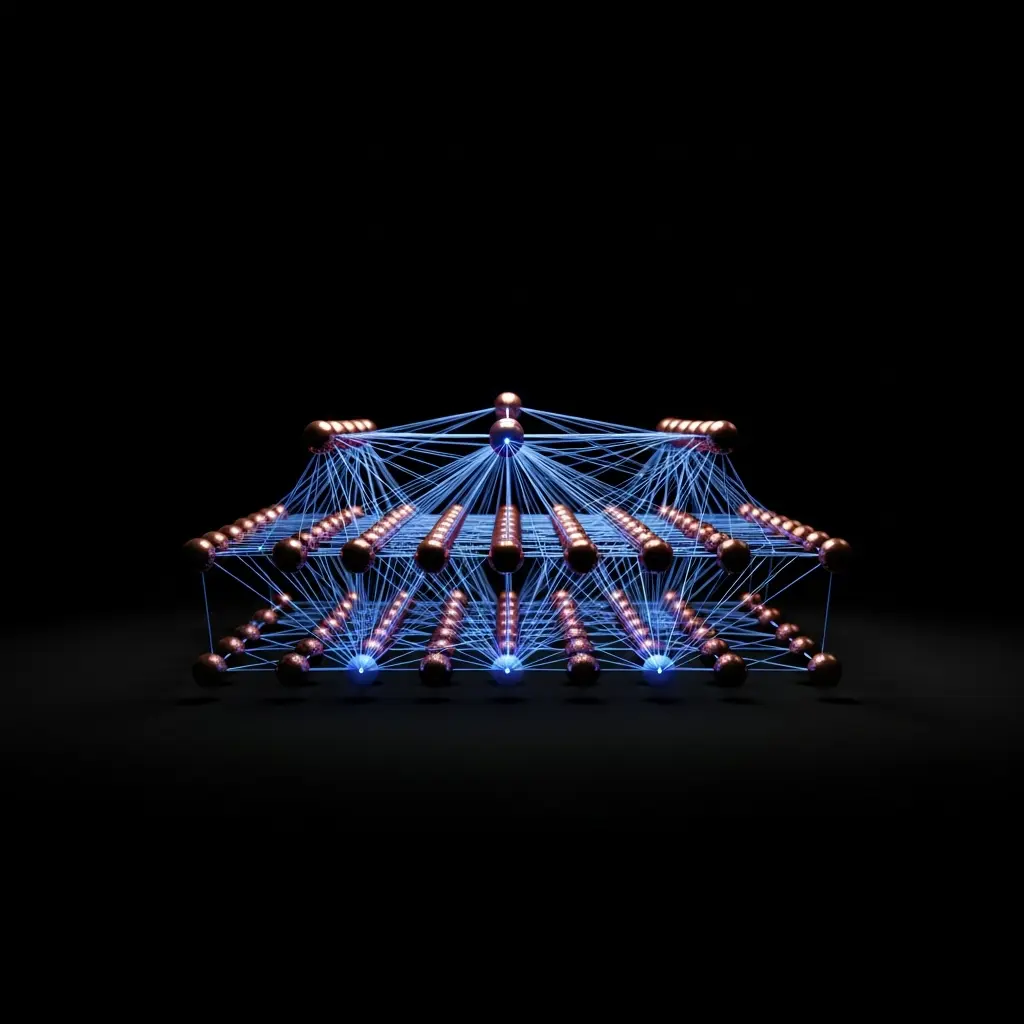
Scientists developed a sophisticated theoretical framework, the layered t-J-V model, to investigate charge dynamics in cuprate materials, specifically addressing the importance of long-range Coulomb interactions. This model extends the standard t-J model by incorporating both the layered structure of these materials and the influence of long-range Coulomb forces, enabling a more accurate description of electron behaviour. To overcome computational challenges, researchers pioneered the use of large-N theory, a mathematical approach that avoids intensive cluster calculations by systematically expanding calculations based on an increasing number of spin states. Initial calculations using this model successfully predicted a well-defined plasmon mode in doped Mott insulators, and subsequent work demonstrated its ability to accurately reproduce experimental data across various materials by carefully selecting appropriate parameters. Further investigations extended this methodology to multilayer cuprates, revealing a relationship between charge dynamics and superconductivity and predicting distinct plasmon modes confirmed by resonant inelastic x-ray scattering experiments.
Long-Range Interactions Govern Cuprate Charge Dynamics
Scientists have established the critical role of long-range Coulomb interactions in understanding charge dynamics within cuprate materials, particularly around zero momentum transfer. Resonant inelastic x-ray scattering data provides compelling evidence supporting the layered t-J-V model, demonstrating how these interactions fundamentally renormalise the properties of electrons, influencing their dispersion and spectral weight. The findings reveal that while conventional Landau quasiparticles persist at low energies, their strength is notably reduced, and charge fluctuations contribute significantly to the formation of the pseudogap phenomenon. Researchers further discovered that optical plasmon excitations generate fermionic quasiparticles called plasmarons, resulting in a distinct incoherent band, and that accurately modelling these plasmonic effects necessitates a three-dimensional theoretical framework.
Long-Range Coulomb Interactions and Charge Dynamics
This research establishes the crucial role of long-range Coulomb interactions in understanding the complex behaviour of charge dynamics within cuprate materials, particularly around zero momentum transfer. Investigations using resonant inelastic x-ray scattering data, combined with the layered t-J-V model, demonstrate how these interactions fundamentally renormalise the properties of electrons, influencing their dispersion and spectral weight. The findings reveal that while conventional Landau quasiparticles persist at low energies, their strength is notably reduced, and charge fluctuations contribute significantly to the formation of the pseudogap phenomenon, though they do not fully explain it. Furthermore, the team discovered that optical plasmon excitations generate fermionic quasiparticles called plasmarons, resulting in a distinct incoherent band, and that accurately modelling these plasmonic effects necessitates a three-dimensional theoretical framework. This understanding of plasmon excitations potentially explains why multi-layer cuprate superconductors consistently exhibit higher critical temperatures than single-layer materials.
👉 More information
🗞 Beyond on-site Hubbard interaction in charge dynamics of cuprate superconductors
🧠 ArXiv: https://arxiv.org/abs/2512.21868