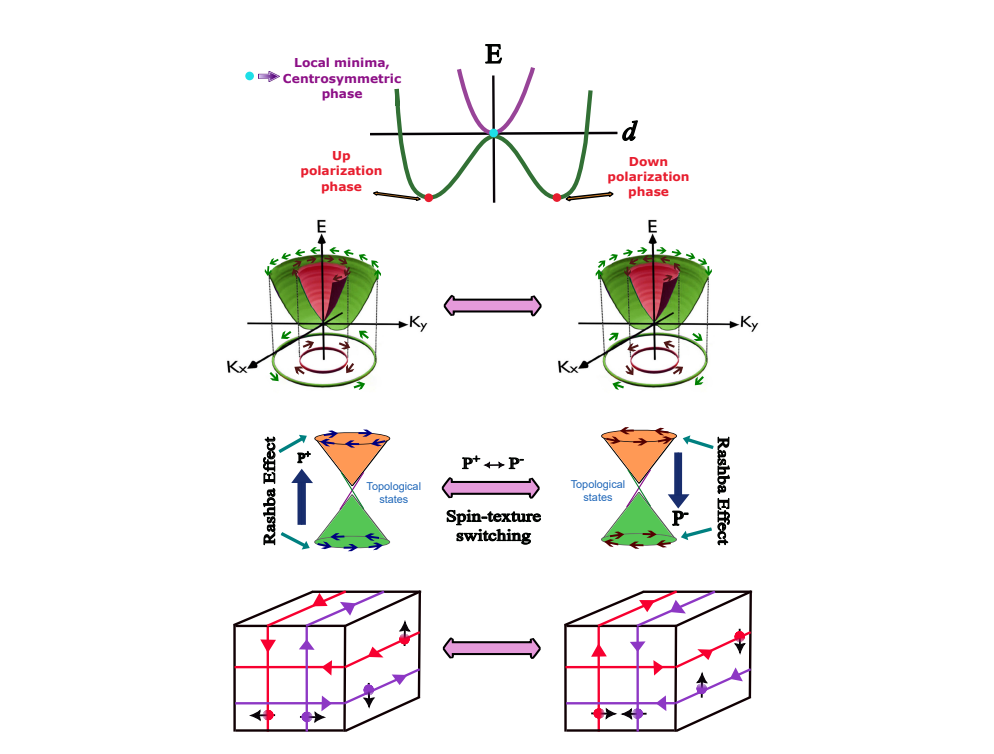
The pursuit of materials exhibiting multiple, intertwined properties represents a significant frontier in condensed matter physics, with potential applications in advanced technologies. Saurav Patel, Paras Patel, Shaohui Qiu, and Prafulla K. Jha investigate the compound lithium zinc arsenide, revealing a remarkable synergy between hyperferroelectricity, diverse topological phases, and a substantial Rashba effect. Their calculations demonstrate that this material not only maintains spontaneous polarization but also exhibits tunable topological states and a giant Rashba spin-splitting, offering a pathway to control both charge and spin. This research establishes a unified framework for achieving such complex functionalities through crystalline symmetries and spin-orbit coupling, and importantly, shows how external strain can further manipulate these properties, potentially leading to novel spintronic devices.
Through calculations, scientists have demonstrated robust hyperferroelectricity, evidenced by a substantial energy well depth and a spontaneous polarization exceeding that of commonly studied materials. This stability arises from the material’s large high-frequency dielectric constant, linked to its relatively small band gap. Furthermore, the study reveals that LiZnAs exhibits tunable topological properties, transitioning into a Weyl semimetal and then a topological insulator under applied strain.
Importantly, the critical point governing this topological transition remains consistent even when calculations are performed using different computational codes, suggesting a robust underlying mechanism. A key finding is the direct link between bulk polarization switching and spin texture reversal, offering a purely electrical method to control spin, and paving the way for novel non-volatile electronics. The ability to tune the material’s properties using strain provides a pathway for designing materials with specific functionalities, and establishes LiZnAs as a promising candidate for developing novel spintronic devices and nonvolatile memory technologies, leveraging the interplay between ferroelectricity, topology, and spin-orbit coupling. The team confirmed a stable hyperferroelectric state, characterized by a significant energy difference indicating robust spontaneous polarization even under challenging conditions.
LiZnAs Exhibits Robust Hyperferroelectricity and Topology
The study of LiZnAs compound reveals a unique combination of properties, establishing a pathway towards advanced materials for spintronics and nonvolatile applications. Researchers demonstrated the existence of intertwined hyperferroelectricity, topological characteristics, and Rashba spin-splitting within this compound, utilizing calculations to explore its potential. This stability arises from the material’s large high-frequency dielectric constant, linked to its relatively small band gap. Further investigation revealed that strain dramatically alters the electronic structure of LiZnAs. Applying strain induces a Weyl semimetal state, while exceeding this strain transforms the material into a topological insulator.
These structural modifications are accompanied by a substantial Rashba coefficient, signifying enhanced spin-orbit coupling. Importantly, the team observed a direct link between bulk polarization switching and spin texture reversal, providing a mechanism to control spin degrees of freedom within the material. The ability to tune the material’s properties using strain provides a pathway for designing materials with specific functionalities, and establishes LiZnAs as a promising candidate for developing novel spintronic devices and nonvolatile memory technologies, leveraging the interplay between ferroelectricity, topology, and spin-orbit coupling.
LiZnAs Exhibits Stable Hyperferroelectricity and Rashba Splitting
This research unveils a unified understanding of how hyperferroelectricity, multiple topological states, and Rashba spin-splitting combine within the LiZnAs compound. Scientists performed detailed calculations to demonstrate stable hyperferroelectricity, characterized by a significant energy difference indicating robust spontaneous polarization even under challenging conditions. This stability arises from the material’s unique electronic structure and its response to external influences. The study rigorously assessed the impact of crystalline symmetries and spin-orbit coupling on these properties, revealing the ability of hyperferroelectricity to maintain spontaneous polarization despite external factors.
Researchers then investigated the influence of strain on the material’s electronic structure, observing a transition to a Weyl semimetal phase and subsequently a topological insulating phase. These structural modifications are accompanied by a substantial Rashba coefficient, signifying enhanced spin-orbit coupling. Furthermore, the study established a robust mechanism for leveraging spin degrees of freedom through the switching of bulk polarization, directly reversing the spin texture. By combining these computational techniques, scientists demonstrated a pathway toward realizing advanced nonvolatile and spintronic applications based on the synergistic interplay of multiple quantum phenomena within a single material.
🗞 Intertwined Hyperferroelectricity, Tunable Multiple Topological Phases and Giant Rashba Effect in Wurtzite LiZnAs
🧠 ArXiv: https://arxiv.org/abs/2511.01370