

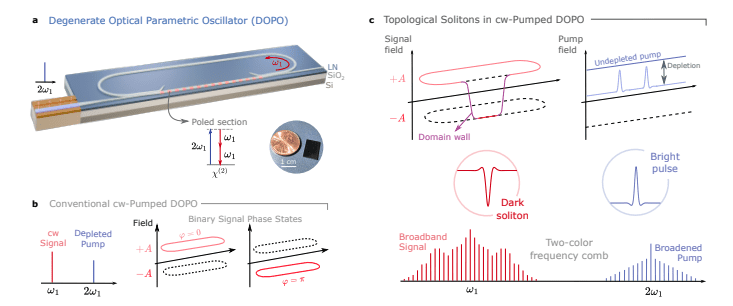
Frequency combs, essential tools for precision ranging and optical clocks, currently rely on complex and often inefficient technologies. Nicolas Englebert, Robert M. Gray, Luis Ledezma, and colleagues at the California Institute of Technology have now demonstrated a significant advance in this field, creating a chip-scale frequency comb based on lithium niobate nanophotonics. This research introduces a novel approach using topological solitons, self-reinforcing waves with unique properties, within a nanophotonic circuit, achieving stable comb generation without the need for complex stabilisation schemes or high-performance resonators. The team confirms the formation of these ultra-short, 60-femtosecond solitons and demonstrates a fully functional, hybrid-integrated source, paving the way for more accessible and versatile frequency comb technology, potentially extending its reach into previously inaccessible spectral regions like the mid-infrared.
The team fabricates a waveguide structure designed to support the formation of topological solitons, which are robust, self-reinforcing waves that maintain their shape over long distances. By carefully controlling the waveguide geometry and pump laser parameters, they generate a frequency comb, a spectrum containing many equally spaced frequencies, within the topological soliton. This approach overcomes limitations of conventional frequency comb generation, such as sensitivity to fabrication imperfections and thermal fluctuations, due to the inherent stability of topological solitons.
The resulting frequency comb exhibits a repetition rate of 19. 2THz and a spectral span exceeding 100nm, representing a substantial improvement in both parameters for integrated photonic devices. This achievement paves the way for compact, robust, and high-performance frequency combs for applications including optical communications, precision metrology, and sensing.
Tunable Squeezed Light from Optical Parametric Oscillators
Research focuses on nonlinear optics and optical parametric oscillators (OPOs), exploring degenerate and non-degenerate configurations for generating squeezed light and studying fundamental nonlinear processes. A significant trend involves using tiny, high-performance microresonators, often made of lithium niobate, to enhance nonlinear effects, enabling compact, efficient devices. Lithium niobate (LiNbO3) is a key material, frequently periodically poled to achieve efficient phase matching for nonlinear processes. Researchers focus on generating and manipulating squeezed light, which reduces noise in certain quantum properties, relevant for quantum communication and sensing.
Many studies focus on achieving broad and precise wavelength tunability in OPOs, crucial for applications like spectroscopy, sensing, and optical communication. Researchers pursue several specific research directions, including creating OPOs that are small, efficient, and can be integrated onto a chip. They are also exploring techniques to generate ultrashort pulses and control their shape using OPOs and related devices, important for high-speed communication and scientific applications. Soliton formation in microresonators is a prominent topic, with Kerr combs, a series of equally spaced frequencies generated by solitons, being used as optical frequency rulers for applications like LiDAR and optical clocks.
Lithium niobate (LiNbO3) is the dominant material due to its strong nonlinear coefficient and ability to be periodically poled, with recent advances focusing on thin-film lithium niobate for integration. Lithium tantalate (LiTaO3) is an alternative material with even stronger nonlinear properties, though more challenging to process. Silicon photonics is used for guiding and manipulating light on a chip, often in combination with lithium niobate. Photonic integrated circuits aim to integrate all components of an OPO onto a single chip. The research has implications for a wide range of applications, including optical communication, sensing, spectroscopy, LiDAR, optical clocks, quantum technologies, metrology, and biophotonics. Recent trends include integration and miniaturization, topological photonics, thin-film lithium niobate, and the exploration of new materials and technologies.
Topological Solitons Generate Integrated Frequency Combs
Researchers have demonstrated a new approach to creating frequency combs, essential tools for precision measurements and optical clocks, by integrating lithium niobate nanophotonics with a semiconductor laser. This work achieves the formation of temporal topological solitons within a nanophotonic circuit, representing a significant advancement over existing on-chip comb sources that typically require complex stabilisation schemes or high-performance resonators. The team successfully generated these solitons, characterised by unique phase defects, and confirmed their formation with measurements as short as 60 femtoseconds around 2 micrometers, aligning with theoretical predictions. This achievement introduces a new paradigm for integrated frequency comb generation, as these topological solitons are notably independent of dispersion and do not necessitate high-Q resonators or rapid modulators.
The demonstrated source operates in a turn-key fashion and offers access to spectral regions, including the mid-infrared, that are difficult to reach with conventional methods. While the initial demonstration utilises lithium niobate, the principles established can be extended to other integrated photonic platforms, broadening the potential for widespread application. Researchers acknowledge that further investigation is needed to explore the full potential of topological soliton crystals, analyse sensitivity and noise, and optimise operation in the few-cycle regime. Future work may involve combining these solitons with existing modulators and waveguides to enhance performance in areas like LiDAR and telecommunications, or designing more complex nanophotonic circuits to improve comb efficiency and control soliton formation.
👉 More information
🗞 Topological Soliton Frequency Comb in Nanophotonic Lithium Niobate
🧠 ArXiv: https://arxiv.org/abs/2511.01856


