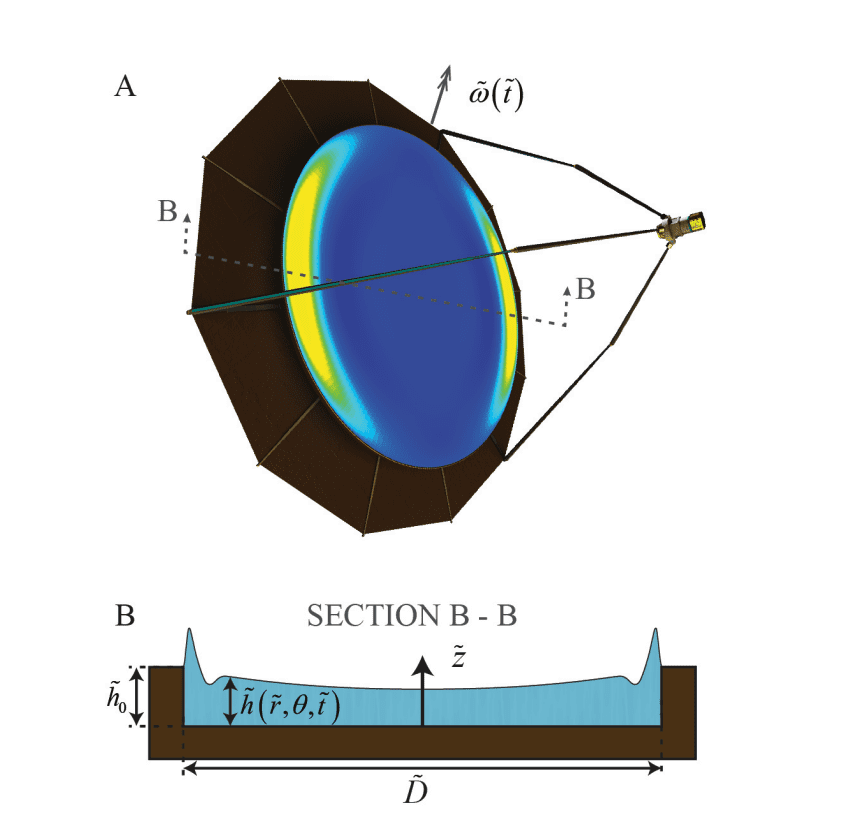
The pursuit of larger astronomical telescopes necessitates innovative designs that circumvent the limitations imposed by conventional solid mirror fabrication and launch constraints. Recent research focuses on the feasibility of utilising liquid mirrors in space, offering the potential for apertures extending to tens of metres. Israel Gabay, Omer Luria, and colleagues, in their paper ‘Fluid dynamics of a liquid mirror space telescope’, present a detailed analytical model examining the dynamic behaviour of a thin liquid film deployed as a telescope mirror. Their work investigates the impact of telescope movements and inherent fluid properties on maintaining optical precision, utilising the 50-metre Fluidic Telescope (FLUTE) concept as a case study. The model demonstrates that, despite potential surface deformations reaching several microns, sustained optical functionality is achievable over extended operational periods, offering valuable insights into the engineering challenges and performance characteristics of this emerging telescope technology.
Large-aperture telescopes are essential tools for astronomical observation, yet conventional solid-mirror designs encounter engineering limitations when attempting to exceed diameters of several metres. The Fluidic Telescope (FLUTE) concept proposes utilising a liquid mirror in space, potentially enabling telescopes exceeding 50 metres in diameter. However, maintaining the necessary optical precision with a fluid surface presents significant challenges. Researchers currently investigate the dynamic behaviour of a thin liquid film confined within a circular domain, specifically modelling the FLUTE concept under anticipated operational conditions. They have developed a closed-form analytical solution to a non-self-adjoint problem, meaning the mathematical problem does not have a simple, symmetrical solution, requiring a more complex approach.
The model examines liquid dynamics during both telescope actuation – the process of moving the telescope into a desired position, known as ‘slewing’ – and the subsequent relaxation phase. It incorporates key geometrical parameters, such as the telescope’s radius and the depth of the liquid film, alongside relevant liquid properties like viscosity and surface tension, to predict the deformation of the liquid mirror surface. Results demonstrate a direct relationship between telescope maneuvers and the resulting degradation of the mirror’s optical quality. This establishes a ‘maneuvering budget’, defining the acceptable range of movements to maintain optical functionality and prevent unacceptable image distortion. Simulations spanning ten years of typical telescope operation reveal that, while maximal deformation reaches several microns – millionths of a metre – the spatial distribution and propagation rate of these deformations allow the telescope to sustain its optical capabilities for extended periods.
This work provides valuable insights into the performance characteristics of liquid-film space telescopes, establishing a predictive model that offers crucial guidelines for the design and operation of future large-aperture telescopes. The analytical solution offers a powerful, computationally efficient tool for evaluating different telescope configurations and liquid properties, circumventing the need for complex and time-consuming numerical simulations in many scenarios. This represents a significant step towards realising the potential of liquid-film space telescopes, allowing for informed decision-making regarding telescope design, operational planning, and the selection of appropriate liquid materials.
A substantial portion of the telescope aperture remains suitable for astronomical observations, even with continuous movement, highlighting the importance of maneuver sequencing and parameter selection in mitigating surface degradation. Future research should focus on validating these theoretical predictions through experimental testing and refining the model to incorporate additional complexities, such as the effects of surface tension – the tendency of liquid surfaces to minimise their area – and the influence of external disturbances like micrometeoroid impacts. Exploring the feasibility of incorporating feedback mechanisms based on real-time surface monitoring could enable dynamic adjustments to maintain optical quality, and investigating different liquid materials with varying viscosities and surface tensions could further optimise telescope performance. This ongoing research promises to unlock new frontiers in astronomical observation, enabling scientists to explore the universe with unprecedented clarity and precision.
👉 More information
🗞 Fluid dynamics of a liquid mirror space telescope
🧠 DOI: https://doi.org/10.48550/arXiv.2507.02812