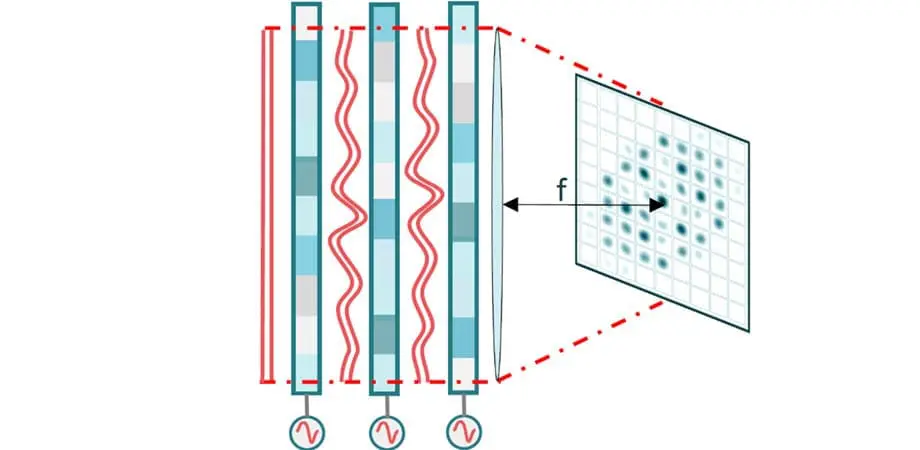
Photonic circuits, crucial for fields such as quantum computing and artificial intelligence, face challenges in scaling due to increasing optical losses. Researchers at the University of Naples Federico II have addressed this issue by developing a liquid-crystal-based platform that enables photonic circuits to handle hundreds of optical modes with minimal loss increase.
Their system uses three precisely engineered liquid-crystal metasurfaces arranged in a compact two-dimensional setup, allowing for efficient simulation of quantum processes like quantum walks. This advancement overcomes previous limitations and supports up to 800 optical modes, achieved through an innovative algorithm that creates smooth patterns with isolated vortices, ensuring stable light propagation. The technology’s versatility opens new possibilities for low-loss photonic circuits, enhancing capabilities in photonic quantum experiments.
Photonic circuits play a crucial role in advanced technologies by manipulating light to perform computational tasks efficiently. These circuits are particularly valuable in fields such as quantum computing and artificial intelligence because they can process information with minimal energy loss. However, scaling these systems has been challenging because increased circuit size and complexity lead to higher optical losses, hindering large-scale applications like multiphoton experiments or all-optical AI.
Researchers at the University of Naples Federico II have addressed this challenge using a liquid-crystal (LC)-based platform. Their system employs three precisely engineered LC metasurfaces to handle hundreds of optical modes in a compact, two-dimensional setup. This approach significantly reduces optical losses compared to traditional photonic circuits, where losses escalate with more modes.
The team overcame challenges transitioning from one-dimensional to two-dimensional systems by developing an algorithm that creates smooth liquid-crystal patterns. These patterns incorporate isolated vortices, which minimally disrupt light propagation and enable the simulation of up to 800 optical modes. This advancement enhances scalability while maintaining low losses, which is crucial for efficient photonic operations.
This technology’s application in quantum simulations underscores its potential for scalable photonic circuits. By maintaining low optical losses, the LCMS platform supports complex quantum tasks, demonstrating a practical approach to advancing photonic technologies and their applications in quantum computing.
Overcoming challenges in two-dimensional photonic circuits
The research by the University of Naples on liquid-crystal metasurfaces (LCMS) represents a notable advancement in photonic circuits, particularly in managing optical losses as the number of modes increases. Here’s an organized summary of the key points:
- Liquid-Crystal Metasurfaces (LCMS): These act as programmable phase masks, enabling precise control over light propagation and facilitating complex quantum operations by simulating arbitrary unitary transformations.
- Transition to 2D Systems: The team successfully moved from one-dimensional to two-dimensional systems using an innovative algorithm that generates smooth liquid-crystal patterns with isolated vortices. These vortices minimize disruption to light propagation, allowing the simulation of up to 800 optical modes—a significant improvement over previous systems.
- Applications and Versatility: The technology is versatile and applicable beyond quantum computing to various computational tasks requiring precise light control, such as data processing or medical imaging.
- Scalability and Efficiency: By handling hundreds of modes in a compact setup, the platform offers scalability without substantial increases in optical losses, making it suitable for integration into existing technologies.
- Impact on Quantum Computing: Reducing optical losses enhances the reliability of quantum operations by minimizing noise and interference, which is crucial for maintaining coherence in quantum states.
- Future Directions and Challenges: While promising, questions remain about manufacturing complexity, scalability beyond 800 modes, and specific real-world applications. Future research may focus on increasing mode numbers, improving efficiency, or exploring new applications.
This advancement holds potential for various fields, though practical implementation and scaling challenges need to be addressed to realize its full impact.
More information
External Link: Click Here For More