Researchers are increasingly exploring photonic memristors as a pathway to create complex, history-dependent systems for advanced computation. Alessio Baldazzi and Roy Philip George Konnoth Ancel, working with colleagues from the Department of Physics at the University of Trento and the Laboratory Light, nanomaterials and nanotechnologies (L2n UMR 7076) at the University of Technology of Troyes-UTT and CNRS, demonstrate a network of coupled integrated photonic memristors fabricated on a silicon nitride photonic integrated circuit. This work, also involving contributions from Sebastiano Guaraldo, Xuan Chen, Ziad Abi Akar, Regis Deturche, Stefano Azzini, Christophe Couteau and Lorenzo Pavesi, is significant because it moves beyond isolated devices to showcase a scalable architecture driven by a room-temperature single-photon source based on a silicon-vacancy colour center. The team’s experimental realisation exhibits enhanced memristive behaviour and novel non-Markovian dynamics, paving the way for compact neuromorphic computing and reservoir architectures.
Scientists have created a novel system merging quantum properties with conventional electronics, potentially revolutionising data processing. This advance uses light, rather than electricity, to create memristors, components that ‘remember’ past activity and offer a new pathway for more efficient computing. The technology could pave the way for smaller, faster and more energy-efficient devices inspired by the human brain.
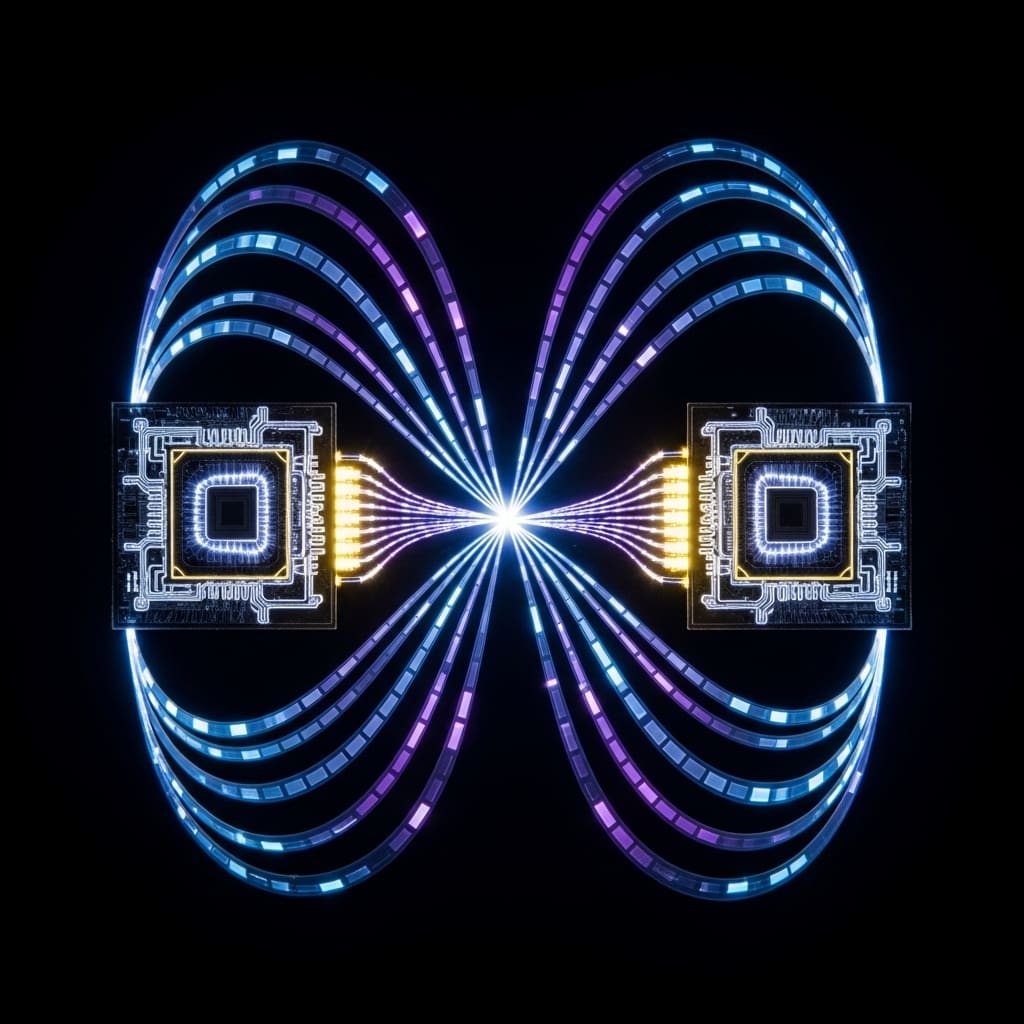
Researchers in Troyes, France have contributed equally to this work. Photonic quantum memristors offer a measurement-induced pathway to nonlinear and history-dependent quantum dynamics. Experimental demonstrations have, until now, concentrated on isolated devices or simple cascaded device configurations. They experimentally realised and characterised a network of two coupled photonic quantum memristors with crossed feedback, implemented on a silicon nitride photonic integrated circuit and fed by a room-temperature single-photon source based on a silicon-vacancy colour centre SiV− in a nanodiamond.
Coupled photonic memristors exhibit enhanced bistability and history-dependent memory effects
Inter-memristor hysteresis curves exhibited form factors exceeding those observed in single devices, revealing a marked increase in bistability and non-trivial memory dynamics within the coupled system. Specifically, the research demonstrates self-intersecting loops in these curves, a characteristic indicative of complex, history-dependent behaviour not previously seen in isolated photonic memristors.
These loops signify the system’s ability to maintain multiple stable states, enhancing its potential for information storage and processing. Numerical simulations corroborate these experimental findings, linking the observed features to the interplay between memory depth and relative input phase for both intra- and inter-memristor relations. The study utilised a silicon nitride photonic integrated circuit to implement a network of two coupled photonic memristors with crossed feedback, driven by a room-temperature single-photon source based on a silicon-vacancy (SiV) colour centre in nanodiamonds.
Each memristor comprises an integrated Mach-Zehnder interferometer, its transfer function adaptively modified by photon detection events occurring on the other memristor. This adaptive process generates non-Markovian input-output dynamics, substantially enhancing the memristive behaviour compared to single devices. The SiV colour centre provided a stable and spectrally narrow single-photon emission, crucial for precise control and characterisation of the memristor network.
Analysis of intra-memristor input-output relations further revealed enhanced memory effects, with the coupled configuration demonstrating a more pronounced history-dependence than isolated memristors. The observed features are not simply a linear combination of individual device responses, but emerge from the complex interactions between the two memristors. This suggests a synergistic effect, where the coupling amplifies the memory capacity and nonlinear response of the system, paving the way for more sophisticated quantum information processing architectures.
Photonic quantum memristor networks exhibit bistable topological memory dynamics
Scientists are investigating adaptively updated photonic quantum memristors, generating novel non-Markovian input-output dynamics with an enhanced memristive behaviour compared to single devices. Researchers report inter-memristor input-output hysteresis curves exhibiting larger form factors and displaying self-intersecting loops, respectively revealing marked bistability and topologically non-trivial memory dynamics.
Furthermore, numerical simulations show how these features emerge from the interplay between memory depth and relative input phase, for both intra- and inter-memristor input-output relations. Machine learning has become one of the most powerful tools in industry, business, and daily life, enabling efficient data processing and decision-making. Building on these successes, it is also increasingly adopted as an innovative tool in scientific research.
A key ingredient in machine learning is the presence of nonlinear computations and memory, the ability to retain and process information based on past inputs. Traditional digital circuits struggle to replicate these features efficiently. The memristor concept was first proposed by Chua in the 1970s as a fundamental circuit element that relates magnetic flux and electric charge, as predicted by symmetry considerations in nonlinear electrical circuits.
Researchers demonstrated a memristor for the first time in 2008 with a nanoscale electronic circuit. The notion of memristive systems was soon extended to capacitive and inductive elements. Nowadays, it has been made clear that memelements are physical devices that satisfy specific physical properties. To study the behaviour of coupled photonic quantum memristors, single photons from a negatively charged silicon vacancy SiV−colour centre coupled to the input of the integrated circuit.
Colour centres are defects created or naturally present in the all-carbon lattice of diamond when adjacent carbon atoms are replaced by a vacancy-impurity atom combination that exhibits an atom-like electronic structure; in the case of SiV−, this impurity is a Silicon atom. The so-called group-IV colour centres, such as the SiV−, exhibit bright, narrow-band, highly polarized and photostable single photon emission with short lifetimes.
The SiV−colour centre used in this work hosts a nanodiamond grown using a high pressure and high temperature (HPHT) process. Researchers selected this specific nanodiamond from among those deposited on a silicon substrate via spin coating. The selection process was conducted using a homemade room temperature micro-photoluminescence (μ-PL) setup by means of confocal intensity scans followed by photoluminescence measurements.
The single photon emission was confirmed using a Hanbury Brown and Twiss interferometer with the measurement of the photon autocorrelation function g showing an antibunching dip and a full width at half maximum. These data were obtained by a fit of the experimental points with a 2-level emitter model. This work constitutes the first implementation of PQMs combining memristive devices and a quantum light source both characterised by a high level of integrability, thus paving the way towards large-scale PQM architectures.
👉 More information
🗞 Coupled integrated photonic quantum memristors using a single photon source made of a colour center
🧠 ArXiv: https://arxiv.org/abs/2602.14736