

The interplay between quantum particles and magnetism forms the basis of many advanced materials, and recent research explores a novel connection between spin and massless particles called axions. Yuto Hosogi and Koichiro Furutani, both from the Department of Applied Physics at Nagoya University, alongside Yuki Kawaguchi and colleagues, demonstrate how the behaviour of electrons confined to a one-dimensional system can generate a dynamical axion field through interactions with the surrounding magnetic spins. This work reveals that these axion fields respond to external stimuli, such as electric fields, in a way that reverses the behaviour predicted by established models of electron transport, offering a new pathway for controlling and manipulating quantum systems. By combining theoretical analysis with advanced computational techniques, the researchers not only predict this unusual behaviour but also propose a potential experimental realisation using cold atoms, paving the way for future investigations into axion physics and novel quantum devices.
Cold Atom Simulation of Topological Matter
This is a comprehensive collection of references to physics literature, primarily focused on topological phases of matter, quantum simulation with cold atoms, and related theoretical concepts. The collection covers a broad range of research areas, providing a valuable resource for scientists working at the intersection of condensed matter physics and quantum information. A significant portion of the references deal with topological insulators and related materials, including discussions of edge and surface states. The collection also explores Weyl and Dirac semimetals, which exhibit unique electronic properties, and utilizes ultracold atoms trapped in optical lattices to simulate condensed matter systems exhibiting topological behaviour.
This approach allows researchers to create and study exotic quantum phases in a controlled laboratory setting. A strong emphasis is placed on gauge theories with fermions, and the axial anomaly is a recurring theme, alongside tensor networks such as DMRG and PEPS, efficient numerical methods for simulating strongly correlated quantum systems. Research concerning the dynamical aspects of topological systems, including solitons and Peierls insulators, is also represented, as are the chiral magnetic effect, chiral anomaly, and their consequences in various materials. While the references do not explicitly name researchers, the recurring themes suggest the work of prominent groups in these fields, such as those led by Bloch and Lewenstein in cold atom quantum simulation, and Bernevig, Fu, Hasan, Zhang, and Qi in topological materials theory. Researchers employing tensor network methods, such as Vidal and White, are also well-represented, alongside the contributions of Son and Kharzeev in gauge theory and anomalies. In summary, this collection represents a vibrant and active area of research at the intersection of condensed matter physics, quantum information, and materials science, highlighting ongoing efforts to understand and harness the exotic properties of topological phases of matter using both theoretical tools and experimental platforms like cold atoms.
Fermions Simulate Axion Field Dynamics
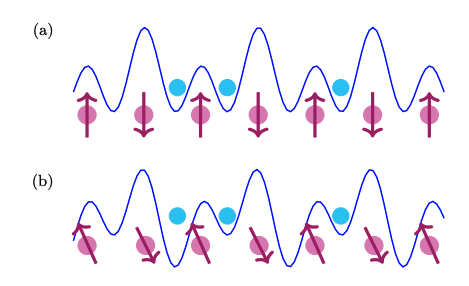
Researchers have demonstrated a novel system where the behaviour of particles closely mimics the dynamics of an “axion field”, a concept originally proposed in high-energy physics and now considered a candidate for dark matter. This work establishes a connection between complex phenomena in particle physics and the controllable environment of a one-dimensional optical lattice, offering new avenues for simulating and understanding these concepts. The system utilizes spinless fermions confined to a lattice, with interactions between particles mediated by spins placed on the links between lattice sites. The key finding is that these link spins, when arranged in a specific antiferromagnetic order, behave collectively as a dynamical axion field.
Applying a chemical potential gradient causes this axion field to rotate, effectively controlling the spin orientations, a phenomenon described by an “axion Lagrangian”. Remarkably, this behaviour represents a phenomenon complementary to Thouless pumping, demonstrating a new way to manipulate particle interactions through spin control. The researchers validated their theoretical predictions using sophisticated numerical simulations, employing tensor networks to model the complex interactions between fermions and spins. Importantly, the results from these full quantum simulations closely matched those obtained using a simpler, classical approximation of the spin behaviour, confirming the robustness of the observed phenomenon.
Furthermore, quantum correlations between the spins accelerate the dynamics of the axion field, allowing for faster and more efficient control. This research opens exciting possibilities for quantum simulation, offering a platform to explore axion physics in a controlled laboratory setting. By manipulating the interactions between particles in this system, researchers can gain insights into the properties of axions and their potential role in dark matter. The demonstrated control over the axion field also suggests potential applications in manipulating particle transport and exploring novel quantum phenomena in condensed matter physics. The team proposes that this system can be experimentally realised using cold-atomic gases, paving the way for future investigations and technological advancements.
Link Spins Mimic Dynamical Axion Response
This research investigates the behaviour of spinless fermions on a one-dimensional lattice interacting with spins located on the links between lattice sites. The study demonstrates that under specific conditions, these link spins behave similarly to a dynamical axion field, a concept from particle physics, and respond to external stimuli like chemical potential gradients. The team confirmed this behaviour using two complementary approaches. First, they modelled the system assuming the spins behaved classically, predicting how they would rotate in response to external forces. Subsequently, they employed a more complex computational method to simulate the full quantum dynamics of both the fermions and the spins, finding strong agreement with the classical predictions.
The researchers also highlight that the correlation between spins accelerates the dynamics of the axion field, allowing for easier rotation. They propose a potential experimental setup using cold atoms to physically realise and test their theoretical model. The authors acknowledge that their calculations rely on approximating the spins as classical entities, which may not fully capture the quantum nature of the system, and suggest future work could explore the impact of quantum spin fluctuations on the observed dynamics. The findings contribute to a deeper understanding of coupled fermion-spin systems and may have implications for exploring novel quantum phenomena and designing new materials with tailored electronic properties.
🗞 Dynamical axion fields coupled with one-dimensional spinless fermions
🧠 ArXiv: https://arxiv.org/abs/2508.02370


