Clock atom interferometry represents a promising frontier in precision measurement, and researchers are increasingly focused on techniques that utilise large momentum transfer (LMT) to enhance sensitivity. Yijun Jiang, Jan Rudolph, and Jason M. Hogan, from Stanford University, address a critical challenge facing these next-generation devices: the impact of laser noise on measurement accuracy. Their work demonstrates that cumulative errors arising from sequential state inversions in an LMT interferometer scale favourably, offering a significant advantage over traditional two-level systems, and importantly, that imperfections in laser pulses do not substantially degrade performance. These findings establish that laser frequency noise does not represent a fundamental barrier to building highly accurate LMT clock atom interferometers, paving the way for advancements in fields ranging from fundamental physics to gravitational wave detection.
Atom Interferometry References and Research Overview
This extensive list details research related to atom interferometry, covering fundamental concepts, advanced techniques, and potential applications. The work is categorised to provide a structured overview of the field and highlight key connections between different studies. Core research focuses on the fundamental principles of atom interferometry and its application to testing fundamental physics, including general relativity and gravity gradients. Advanced interferometer designs, such as long-baseline instruments for gravitational wave detection, are also prominent. A major theme throughout the research is the enhancement of atom interferometer performance.
Many papers focus on techniques like pulse shaping and composite pulses, which compensate for inhomogeneities, improve phase response, and enhance robustness against noise. The use of broadband Raman pulses and temporal pulse shaping are also investigated, with symmetric large momentum transfer (SLMT) techniques offering benefits by reducing sensitivity to systematic errors. Research also explores the use of top-hat laser beams for improved performance. Reducing noise and controlling systematic errors are critical areas of research. Studies address the impact of laser noise and magnetic fields on interferometer fidelity, and techniques for mapping and controlling these effects are investigated.
Composite light pulses are demonstrated as a method for reducing systematic errors. Research also focuses on specific atom species, particularly strontium, which offers advantages for high-precision interferometry due to its optical clock transitions, with cesium and rubidium also commonly used in these experiments. Applications include gravimeters, gradiometers, and gravitational wave detection.
Laser Noise Limits Large Momentum Transfer Interferometry
Clock atom interferometry offers a promising route to precision measurement, with potential applications ranging from fundamental physics tests to gravitational wave detection and dark matter searches. Increasing the momentum imparted to the atoms, a technique known as large momentum transfer (LMT), enhances the sensitivity of these instruments. Recent proposals envision LMT levels exceeding 10 4, but concerns have been raised regarding the impact of laser frequency noise on achieving such high levels of precision. Researchers have now investigated the cumulative effect of laser frequency noise on the fidelity of LMT clock atom interferometers, demonstrating that it does not present an insurmountable obstacle.
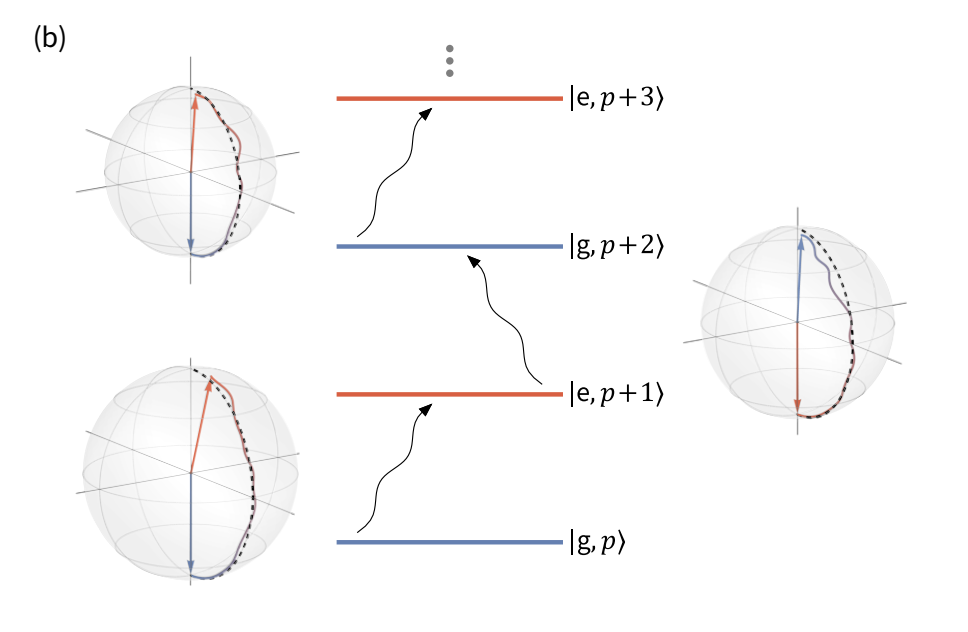
Their analysis focuses on the sequential application of pulses to atoms, alternating the direction of momentum transfer with each pulse. The team’s simulations reveal that the population error resulting from these pulses scales linearly with the number of pulses applied, a significant improvement over the quadratic scaling observed when probing atoms from a single direction. This linear relationship indicates that the impact of laser frequency noise grows much more slowly than previously feared, easing the requirements for laser stability. The study also addresses the potential for errors to accumulate through unintended signal pathways created by imperfect pulses.
By carefully modelling these pathways, the researchers demonstrate that their contribution to signal loss is negligible, regardless of the number of pulses used. This finding further supports the feasibility of achieving very high LMT levels. Specifically, the team’s calculations show that a laser stabilised to a noise level of 10 Hz is sufficient to support an LMT enhancement of 10 4. This result aligns with previous proposals for next-generation long-baseline atom interferometers and confirms that laser frequency noise does not represent a fundamental limitation for developing highly sensitive LMT-based instruments. These findings pave the way for future experiments capable of probing fundamental physics with unprecedented precision.
Laser Noise Does Not Limit Interferometry
This research addresses a key concern regarding the feasibility of next-generation clock atom interferometers that utilise large momentum transfer (LMT) techniques. The team demonstrates that laser frequency noise, previously thought to be a limiting factor, does not pose a practical constraint for achieving high-fidelity LMT interferometry. Their analysis reveals that population errors resulting from sequential pulses in these interferometers scale favourably, simplifying the requirements for laser stability and enhancing the potential for high-precision measurements. Importantly, the study establishes that contributions from unintended signal pathways created by imperfect pulses are negligible, regardless of the number of pulses employed.
Through analytical calculations and modelling with realistic laser noise spectra, the researchers show that a laser stabilised to a reasonable level of noise, 10 Hz, can support LMT enhancement at a level of 10 4. This finding validates existing proposals for long-baseline clock atom interferometers and reinforces the potential of LMT techniques for precision measurement. The authors acknowledge that their analysis focuses on specific aspects of interferometer performance and does not encompass all potential sources of error. Future work could explore the impact of other noise sources or investigate the optimisation of pulse sequences for even greater fidelity. Nevertheless, this research provides a strong theoretical foundation for the development of high-performance LMT clock atom interferometers and paves the way for advancements in precision sensing technologies.
🗞 Cumulative Fidelity of LMT Clock Atom Interferometers in the Presence of Laser Noise
🧠 ArXiv: https://arxiv.org/abs/2508.10288