

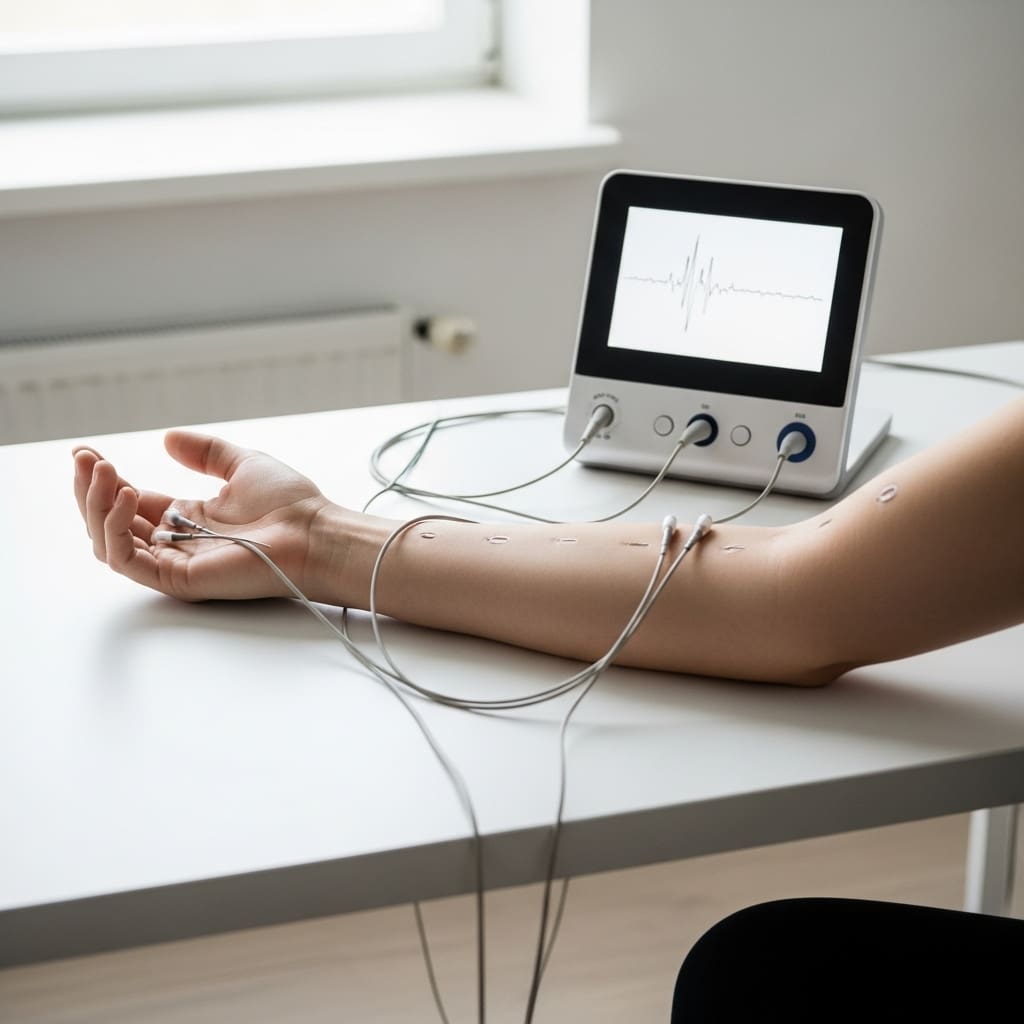
Decoding surface electromyography (EMG) signals reliably over extended periods remains a significant challenge, as performance is often compromised by factors like electrode movement, muscle fatigue and changes in posture. Nia Touko, Matthew O A Ellis, and Cristiano Capone, from the University of Sheffield and the Istituto Superiore di Sanità, alongside Alessio Burrello, Elisa Donati, Luca Manneschi et al., have addressed this issue with a novel, lightweight framework for test-time adaptation. Their research introduces three strategies , causal adaptive batch normalization, a Gaussian Mixture Model alignment with experience replay, and a rapid calibration technique , designed to maintain accuracy without requiring substantial computational resources. This work is particularly important as it paves the way for more robust and practical myoelectric control systems, potentially enabling truly “plug-and-play” prosthetics and wearable devices. By demonstrating significant improvements on the NinaPro DB6 dataset with minimal overhead, the team offers a promising solution for long-term, energy-efficient EMG-based gesture recognition.
EMG Drift Correction via Lightweight Test-Time Adaptation Reliable
Reliable long-term decoding of surface electromyography (EMG) is hindered by signal drift caused by electrode shifts, muscle fatigue, and posture changes. While state-of-the-art models achieve high intra-session accuracy, their performance often degrades sharply over time. Researchers propose a lightweight framework for Test-Time Adaptation (TTA) utilising a Temporal Convolutional Network (TCN) backbone to address these limitations. The primary objective of this research is to develop a practical and efficient TTA framework for long-term EMG decoding suitable for wearable applications. The approach focuses on minimising recalibration or user intervention while maintaining high decoding accuracy despite non-stationary EMG signals, with specific contributions including the proposed causal adaptive batch normalisation technique and the uncertainty-aware weighting scheme.
TCNs for EMG Drift Correction Strategies
Researchers addressed signal drift in surface electromyography (EMG) by developing a lightweight framework for test-time adaptation (TTA) utilising a Temporal Convolutional Network (TCN). The study employed the NinaPro DB6 multi-session dataset, containing recordings of seven distinct grasping gestures captured using fourteen double-differential EMG electrodes around the forearm. A TCN decoder was tailored for physiological time-series analysis, enabling systematic evaluation of both intra- and inter-session generalisation performance. The core of the research involved engineering three strategies to mitigate signal drift.
The team implemented causal adaptive batch normalization, an unsupervised method that dynamically updates normalization statistics during inference for rapid alignment with minimal computational cost. Scientists also developed a replay-regularized statistical alignment technique, updating a low-rank parameter subset while leveraging a replay buffer to preserve representations from the source domain and prevent catastrophic forgetting. To further enhance calibration efficiency, the study pioneered the use of meta-learning as an optimisation strategy, designed to harness cross-session variability for high-efficiency, few-shot calibration. Experiments employed a TCN architecture comprising stacked causal convolutional blocks, each incorporating batch normalization and residual connections.
The system delivers a model with only 0.05x 10⁶ parameters, significantly reducing computational demands compared to benchmarks like Bioformer and Moment. Benchmarking revealed that while the baseline model achieved state-of-the-art intra-session accuracy, performance degraded significantly in inter-session scenarios. Experience-replay updates demonstrated superior stability under limited data conditions, while the meta-learning approach achieved competitive performance in one- and two-shot regimes, utilising a fraction of the data required by existing methods. This work establishes a pathway towards robust, “plug-and-play” myoelectric control, paving the way for long-term prosthetic use and energy-efficient wearable devices.
Long-Term EMG Decoding via Test-Time Adaptation
Scientists achieved advancements in long-term surface electromyography (EMG) decoding, addressing signal drift caused by electrode shifts and muscle fatigue. The research team developed a lightweight framework utilising a Temporal Convolutional Network (TCN) backbone, designed for Test-Time Adaptation (TTA) and deployed with three distinct strategies. Experiments revealed that causal adaptive batch normalization effectively aligns statistical distributions in real-time. Furthermore, the team implemented meta-learning, achieving competitive performance in one- and two-shot calibration regimes, requiring substantially less data than current benchmark methods. Evaluated on the NinaPro DB6 multi-session dataset, the framework bridges the inter-session accuracy gap, a critical step towards practical, long-term EMG control. The baseline model achieved state-of-the-art intra-session accuracy, but performance degraded significantly when tested across recording sessions.
The developed TTA strategies substantially reduced this discrepancy, demonstrating the potential for “plug-and-play” myoelectric control systems. Measurements confirm the TCN architecture, with 0.05x 10 6 parameters, offers a competitive balance between accuracy and computational efficiency. Results demonstrate that experience-replay updates provide superior stability under limited data conditions, while meta-learning excels in rapid, few-shot calibration. Benchmarking against other models, including Random Forest, TempoNet, Bioformer, Moment, and Waveformer, highlights the efficiency of the proposed TCN-based approach. The framework’s ability to adapt to unseen recording sessions establishes a path toward robust, energy-efficient prosthetic control, paving the way for more reliable and user-friendly myoelectric interfaces.
Test-Time Adaptation Stabilises Myoelectric Decoding Across Sessions
This research demonstrates a framework for improving the reliability of electromyography (EMG) signal decoding across different sessions, addressing a significant challenge in long-term myoelectric control. Evaluation on a multi-session dataset showed substantial improvements in accuracy between sessions, particularly with experience replay enhancing stability when data is limited and the rapid calibration method performing well with minimal data. The significance of this work lies in establishing a pathway towards more robust and practical “plug-and-play” myoelectric control systems, crucial for applications like prosthetic limbs. The findings suggest that incorporating modest adaptation during deployment can be more effective than relying solely on extensive training data to account for all possible operating conditions, a particularly relevant point given the difficulties in obtaining comprehensive medical data and the constraints of wearable devices. Future research could explore integrating this framework with privacy-preserving personalization techniques, such as federated learning, to enable collaborative model updates without compromising user data.
👉 More information
🗞 Lightweight Test-Time Adaptation for EMG-Based Gesture Recognition
🧠 ArXiv: https://arxiv.org/abs/2601.04181


