

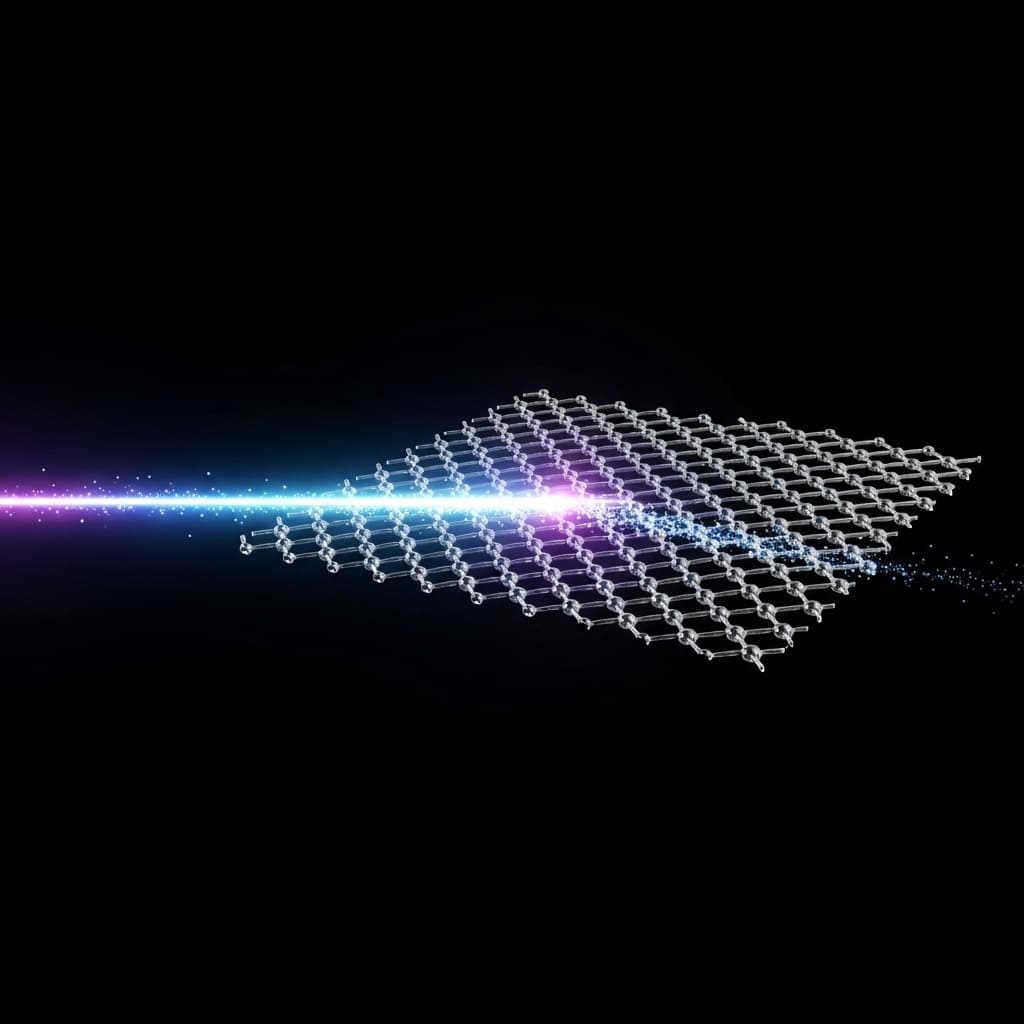
Scientists are now able to directly visualise how electrons move within materials using light, offering unprecedented insight into fundamental quantum processes. Vincent Eggers, Giacomo Inzani and Manuel Meierhofer, working at the Department of Physics and Regensburg Center for Ultrafast Nanoscopy (RUN), University of Regensburg, in collaboration with colleagues at Philipps-Universität Marburg and the Peter Grünberg Institut (PGI-3), Forschungszentrum Jülich, have developed a technique called subcycle band-structure videography. This new method captures electron motion with attosecond precision across the entire first Brillouin zone, allowing them to observe the elusive Landau-Zener-Majorana (LZM) tunnelling effect in graphene. By visualising the coherent displacement and distortion of momentum distributions, this research provides a panoramic view of strong-field-driven electron dynamics, establishing a crucial foundation for understanding and controlling light-driven phenomena in quantum materials.
The research focuses on graphene and visualises a fundamental process known as non-adiabatic Landau-Zener-Majoraja (LZM) tunnelling, a quantum mechanical effect governing how electrons transition between energy bands.
By directly observing this tunnelling, researchers gain insight into the underlying mechanisms driving lightwave-controlled electron dynamics. This advancement overcomes limitations in existing techniques, which previously could only image electrons at small momenta or averaged over multiple light cycles, expanding the accessible momentum area with subcycle resolution by more than two orders of magnitude and increasing available field strengths by one order of magnitude.
Exploiting few-cycle mid-infrared field transients, the study demonstrates coherent electron dynamics throughout the entire band structure of graphene, revealing a simultaneous displacement and distortion of the light-driven electron distribution. This panoramic view of electron behaviour lays the foundation for a microscopic understanding of light-driven phenomena in quantum materials, combining attosecond spectroscopy with time- and angle-resolved photoemission spectroscopy.
By employing ultrashort XUV pulses to photoemit electrons from graphene, researchers map the occupied band structure with sub-10-femtosecond temporal resolution, allowing for the observation of how strong light fields accelerate charge carriers within bands, leading to LZM transitions at avoided crossings in the energy landscape. The resulting data reveals a complex interplay between coherent intra- and interband dynamics, offering a detailed picture of how electrons respond to intense light and enabling the preparation and tracking of extremely non-thermal electron distributions in two-dimensional momentum space.
This capability disentangles competing scattering processes and their impact on coherent electronic control. The research demonstrates how field-driven acceleration and periodic LZM tunnelling manifest in a coherent displacement and distortion of the momentum distribution at the edge of the Brillouin zone, opening revolutionary prospects for next-generation quantum control, quantum sensing, and quantum computation applications.
Intense, phase-stable mid-infrared (MIR) pulses with a central frequency of 30THz initiate the experiments, driving electrons within a monolayer of graphene epitaxially grown on a silicon carbide substrate. Following a variable delay time, designated as ‘t’, ultrashort extreme ultraviolet (XUV) pulses, possessing a central photon energy of 21.7 eV, photoemit electrons with subcycle temporal resolution.
The energies and momenta of these photoemitted electrons are meticulously detected using a time-of-flight photoemission momentum microscope, which maps the occupied four-band structure of graphene in equilibrium conditions. Its high XUV photon energy coupled with a large acceptance angle allows for imaging of the entire first Brillouin zone (BZ) in a single measurement, achieving sub-10-femtosecond temporal resolution and capturing the six K points located at the edge of the first BZ, where the Dirac cones reside.
Momentum distribution maps, filtered for curvature, reveal details near these K points at discrete energies, with the in-plane component of the p-polarized XUV radiation aligned parallel to the kx axis, producing a characteristic horseshoe-like intensity distribution for energies far below the Dirac point due to matrix element effects. To isolate dynamics along a direction where both branches of the Dirac cone exhibit equal photoemission intensity, an s-polarized MIR field is applied along the ky axis.
For delay times of −70 fs, a slice of the curvature-filtered photoelectron intensity at kx −K = 0 displays two linear bands with a slope corresponding to ħvF, where vF is the Fermi velocity of 10.7 Å/fs, and a Fermi level positioned 200 meV above the Dirac point. Momentum streaking of the photoemitted electrons in the incident MIR field in vacuum is observed with increasing delay, but this effect is leveraged to directly retrieve the MIR waveform at the sample surface, allowing for isolation of the subcycle field-driven electron dynamics occurring within the graphene’s electronic band structure.
Simulations predict a broadening of the carrier distribution up to 0.053 Å −1 and a displacement of approximately 0.107 Å −1 along the direction of the driving field when scattering is neglected, maintaining a momentum hallmark of LZM transitions at the end of the measurement period of 233 femtoseconds. Introducing electron-electron scattering partially thermalizes the initially broadened momentum distribution, reducing its radius to approximately 0.038 Å −1, although a significant ellipticity persists on shorter timescales.
Surprisingly, the phase delay remains only marginally affected by the inclusion of electron-electron scattering, potentially due to the pseudospin texture of graphene and the unidirectional nature of LZM tunnelling. Further inclusion of electron-optical phonon scattering fully reproduces the experimentally observed dynamics, demonstrating a significant broadening of the electron distribution, 0.045 Å −1 parallel and 0.037 Å −1 perpendicular to the pump field, at early interaction stages of 27 femtoseconds.
This isotropic redistribution of charge carriers results in an almost circular distribution with a centre-of-mass shift of only 0.008 Å −1, a substantial reduction from the 0.081 Å −1 observed when scattering was not considered, correlating with a phase delay approaching π/4 and indicating a shift in the dominant mechanism governing electron motion. After the pulse, at 233 femtoseconds, the distribution relaxes to a fully circular shape with a radius of approximately 0.031 Å −1, with both the phase delay and time-dependent broadening of the electron distribution along the kx and ky directions aligning with experimental observations.
These findings identify electron-optical phonon scattering as the fastest momentum redistribution channel and the key limiting factor for coherent control in graphene. Scientists have, for the first time, created a complete moving picture of electrons responding to light within a material, revealing the intricate dance at the heart of light-matter interaction.
This isn’t merely about observing faster processes; it’s about seeing the quantum mechanisms that govern how light controls electrons, something previously hidden within averaged measurements. For years, understanding strong-field physics demanded a way to visualise electron behaviour not just in terms of energy, but also in terms of momentum, a full picture across the material’s fundamental building blocks.
This detailed view exposes the subtle interplay between acceleration by the light field and a quantum tunnelling process known as Landau-Zener-Majorana, revealing how electrons navigate the material’s unique band structure. The ability to disentangle competing scattering processes is particularly valuable, offering insights into maintaining coherent control over these light-driven electrons. While graphene serves as an ideal testbed, extending this technique to other, more complex quantum materials will undoubtedly prove difficult, and simulations remain crucial for interpreting the complex data, disentangling all contributing factors, such as matrix elements, will be an ongoing challenge.
👉 More information
🗞 Subcycle videography of lightwave-driven Landau-Zener-Majorana transitions in graphene
🧠 ArXiv: https://arxiv.org/abs/2602.12844