Light-sheet fluorescence microscopy is rapidly becoming an essential technique for detailed investigation of cancer, offering unprecedented views of tissue structure and organisation. Uma Pisarović, Taichi Ochi, and Iryna Samarska, from Maastricht University and the University of Groningen, lead a comprehensive review of how this powerful imaging method is currently applied to oncology. Their work highlights the ability of light-sheet microscopy to visualise intact cancer specimens, including those derived from patients, and to reveal complex three-dimensional tumour architecture. This advance promises to improve diagnostic accuracy and unlock new understanding of cancer development, potentially paving the way for its integration into routine clinical practice alongside colleagues Ludovico Silvestri, Thiemo J. A. van Nijnatten, and Loes F. S. Kooreman.
D Light-Sheet Microscopy for Cancer Diagnosis
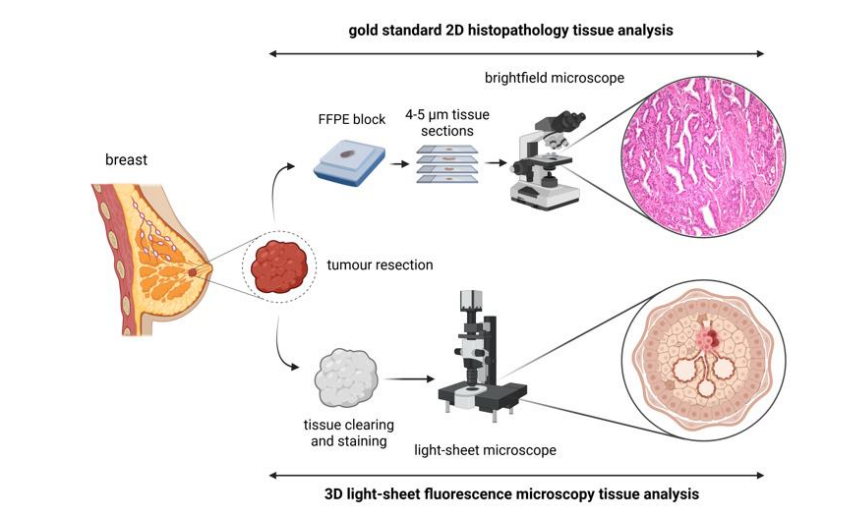
This research explores the potential of light-sheet fluorescence microscopy (LSFM) as a powerful tool for cancer diagnostics, moving beyond traditional two-dimensional histopathology. LSFM offers significant advantages for visualizing large-scale tissue samples in three dimensions, potentially improving cancer diagnosis, understanding tumor complexity, and guiding treatment decisions. The technique allows for the non-destructive imaging of entire tissue samples, preserving crucial spatial context, and enables rapid imaging of large volumes, facilitating efficient analysis. Researchers demonstrate LSFM’s effectiveness in analyzing prostate and breast cancer samples, revealing complex growth patterns and offering a more complete picture of tumor extent and characteristics.
LSFM can also be used for three-dimensional pathology of whole lymph nodes for breast cancer staging. To fully realize this potential, rigorous validation against current diagnostic methods is crucial, alongside standardized clearing and staining protocols and user-friendly software tools for data manipulation. Artificial intelligence (AI) can further enhance diagnostic accuracy and consistency, and collaboration between researchers and clinicians is vital for successful implementation in clinical workflows. Reducing the cost of LSFM systems is important for wider adoption, presenting a compelling case for LSFM as a promising technology with the potential to revolutionize cancer diagnostics.
Light-Sheet Imaging of Cancer Tissues and Models
Light-sheet fluorescence microscopy (LSFM) is increasingly employed to visualize cancer tissue, including patient-derived specimens and models. This work demonstrates the potential of LSFM to image both large-scale, freshly resected surgical specimens and fixed, optically cleared tissues, positioning it as a promising candidate for future diagnostic applications. Researchers utilize various LSFM systems tailored to different tissue types, applying them to both breast and prostate cancer samples. The study pioneers the use of open-top light-sheet microscopy for imaging fresh, uncleared breast and prostate cancer tissues, and employs both open-top and dual view illumination microscopy for fixed and cleared tissues, expanding the range of applicable sample types.
Core needle biopsies are also imaged using open-top light-sheet microscopy after fixation and optical clearing. To validate LSFM’s diagnostic potential, researchers compare three-dimensional LSFM images with current diagnostic methods using thin tissue sections. This comparative analysis assesses the reliability of single optical slices in accurately reflecting diagnostic information. The study emphasizes the importance of analytically validating clearing and staining protocols to ensure consistent and accurate results, and acknowledges the need for health technology assessments to determine LSFM’s place within the clinical diagnostic pipeline. The development of user-friendly software tools for manipulating large-scale three-dimensional imaging datasets is also prioritized, alongside the integration of artificial intelligence for enhanced diagnostic accuracy.
Rapid 3D Imaging Reveals Cancer Architecture
Light-sheet fluorescence microscopy (LSFM) is rapidly becoming a powerful tool for detailed analysis of cancer tissues, including patient biopsies and models of disease. This work demonstrates the potential of LSFM to enhance diagnostic precision and provide novel insights into tumour architecture, particularly in prostate and breast cancers. Researchers have achieved rapid, three-dimensional imaging of intact cancer specimens, offering a significant advance over traditional methods. In prostate cancer research, LSFM enables full three-dimensional visualization of entire core biopsies, allowing for a comprehensive assessment of cancerous tissue architecture.
LSFM imaging of a cleared prostate cancer sample can be achieved in several hours, at a rate of approximately 1. 7 cm³/h, with an isotropic resolution of 16. 4μm. The technique allows for accurate quantification of tumour volume and may improve detection of small foci of adenocarcinoma often missed in two-dimensional sections. Recent advances show that artificial intelligence-powered analysis of LSFM data can match, or even surpass, traditional Gleason scoring.
In breast cancer research, LSFM has enabled rapid three-dimensional imaging of fresh, non-cleared surgical specimens, facilitating detailed assessments of tumour architecture, surgical margins, and vascular structures. Researchers have also successfully used multiresolution LSFM to non-destructively analyse cleared lymph nodes, revealing that standard two-dimensional histology underestimates the size of lymph node metastases. These findings demonstrate the potential of LSFM to revolutionize cancer diagnostics and improve patient outcomes.
Light-sheet microscopy visualises cancer tissue morphology
Light-sheet fluorescence microscopy has emerged as a powerful imaging technology with increasing applications in cancer research, demonstrating its ability to visualise both large, freshly resected tissue specimens and fixed, optically cleared samples. This work highlights the potential of this technique to enhance understanding of tumour morphology and ultimately improve clinical decision-making, offering a means to examine complex tissue structures in three dimensions. The researchers demonstrate the utility of light-sheet microscopy in analysing samples from various cancers, including prostate and breast, suggesting its suitability for future diagnostic use. Stronger collaboration between the microscopy community and clinical experts in pathology and radiology is needed to seamlessly integrate light-sheet data into existing clinical workflows and to refine image analysis techniques. The rapidly evolving field of artificial intelligence, particularly large language models and deep learning, offers promising avenues for automated image analysis and enhanced diagnostic accuracy, potentially bringing fully automated three-dimensional histopathology within reach.
🗞 Light-sheet microscopy to assess cancer pathology: current views and future trends
🧠 ArXiv: https://arxiv.org/abs/2510.21260