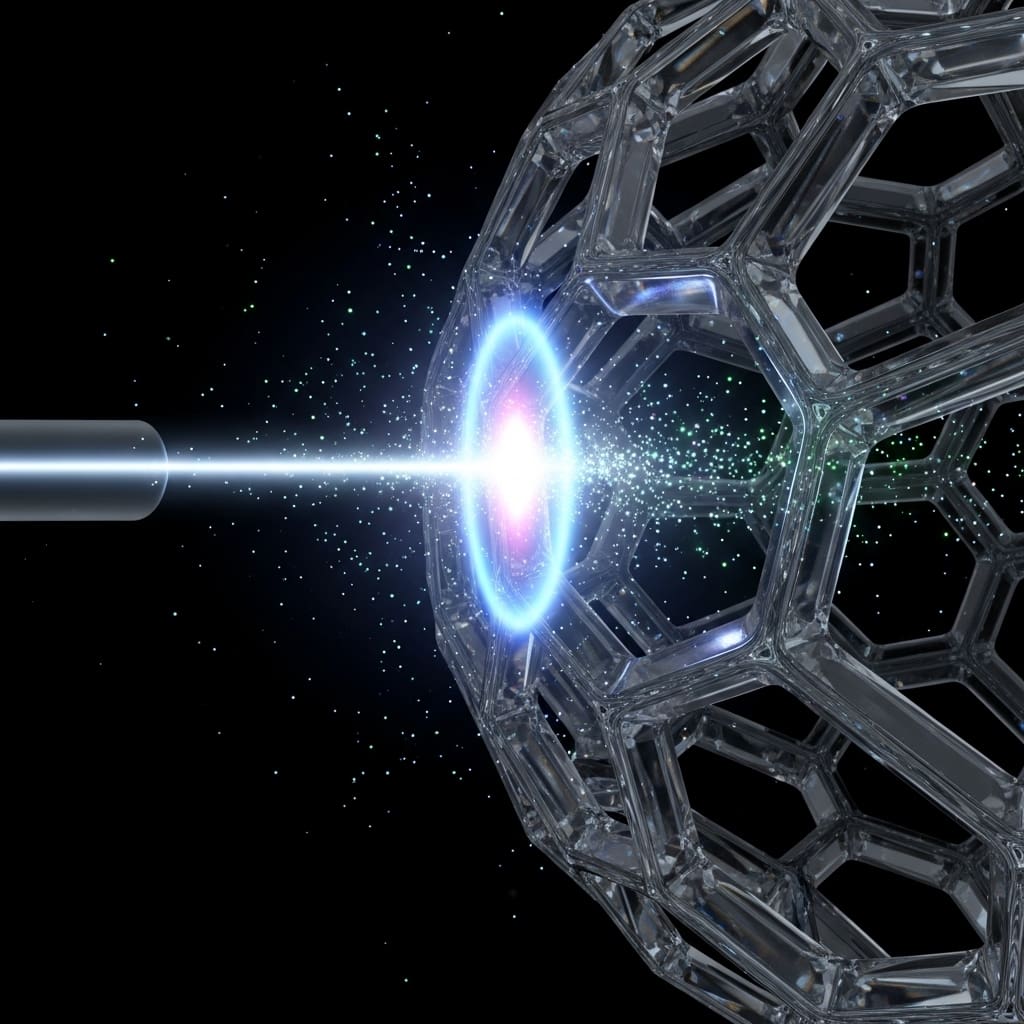
Researchers are increasingly focused on understanding interacting bosonic quasiparticles to unlock new physics and nonlinear phenomena in correlated light-matter systems. Haifeng Kang, Quanbing Guo, and Tianyi Zhou, working with colleagues from the Key Laboratory of Artificial Micro/Nano Structure of Ministry of Education at Wuhan University, the Wuhan Institute of Quantum Technology, the École Polytechnique Fédérale de Lausanne, the National Institute for Materials Science in Ibaraki, Japan, and the Wuhan National High Magnetic Field Center at Huazhong University of Science & Technology, demonstrate strong coupling of dipolar excitons within a gated bilayer MoS2 device integrated with a one-dimensional photonic crystal. This work reports the hybridization of cavity photons with a coherent superposition of two electrically tunable, anti-aligned dipolar excitons, effectively binding them into composite quasiparticle states. By achieving in situ reconfiguration of the polariton wavefunction and observing non-monotonic Stark shifts, the team provides a scalable pathway toward electrically programmable fluids of light and correlated polariton phases suitable for on-chip photonic integrated circuits, representing a significant advance in the control of nonlinear interactions at the nanoscale.
This work overcomes a longstanding limitation in the field, the difficulty of simultaneously achieving both strong exciton interactions and strong light-matter coupling.
Researchers integrated a bilayer molybdenum disulfide (MoS2) device, possessing interlayer excitons with inherent electric dipole moments, with a one-dimensional photonic crystal designed to host bound-states-in-continuum (BIC), resonances that trap light even within a periodic structure. The resulting polaritons, hybrid light-matter quasiparticles, combine the properties of photons and excitons, effectively binding them into composite states.
By leveraging the quantum-confined Stark effect (QCSE), an applied electric field tunes the energy levels of the excitons, allowing for reconfiguration of the polariton wavefunction. This precise control enables the creation of an emergent polariton branch exhibiting non-monotonic Stark shifts, a phenomenon where the energy of the polariton changes in a non-linear fashion with the applied electric field.
Notably, this tunability facilitates customized control over nonlinear interactions through distinct excitonic hybridization and dipolar configurations. The ability to manipulate these interactions opens new avenues for exploring exotic many-body physics and correlated polariton phases. This research details the fabrication of a gated bilayer MoS2 device integrated with a specifically designed photonic crystal.
The gating device, consisting of MoS2 encapsulated within hexagonal boron nitride and contacted by graphene electrodes, allows for the application of a perpendicular electric field. This field lifts the degeneracy of the interlayer excitons, splitting their energy levels and enabling precise control over their dipole moments. The resulting hybrid exciton-polariton system exhibits strong coupling, evidenced by the formation of distinct polariton branches in the optical spectrum.
The in situ tunability of these dipolar polaritons represents a scalable pathway toward on-chip photonic integrated circuits capable of processing quantum information. By dynamically controlling the exciton hybridization and dipolar configurations, researchers envision creating electrically programmable fluids of light with tailored nonlinear properties, potentially revolutionizing areas such as quantum simulation and optical computing. This work establishes a crucial step toward realising advanced photonic technologies based on correlated polariton phases and programmable quantum materials.
Hybrid photonic crystal characterisation and observation of exciton behaviour
Characterisation of the hybrid 2L-MoS2 system revealed a Si3N4 grating structure with a period of 365nm, a height of 106nm, and a filling factor of 0.65, designed to host bound-states-in-continuum with an extremely high quality (Q) factor at the Γ point. Lateral dimensions of the exfoliated 2L-MoS2 flake measured approximately 40μm, while the hBN and graphene extended to 80μm, ensuring optimal conditions for both optical characterisation and electrical control.
Reflectance contrast spectra of the bare 2L-MoS2 identified a main exciton resonance at 1.907 eV, designated the A exciton, and a hybrid interlayer exciton at 1.974 eV. Application of an electric field induced the quantum-confined Stark effect, lifting the degeneracy of the interlayer exciton into two split resonances, IX1 and IX2, at an applied field of 0.03V/nm.
Experimental photonic dispersions of the 1DPC under transverse-electric polarization closely matched simulations, demonstrating a broad spectral range and tight confinement of photonic modes, with a bound-state-in-continuum mode at 2.24 eV. Angle-resolved reflectance spectroscopy then characterised the strong coupling regime, revealing pronounced anti-crossing features near the interlayer exciton and A exciton resonances, indicative of multiple polariton branch formation.
Without an applied electric field, the spectra showed strong coupling between excitons and a shared photonic mode. Upon applying a 0.035V/nm electric field, the single interlayer exciton feature evolved into two anti-crossing features, resulting in three polariton branches, including a newly emergent middle branch. Further increasing the electric field to 0.05V/nm caused further separation of the three polariton branches, designated lower, middle, and upper branches, consistent with stronger coupling to increasingly split exciton resonance energies.
This persistence of strong coupling even with larger exciton separation confirms the effective binding of non-degenerate dipolar excitons into composite quasiparticle states. Analysis using a two-coupled-oscillator model supports these observations and provides a framework for understanding the polariton Hamiltonian.
Fabrication and alignment of a MoS2 heterostructure with a silicon nitride photonic crystal
A gated bilayer MoS2 device integrated with a one-dimensional photonic crystal forms the basis of this work, enabling strong coupling between dipolar excitons and photonic modes. The fabrication process began with mechanically exfoliated two-layer MoS2, subsequently encapsulated within few-layer hexagonal boron nitride to protect it and facilitate electrical control.
Graphene electrodes were then contacted to this heterostructure, creating a planar capacitor configuration allowing application of a perpendicular electrostatic field to induce the quantum-confined Stark effect (QCSE) in the dipolar excitons. This gated device was meticulously aligned atop a silicon nitride grating-based 1DPC, possessing a period of 365nm, a height of 106nm, and a filling factor of 0.65.
The 1DPC was designed to host bound-states-in-continuum (BIC), resonant modes exhibiting extremely high quality factors at the Γ point, crucial for enhancing light-matter interaction. Crucially, the photonic modes of the 1DPC exhibit a highly confined electromagnetic field near the interface with the gated device, maximising the coupling efficiency with the MoS2 layer.
A portion of the MoS2 flake was intentionally left uncoupled from the 1DPC, serving as an intrinsic reference for monitoring exciton resonances during electrical tuning. Reflectance contrast spectroscopy was employed to characterise both the bare 2L-MoS2 exciton resonances and the photonic resonances of the 1DPC, providing a baseline for assessing strong coupling.
Experimental photonic dispersions were obtained under transverse-electric (TE) polarization and were found to be in close agreement with corresponding simulations, validating the device design. This careful characterisation of individual components paved the way for investigating the strong coupling regime and electrical tunability within the hybrid structure using angle-resolved reflectance spectroscopy. The choice of reflectance spectroscopy allows for direct observation of polariton dispersion and anti-crossing features, indicative of strong coupling between excitons and photons, while the gated structure provides a means to dynamically control the exciton energies and, consequently, the polariton properties.
The Bigger Picture
Scientists have long sought to manipulate light at the nanoscale with the same ease as electrical signals are controlled in conventional circuits. This latest work represents a significant step towards that goal, demonstrating a level of electrical control over light-matter interactions that was previously difficult to achieve. The challenge lies in creating materials where light and matter couple strongly, forming hybrid quasiparticles called polaritons, and then finding a way to dynamically tune those interactions without disrupting the delicate balance required for strong coupling.
The ability to reconfigure polariton wavefunctions in situ , within the device itself, is particularly noteworthy. Previous approaches often relied on external stimuli or static material properties, limiting scalability and real-time control. This research utilizes a cleverly designed van der Waals heterostructure and the quantum-confined Stark effect to not only achieve strong coupling but also to tailor the resulting polariton properties.
The emergence of a non-monotonic Stark shift is a clear indication of this enhanced control, opening doors to customized nonlinear optical responses. However, translating this success into practical devices will require addressing several hurdles. Maintaining strong coupling at higher temperatures and scaling up the fabrication of these complex heterostructures remain significant challenges.
Furthermore, while the potential for “fluids of light” and programmable photonic circuits is exciting, demonstrating complex information processing or computation using these tunable polaritons is the next crucial step. Future research will likely focus on integrating these structures with existing photonic platforms and exploring novel materials combinations to further enhance performance and functionality.
🗞 Polariton-mediated binding of anti-aligned dipolar excitons
🧠 ArXiv: https://arxiv.org/abs/2602.13054